

The Best Training Paths for Newly Appointed HIPAA Officers
What Is HIPAA Compliance Officer Training — and Where Do You Start?
If you've just been appointed to a compliance role, HIPAA compliance officer training is the single most important step you can take before touching a policy document or running a risk assessment.
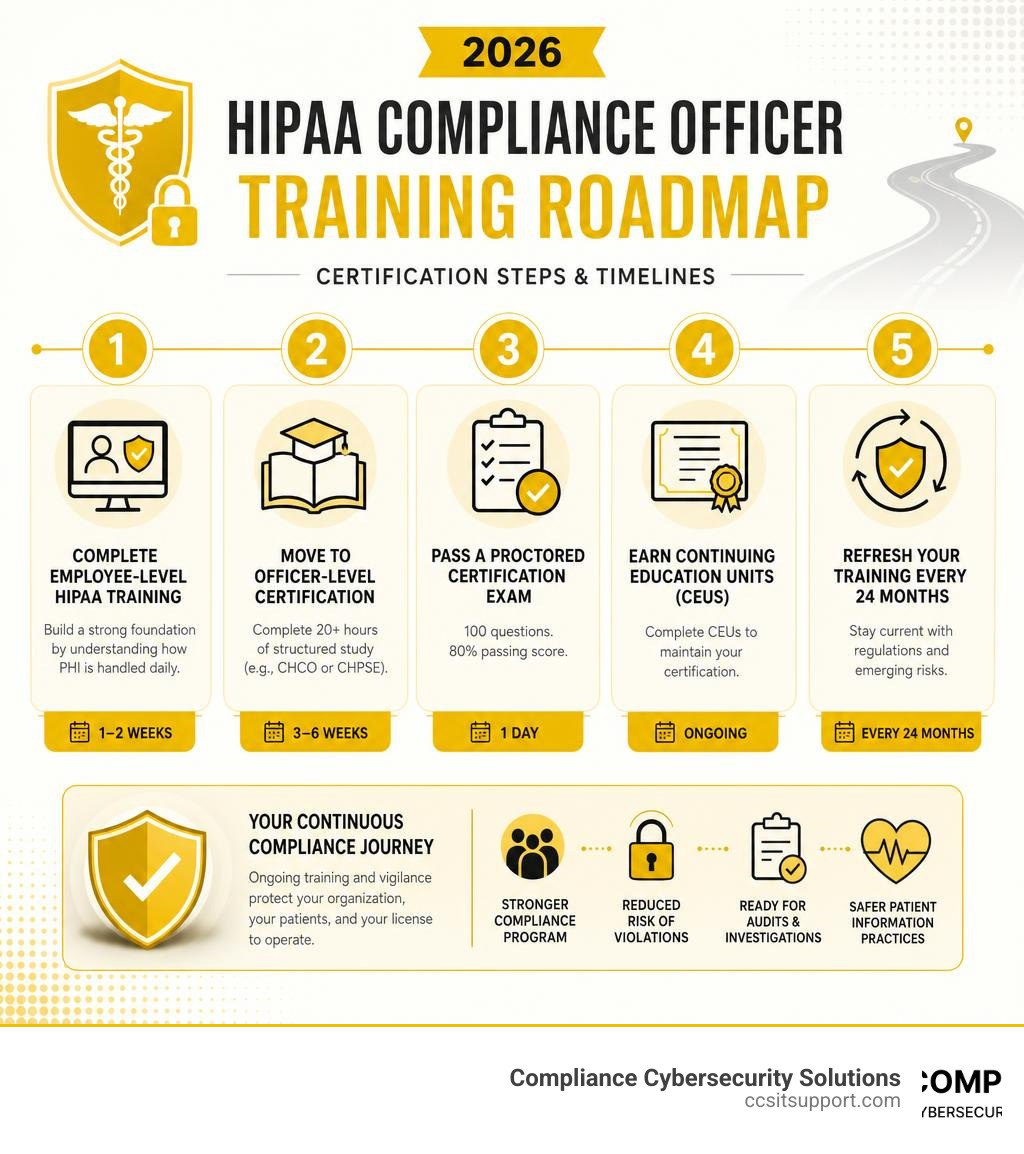
Here's a quick-start answer for newly appointed officers:
Complete employee-level HIPAA training first — understand how your staff actually handles PHI day-to-day
Move to officer-level certification — programs like the CHCO or CHPSE require 20+ hours of structured study
Pass a proctored certification exam — typically 100 questions, 80% passing score (92% of candidates pass on the first attempt when they test within 3 weeks of finishing the course)
Earn continuing education units (CEUs) — most certifications require ongoing credits to stay current
Refresh your training every 24 months — or sooner when regulations or technology change
The stakes are real. The OCR collected over $15 million in HIPAA violation settlements in 2023, with a single case reaching $4.3 million. Civil penalties alone range from $100 to $50,000 per violation. For a newly appointed officer, that's not an abstract risk — it's your organization's exposure if the compliance program falls short.
Most officers are surprised to learn that HIPAA doesn't prescribe one standardized training program. As HHS notes, the rules are "flexible and scalable to accommodate the enormous range in types and sizes of entities." That flexibility is helpful — but it also means the burden is on you to build the right training path from scratch.
I'm Michael Gaigelas II, and I've guided organizations through HIPAA, CMMC 2.0, and ISO 27001 compliance — helping teams build efficient, audit-ready HIPAA compliance officer training programs without unnecessary cost or delay. In this guide, I'll walk you through exactly which training path to take, which certifications matter, and how to build a compliance program that actually holds up under scrutiny.
Why HIPAA Compliance Officer Training is Mandatory for Healthcare Organizations
If you are hoping to get by on basic "common sense" or a quick one-hour video course, we have some tough news. Under the administrative simplification provisions of the Health Insurance Portability and Accountability Act, assigning a dedicated officer and ensuring they are thoroughly trained is a firm legal mandate.
When federal regulators at the Office for Civil Rights (OCR) audit a healthcare organization or investigate a data breach, one of the first things they ask to see is the training log for your designated officers.
To understand why this role is so heavily scrutinized, we have to look at the core federal rules that govern health data:
The Privacy Rule: Governs how Protected Health Information (PHI) can be used and disclosed, establishing patient rights (like the Right of Access) and the "Minimum Necessary" standard.
The Security Rule: Sets the standards for protecting Electronic Protected Health Information (ePHI) across administrative, physical, and technical safeguards.
The Breach Notification Rule: Requires organizations to notify patients, the HHS, and sometimes the media when unsecured PHI is compromised.
The Enforcement Rule: Establishes the framework for investigations, compliance reviews, and financial penalties.
If you don't know the ins and outs of these rules, you won't know how to build the policies that keep your organization safe. The cost of failing to train your compliance officer is incredibly high. Civil penalties for HIPAA violations range from $100 to $50,000 per violation, and criminal penalties for willful neglect can include fines up to $250,000 and even imprisonment.
By leveraging official government training materials, such as those found on the HIPAA Training and Resources - HHS.gov portal, newly appointed officers can build a legally defensible foundation. However, government resources only outline what the rules are; they do not teach you how to manage a compliance program day-to-day. That is where professional HIPAA Compliance Officer training paths become indispensable.
Key Differences Between Privacy and Security Officer Roles
A common point of confusion for smaller medical practices and business associates in Florida is whether they need a "Privacy Officer," a "Security Officer," or both.
While smaller organizations often assign both roles to a single individual (such as an office manager or IT director), the responsibilities themselves are legally distinct.
The HIPAA Privacy Officer focuses on the administrative and contractual aspects of compliance. They ensure that patients receive their Notice of Privacy Practices, manage patient authorization forms, handle Right of Access requests, oversee Business Associate Agreements (BAAs), and ensure that staff adhere to the Minimum Necessary Standard.
The HIPAA Security Officer is responsible for the technical, physical, and administrative safeguards that protect ePHI. They handle the technical infrastructure, implement encryption, configure access controls, manage firewalls, run vulnerability tests, and design the disaster recovery and business continuity plans.
To keep these distinct roles organized, we can look at how their primary safeguards differ:
Focus Area HIPAA Privacy Officer HIPAA Security Officer Primary Domain Written agreements, patient rights, administrative policies, and physical paper records. Digital infrastructure, secure networks, databases, and ePHI storage. Key Safeguards Administrative (Notice of Privacy Practices, training governance, policy development). Technical & Physical (Encryption, firewalls, server room access, multi-factor authentication). Core Duty Ensuring PHI is only shared with authorized parties and that patients can access their records. Ensuring ePHI is secure from unauthorized digital access, cyberattacks, and system failures. Key Tools BAAs, Release of Information (ROI) forms, employee disclosure logs. Risk assessments, penetration testing, endpoint security tools, audit logs.
For a compliance program to succeed, these two roles must work hand-in-hand. The Privacy Officer sets the rules of who should have access, and the Security Officer builds the technical walls to enforce those rules.
If your organization is struggling to bridge the gap between policy and technical execution, utilizing specialized HIPAA Compliance IT Security strategies and HIPAA Security Consulting services is the fastest way to align your operations with federal standards.
Step-by-Step Training Paths to Obtain Professional Certification
Becoming a certified compliance professional requires a structured approach. You cannot simply read a 700-page manual over a weekend and expect to run a compliant program. The best training paths combine formal education, role-specific certification courses, and practical, hands-on application.

Most professional officer certifications require at least 20+ hours of dedicated study. The two most respected credentials in the industry are:
Certified HIPAA Privacy Security Expert (CHPSE): A comprehensive credential that covers both the Privacy and Security rules in deep technical detail.
Certified HIPAA Compliance Officer (CHCO): A leadership-focused credential designed for professionals who manage the entire corporate compliance program.
If you are building your roadmap to certification, we recommend partnering with experienced advisors who understand the landscape. Engaging with professional HIPAA Consulting Services can help you determine which credential fits your specific business model and state-level compliance requirements.
Foundational HIPAA Compliance Officer Training for New Appointees
The biggest mistake a newly appointed officer can make is skipping straight to advanced executive training. If you don't understand what your front-desk receptionists, nurses, and billing staff experience in their daily routines, you cannot build policies that actually work.
Your foundational step should be taking the exact same employee-level training that your workforce takes. This gives you a clear view of how core concepts like the Minimum Necessary Standard, patient authorization, and ePHI handling apply to daily workflows.
For Florida-based organizations, aligning with local training structures is highly beneficial. For example, you can review the Florida HIPAA Training Class or leverage state-specific resources like the Catalog - TRAIN Florida - TRAIN Florida platform to ensure your foundational knowledge matches state and federal expectations. Additionally, keeping an eye on structured compliance schedules, such as the 2026 HIPAA complete training calendar - The Baldwin Group , will help you keep your organization's training cycles organized.
Once you have mastered the employee baseline, you can begin layering on advanced administrative and technical oversight concepts with the help of specialized IT Compliance Consulting partners.
Professional Certifications and Advanced HIPAA Compliance Officer Training
Once your foundation is secure, it is time to pursue professional certification. These advanced courses go beyond basic rules to teach you the mechanics of policy design, breach incident response, and federal audit preparation.
To select the best path for your career and organization, consider these industry-standard programs:
Certified HIPAA Compliance Officer (CHCO): This program, detailed in the HIPAA Privacy & Security information packet, is a gold standard for compliance directors. It awards 18 Continuing Education Units (CEUs) and culminates in a 100-question, 3-hour proctored exam. Candidates enjoy an impressive 92% pass rate on their first attempt when taking the exam within three weeks of course completion.
Certified HIPAA Privacy Officer (HPOC): If your role focuses strictly on privacy, patient rights, and release of information, the HIPAA Privacy Officer Training program is highly recommended. It offers 12 CEUs approved by both AIHC and AHIMA, focusing on complex topics like 42 CFR Part 2 (substance abuse records) and the 21st Century Cures Act.
Executive Certification Programs: For compliance leaders looking for an intensive, high-level approach, the HIPAA Compliance Training for Healthcare Professionals program from the US Compliance Institute is an excellent 8-to-10-week self-paced curriculum that connects HIPAA rules with broader frameworks like NIST and FISMA.
Role-Specific Officer Training: If you need a practical, tool-focused program that gets straight to the point of policy creation, the HIPAA for Compliance Officers - VanRein Compliance course provides excellent real-world scenarios and actionable templates.
Earning these credentials is proof to regulators, partners, and patients that you possess the technical expertise to protect sensitive data. To make sure your newly designed compliance controls are truly audit-ready, we recommend pairing your training with professional HIPAA Compliance Audit Services to identify any remaining security gaps before the federal government does.
Core Topics Covered in Officer-Level Training
Officer-level training is vastly different from general staff training. While employees learn not to leave paper charts on a counter, an officer must learn how to design, implement, and audit the entire technical and administrative ecosystem.

A comprehensive officer training curriculum must cover several advanced technical and administrative areas:
Risk Assessment and Analysis: You will learn how to perform a comprehensive Security Risk Analysis (SRA). This is not a simple checklist; it requires identifying every single asset that touches ePHI, assessing vulnerabilities, and calculating risk levels using qualitative and quantitative risk matrices.
Business Associate Agreements (BAAs) and Vendor Management: Under the HIPAA Omnibus Rule, business associates and subcontractors face direct civil and criminal liability. Training teaches you how to draft, execute, and audit BAAs, ensuring your cloud providers, IT vendors, and billing companies are holding up their end of the security bargain.
Emerging Technologies (AI and Telehealth): The healthcare landscape is evolving rapidly. Newly appointed officers must understand how to implement the NIST AI Risk Management Framework to govern artificial intelligence tools in clinical environments, and secure telehealth platforms to prevent unauthorized digital exposure.
Securing these areas requires a deep understanding of modern IT infrastructure. Implementing HIPAA Cybersecurity Best Practices and utilizing secure, encrypted HIPAA Cloud Security architectures are critical steps in protecting your digital health data from modern cyber threats.
Frequently Asked Questions about HIPAA Compliance
How often should HIPAA Compliance Officers receive refresher training?
While HIPAA does not establish a rigid, calendar-based deadline for officer retraining, industry best practices and administrative rules dictate that Privacy and Security Officers should receive refresher training every 24 months.
For supervisors and general managers, a 36-month cycle is generally acceptable. However, any major change in federal regulations, organizational structure, or your technical environment (such as migrating to a new cloud-based EHR system) should trigger immediate training updates. Keeping your Healthcare Cybersecurity Policy documentation updated alongside these training cycles ensures your team is never caught off guard.
What are the most common HIPAA violations and how can training prevent them?
The most common violations investigated by the OCR include:
Unsecured PHI: Leaving paper records in public areas or failing to encrypt digital databases.
Improper Disposal: Throwing paper charts into standard trash bins instead of shredding them, or discarding old hard drives without sanitizing them.
Unauthorized Disclosures: Staff sharing patient details on social media or discussing cases in public hallways.
Mobile Device Breaches: Losing unencrypted laptops, tablets, or smartphones containing ePHI.
Proper officer training prevents these issues by teaching you how to implement technical safeguards like automatic screen locking, mandatory device encryption, remote-wipe capabilities, and strict physical security logs. Aligning your hardware and network configurations with HIPAA Compliant Computer Security guidelines is the most effective way to eliminate these common physical and digital vulnerabilities.
How do emerging technologies like AI affect HIPAA compliance?
Artificial intelligence tools are rapidly entering the healthcare space to assist with clinical documentation, diagnostics, and administrative workflows. However, if an employee inputs patient data into a public, non-compliant AI tool, it constitutes an unauthorized disclosure and a major HIPAA breach.
Compliance officers must establish strict policies governing AI use, ensuring that any AI vendor signs a BAA and complies with the NIST AI Risk Management Framework. Telehealth platforms must also use end-to-end encryption and secure peer-to-peer connections. For a deeper look at protecting patient data in the digital age, explore our guide on Healthcare Cybersecurity HIPAA compliance.
Conclusion
Stepping into the role of a HIPAA Compliance Officer can feel overwhelming, but you do not have to navigate the complex world of federal regulations alone. By choosing a structured training path, pursuing respected certifications like the CHCO or CHPSE, and building a compliance-first culture, you can protect your patients' privacy and secure your organization against devastating financial penalties.
At Compliance Cybersecurity Solutions (CCS), we specialize in helping healthcare organizations, defense contractors, and financial institutions in Fort Lauderdale and throughout Florida align their IT systems with rigorous federal standards like HIPAA and CMMC. Our expert team designs layered security policies, implements advanced threat detection, and ensures your technical infrastructure is completely secure and audit-ready.
Ready to take the stress out of compliance? Get started with professional HIPAA compliance services today, and let us help you build a secure, compliant future.