
Locking Down Your ePHI with Expert HIPAA Security Consulting
Why HIPAA Security Consulting Is Essential for Protecting Patient Data in 2026
HIPAA security consulting helps healthcare organizations and their vendors identify risks to patient data, build the right safeguards, and stay compliant with federal law — before a breach or audit forces their hand.
Here's what it covers at a glance:
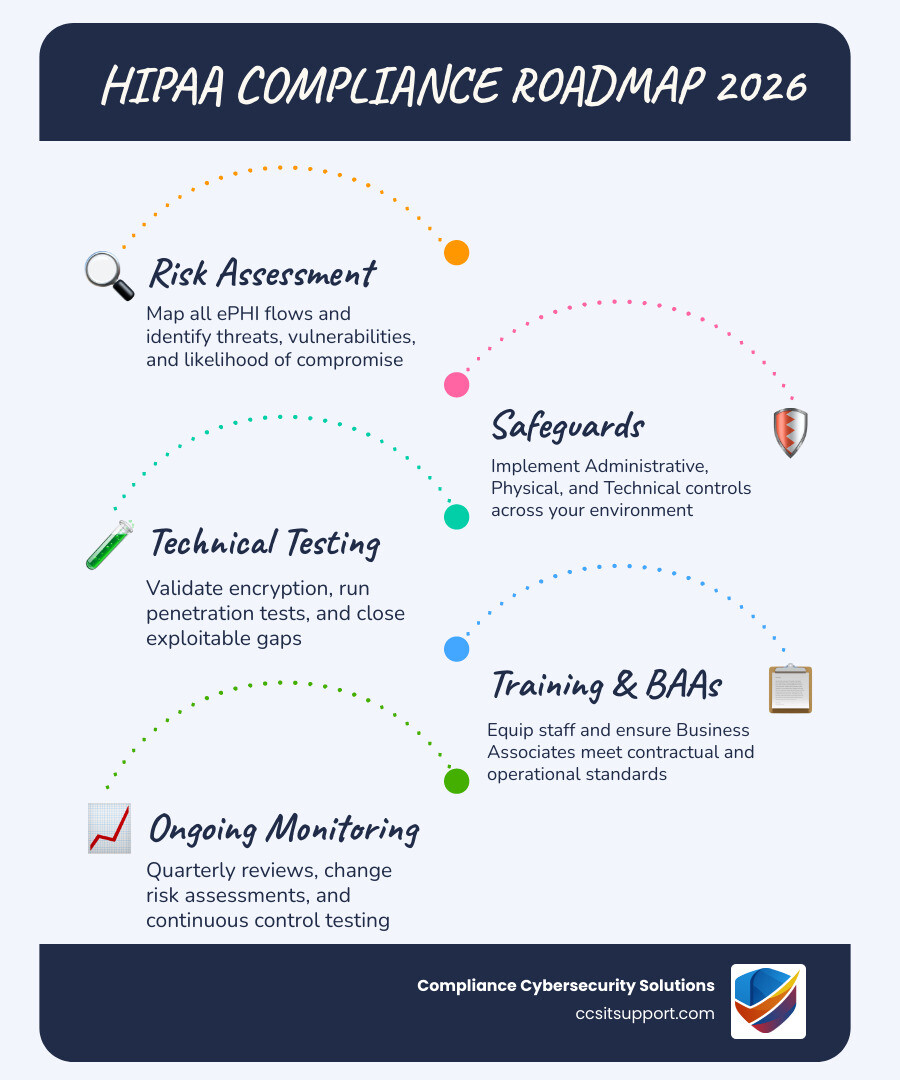
Risk Assessment — Find where electronic Protected Health Information (ePHI) is exposed and how likely it is to be compromised
Policies & Procedures — Build documented controls across Administrative, Physical, and Technical Safeguards
Technical Testing — Validate encryption, run penetration tests, and close gaps attackers would exploit
Workforce Training — Equip staff to recognize threats and handle ePHI correctly
Business Associate Oversight — Ensure vendors with PHI access are contractually and operationally compliant
Ongoing Monitoring — Keep controls current as your systems, staff, and threats evolve
HIPAA violations carry federal fines of up to $50,000 per violation and $1.5 million annually — and that's before reputational damage or civil liability. Yet many organizations still treat compliance as a one-time checkbox rather than a continuous program. That gap is exactly where breaches happen.
The good news? With the right guidance, compliance doesn't have to be overwhelming.
I'm Michael Gaigelas II, founder of Compliance Cybersecurity Solutions, and I specialize in rapid, cost-effective HIPAA security consulting alongside CMMC 2.0, ISO 27001, and SOC 2 — helping organizations achieve real security without unnecessary delays or costs. In the sections below, I'll walk you through exactly how to lock down your ePHI with a structured, defensible approach.
The Critical Role of HIPAA Security Consulting in Modern Healthcare
As we navigate the healthcare landscape of 2026, the complexity of data sharing has reached an all-time high. It isn't just about doctors and nurses anymore; it’s about the massive web of software developers, cloud providers, and billing services that keep the wheels turning. This is where hipaa security consulting becomes the bridge between "we think we're secure" and "we can prove we're secure."
Under the law, both Covered Entities (like hospitals and clinics) and Business Associates (the vendors who serve them) are on the hook. The Office for Civil Rights (OCR) doesn't take "I didn't know" as an excuse. Federal fines can skyrocket to $1.5 million per year for a single type of violation. Beyond the money, a breach can halt operations, leading to diverted ambulances and cancelled surgeries. Our HIPAA Consulting Services are designed to prevent these nightmare scenarios by building a resilient framework around your data.
Why Organizations Need Professional Guidance
Most healthcare providers are experts at patient care, not packet inspection. Trying to DIY HIPAA compliance often leads to "template fatigue"—where an organization downloads a generic policy but never actually implements the controls. Professional hipaa security consulting provides risk mitigation that holds up under the scrutiny of an investigator or a cybersecurity insurance adjuster. By following Healthcare Cybersecurity HIPAA best practices, we help you build a defensible position that protects your reputation and your patients' trust.
Evaluating Your Need for External Expertise
How do you know if you need help? If your internal IT team is already stretched thin just keeping the printers running, they likely don't have the 40+ hours required to conduct a proper annual Risk Analysis. Furthermore, if you are undergoing healthcare procurement reviews—where a large health system audits you before signing a contract—you need evidence of a formal program. In fact, 98% of organizations that use professional preparation pass these reviews on the first try. If you're unsure where you stand, IT Compliance Consulting can provide a gap analysis to highlight exactly what's missing.

Core Components of a Comprehensive HIPAA Security Consulting Engagement
A "check-the-box" audit is a recipe for disaster. A truly comprehensive engagement looks at the "Three Pillars" of the HIPAA Security Rule: Administrative, Physical, and Technical Safeguards. We don't just look at your firewall; we look at who has the keys to the server room and how you train your staff. This holistic approach ensures HIPAA Compliant Computer Security across your entire footprint.
Conducting a Defensible HIPAA Security Risk Assessment
The Security Risk Assessment (SRA) is the foundation of everything. If you don't have a current SRA, you aren't HIPAA compliant—period. We start by mapping every system that touches ePHI. Where does the data go? Who has access? We then evaluate threats (like ransomware or insider threats) and vulnerabilities (like unpatched software).
The deliverable is a Risk Register: a prioritized list of every gap found, ranked by its likelihood and impact. This isn't just a report to file away; it’s an operational roadmap. Our HIPAA Compliance Audit Services ensure that this assessment is "OCR-quality," meaning it follows the exact protocols federal auditors use.
Developing Essential Policies and Procedures
Policies are the "laws" of your office. They must be customized to how you actually work. We help develop policies for access control (who gets in), workforce security (how you offboard employees), and incident response (what to do when things go sideways). Versioning is key here—you must be able to prove to an auditor what policy was in place on a specific date two years ago. We integrate these into Healthcare Network Security Solutions so that your technical setup matches your written rules.
Technical Security Assessments and Vulnerability Scanning
You can have the best policies in the world, but if your "back door" is unlocked, they won't matter. Technical assessments involve vulnerability scanning to find software bugs and penetration testing to simulate a real-world attack. We also validate that encryption is active both "at rest" (on your hard drives) and "in transit" (when you email a colleague). Following HIPAA Cybersecurity Best Practices means verifying that your logging and alerting systems actually work, so you know the moment an unauthorized user tries to peek at a record.

Managing Business Associates and Implementing HIPAA Security Consulting Training
In the modern healthcare ecosystem, your security is only as strong as your weakest vendor. If your cloud storage provider or your shredding company isn't compliant, you are at risk. This is why hipaa security consulting focuses heavily on the "extended enterprise."
Designing Effective HIPAA Security Consulting Awareness Programs
Human error remains the #1 cause of healthcare data breaches. We don't believe in boring, once-a-year slideshows. Effective programs use microlearning—short, punchy lessons delivered throughout the year. We cover phishing resistance, the "minimum necessary" rule (only looking at what you need for your job), and secure device handling. We track attendance and use comprehension checks to ensure the message actually sticks. This culture of vigilance is a core part of Cybersecurity and protects your organization from the inside out.
Navigating Business Associate Agreements (BAAs)
A BAA is a legal contract that "chains" the responsibility of HIPAA from you to your vendors. It must define exactly how they can use PHI, their security obligations, and their requirement to notify you of a breach within a specific timeframe (usually 60 days or less). We help you inventory your vendors, implement BAAs with audit rights, and perform due diligence on their security posture. For smaller firms, Small Business Cyber Security Consulting can be a lifesaver in managing these complex legal and technical requirements through our Compliance Solutions.
Evaluating Costs and Choosing the Right HIPAA Security Consulting Partner
One of the most common questions we hear is: "How much is this going to cost me?" The answer depends on your scope, but there is a major opportunity for efficiency that many organizations miss.
Factors Influencing Consulting Fees
Fees can range from a few thousand dollars for a small practice to tens of thousands for a large enterprise. Factors include the number of locations, the complexity of your data flows, and whether you need "remediation support" (us actually fixing the problems we find).
Interestingly, many of our clients are now opting for a combined SOC 2 + HIPAA program. Because there is a 30–40% overlap in the controls required for both, doing them together saves significant time and money. A combined engagement typically takes 10–14 weeks, whereas doing them separately could take six months or more. This efficiency is why many choose our Healthcare IT Helpdesk Services to manage the technical side of these requirements.
Service Type Typical Timeline Cost Factor Best For Standalone HIPAA SRA 4–6 Weeks Low to Moderate Small Clinics / Local Providers Full HIPAA Implementation 8–12 Weeks Moderate Growing Business Associates Combined SOC 2 + HIPAA 10–14 Weeks High (but 30% savings) HealthTech / SaaS Companies
Comparing Service Provider Approaches
When choosing a partner for hipaa security consulting, beware of "template mills" that just hand you a folder of Word documents. You want a human-led approach that applies judgment to your specific workflows. Some firms offer a vCISO (Virtual Chief Information Security Officer) service, providing ongoing leadership without the $200k/year salary of a full-time hire. At Compliance Cybersecurity Solutions, we pride ourselves on being an extension of your team, not just an outside auditor.
Preparing for Audits with Ongoing Monitoring and Support
Compliance is a marathon, not a sprint. The OCR is currently conducting "Phase 2" audits, which are more rigorous than ever. If you wait until you get an audit letter to start preparing, you've already lost.
Post-Implementation Support and Maintenance
A defensible program requires ongoing evidence. We recommend quarterly control testing and "change risk reviews" whenever you add new software or move to a new office. We also conduct tabletop exercises—simulated breach scenarios where your leadership team practices exactly how they would respond to a ransomware attack. This ensures that your Incident Response Plan isn't just a dusty document, but a functional tool.
Demonstrating Program Maturity to Regulators
When an auditor walks in, they want to see a Risk Management Framework. They want to see that you identified a risk in January, assigned a fix in February, and verified the fix in March. This "closed-loop" documentation is what results in a 98% first-time pass rate for procurement and audits. By maintaining this level of Compliance, you turn security from a liability into a competitive advantage.
Frequently Asked Questions about HIPAA Consulting
How much does HIPAA security consulting typically cost?
Fees range from a few hundred dollars for very basic, automated assessments to tens of thousands of dollars for complex, multi-site enterprise implementations. For most mid-sized organizations, a comprehensive initial engagement falls into the $5,000 to $15,000 range, depending on the level of "hands-on" remediation required.
What is the difference between a Risk Assessment and a Vulnerability Scan?
A vulnerability scan is a technical tool—like a digital locksmith checking if your windows are locked. A Risk Assessment is a much broader process. It includes the scan, but also looks at your policies, how you train your staff, your physical office security, and your vendor contracts. HIPAA requires the full Assessment, not just the scan.
How often should we engage a consultant for a review?
The law requires "periodic" reviews. In practice, this means a formal Security Risk Assessment should be done annually. However, you should also trigger a review whenever a "material change" occurs—such as moving your data to the cloud, opening a new location, or experiencing a security incident.
Conclusion
In the high-stakes world of 2026 healthcare, "good enough" security is no longer an option. HIPAA security consulting provides the expertise and the roadmap necessary to protect your patients, your data, and your business's future. At Compliance Cybersecurity Solutions (CCS), we don't just give you a report; we give you long-term resilience and the peace of mind that comes with knowing you are truly protected.
Don't wait for a breach to discover the gaps in your defenses. Secure your healthcare organization today with a partner who understands the unique challenges of Florida's healthcare landscape. Let's build a culture of compliance together.