

The Ultimate Guide to HIPAA Security Compliance and Controls
Why HIPAA Compliance IT Security Is Non-Negotiable for Healthcare Organizations
HIPAA compliance IT security refers to the technical, administrative, and physical safeguards that healthcare organizations must implement to protect electronic patient health information (ePHI) from breaches, unauthorized access, and cyberattacks.
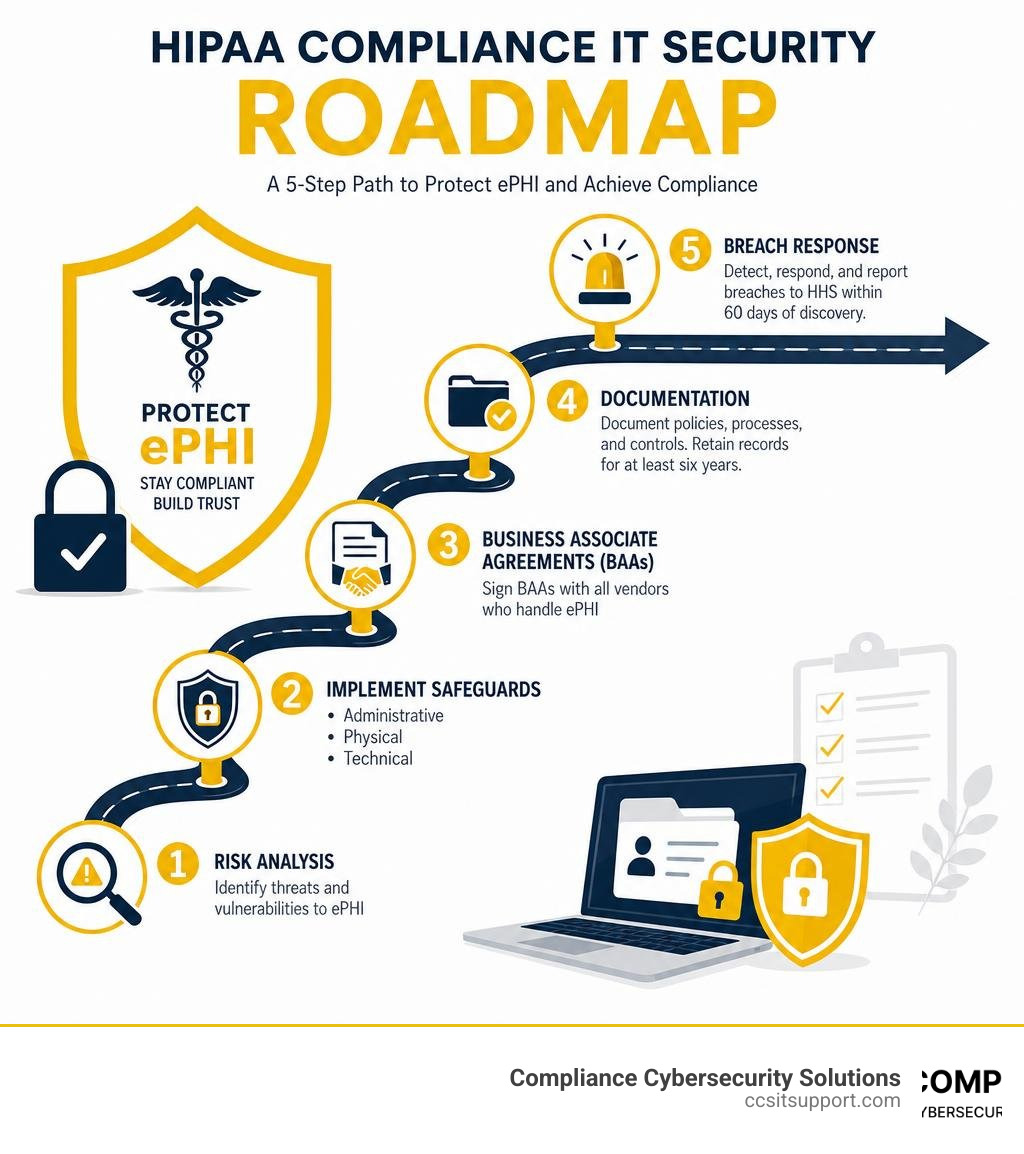
Quick answer — what HIPAA IT security compliance requires:
Conduct a risk analysis to identify threats and vulnerabilities to ePHI
Implement administrative safeguards — designate a security officer, train staff, create policies
Apply physical safeguards — control facility access, secure workstations, manage device disposal
Deploy technical safeguards — access controls, audit logs, encryption, and transmission security
Sign Business Associate Agreements (BAAs) with all vendors who handle ePHI
Document everything and retain records for at least six years
Respond to incidents — report breaches to HHS within 60 days of discovery
The stakes are high. Ransomware attacks on healthcare organizations rose more than 165% in 2023 compared to the year before. The Office for Civil Rights (OCR) has imposed over $137 million in fines across 138 enforcement actions. And with 725 reported breaches in 2024 exposing an estimated 276.8 million records, no organization handling patient data can afford to treat compliance as optional.
This guide walks you through every layer of HIPAA's security requirements — from understanding what data is protected, to implementing the right controls, to avoiding the most common and costly mistakes.
I'm Michael Gaigelas II, founder of Compliance Cybersecurity Solutions, and I've helped organizations across healthcare and other regulated industries navigate HIPAA compliance IT security requirements — from initial gap assessments through full remediation — without unnecessary cost or delay. Let's break down exactly what you need to know and do.
Understanding the HIPAA Security Rule and Protected Data
The Health Insurance Portability and Accountability Act (HIPAA) Security Rule establishes national standards to protect individuals’ electronic personal health information. It is designed to be flexible, scalable, and technology-neutral. This means the federal government does not tell you exactly which brand of firewall to buy; instead, it requires you to achieve specific security outcomes based on the size and complexity of your organization.
Under the HHS Security Rule Overview, any organization that falls under the category of a "covered entity" or a "business associate" must comply with these standards.
Covered Entities: Healthcare providers (doctors, clinics, hospitals, dentists, pharmacies), health plans (health insurance companies, HMOs, government programs like Medicare), and healthcare clearinghouses.
Business Associates: Any third-party service provider, contractor, or vendor that creates, receives, maintains, or transmits ePHI on behalf of a covered entity. This includes IT service providers, cloud storage hosts, billing companies, and legal consultants.
Defining PHI vs ePHI in Healthcare IT
To build an effective security strategy, we must first understand exactly what we are protecting.
Protected Health Information (PHI): This is any individually identifiable health information that relates to an individual's past, present, or future physical or mental health condition, the provision of healthcare, or payment for that healthcare. It includes names, geographic data, birth dates, social security numbers, and medical record numbers.
Electronic Protected Health Information (ePHI): This is simply PHI that is produced, saved, transferred, or received in an electronic format.
As outlined in the University of Florida HIPAA Guidelines, the Security Rule focuses exclusively on ePHI. If a piece of paper with patient data is sitting on a desk, it is governed by the Privacy Rule. The moment that paper is scanned into an electronic health record (EHR) system, it becomes ePHI and falls squarely under the jurisdiction of the Security Rule.
How the Security Rule Differs from Privacy and Breach Notification Rules
While they all work together to protect patient rights, the three primary rules under HIPAA serve very different operational purposes:
The HIPAA Privacy Rule: Focuses on the right of patients to keep their health information private. It sets limits on how PHI can be used and disclosed, and gives patients rights over their own health records.
The HIPAA Security Rule: Focuses specifically on the operational and technical security controls required to protect ePHI from unauthorized access, alteration, or destruction.
The HIPAA Breach Notification Rule: Requires covered entities and business associates to notify affected individuals, the Secretary of HHS, and, in some cases, the media when a breach of unsecured PHI occurs. For breaches affecting 500 or more individuals, notification must be provided without unreasonable delay and no later than 60 days from the discovery of the breach.
By implementing proactive Healthcare Cybersecurity HIPAA controls, we establish a "safe harbor." If your data is properly encrypted according to federal standards and a breach occurs, the data is considered secured, and you may be exempt from the costly and reputation-damaging public notification requirements.
Business Associate Agreements and Subcontractor Compliance
Many healthcare organizations mistakenly believe that they can outsource their compliance liabilities to third-party vendors. However, under the HITECH Act and the subsequent Omnibus Rule, business associates have direct legal liability for HIPAA violations.
Before sharing any ePHI with a vendor, you must execute a formal Business Associate Agreement (BAA). This contract establishes that the vendor will protect the data in accordance with HIPAA standards. Furthermore, if your business associate hires subcontractors to handle that data, those subcontractors must also sign BAAs and maintain full compliance.

Managing these vendor relationships is a critical component of IT Compliance Consulting. We help organizations establish robust vendor risk management workflows to ensure that no ePHI is shared with third parties without the appropriate contractual and technical safeguards in place.
The Core Safeguards of HIPAA Compliance IT Security
The HIPAA Security Rule divides its compliance standards into three logical categories: administrative, physical, and technical safeguards. To achieve comprehensive hipaa compliance it security, an organization must address all three areas.
Adhering to HIPAA Cybersecurity Best Practices requires a layered security strategy where these safeguards overlap to protect your systems.
Administrative Safeguards and Risk Management
Administrative safeguards represent the "brain" of your compliance program. They comprise the policies, procedures, and management actions used to select, develop, and maintain security measures. Key requirements include:
Security Management Process: This is the foundation of compliance. It requires you to perform regular risk analyses and implement a structured risk management plan to reduce risks to a reasonable level.
Assigned Security Responsibility: You must designate a dedicated security official (often a Chief Information Security Officer or a designated IT compliance manager) responsible for developing and implementing security policies.
Workforce Security: You must establish clear procedures for authorizing, supervising, and terminating employee access to ePHI.
Security Awareness and Training: Every member of your team must receive regular training on cybersecurity risks, phishing prevention, and your internal security policies.
Contingency Planning: You must develop a disaster recovery plan, a data backup plan, and emergency mode operation procedures to ensure that patient data remains accessible during a power outage, natural disaster, or cyberattack.
Establishing a clear Healthcare Cybersecurity Policy ensures that your staff knows exactly how to handle sensitive data, respond to potential incidents, and maintain operational continuity when systems go down.
Physical Safeguards for Workstations and Facilities
Physical safeguards protect your physical environment, buildings, and equipment from unauthorized access, theft, and natural hazards. Even the strongest digital encryption is useless if an intruder can walk into your office and steal a server.
Facility Access Controls: Implement physical barriers, locks, security cameras, and visitor logs to limit access to electronic systems and the facilities in which they are housed.
Workstation Security: Ensure that workstations displaying ePHI are positioned to prevent public viewing (e.g., using privacy screens) and are configured to lock automatically after a period of inactivity.
Device and Media Controls: Establish strict procedures for how hardware and electronic media (laptops, USB drives, hard drives) containing ePHI are moved, reused, and disposed of.

When implementing HIPAA Compliant Computer Security, we always recommend physical security controls like keycard access for server rooms and automatic 15-minute screen locks on all clinical workstations.
Technical Safeguards and HIPAA Compliance IT Security Specifications
Technical safeguards are the technology and policy controls used to protect ePHI and control access to it. This is where your IT department or managed service provider (MSP) will focus most of their efforts.
The technical standards, outlined in 45 CFR 164.312 Technical Safeguards, include both Required and Addressable implementation specifications. Addressable specifications are not optional; rather, they allow you to implement an alternative, equivalent security measure if the standard specification is not reasonable or appropriate for your specific environment.
Standard Implementation Specification Type Operational Action Required Access Control Unique User Identification Required Assign a unique username and password to every single user. Access Control Emergency Access Procedure Required Establish a documented way to retrieve ePHI during an emergency. Access Control Automatic Logoff Addressable Configure workstations to log off or lock after a set period of inactivity. Access Control Encryption and Decryption Addressable Encrypt ePHI at rest using AES-256 or equivalent. Audit Controls Audit Logs Required Implement mechanisms to record and examine activity in systems containing ePHI. Integrity Mechanism to Authenticate ePHI Addressable Use checksums or digital signatures to ensure ePHI is not altered. Authentication Person/Entity Authentication Required Implement procedures to verify that a person seeking access is who they claim to be. Transmission Security Integrity Controls Addressable Ensure that transmitted ePHI is not altered without detection. Transmission Security Encryption Addressable Encrypt ePHI in transit using TLS 1.3 or equivalent.
Conducting a HIPAA Risk Analysis and Management Process
A thorough risk analysis is not just a checkbox; it is the absolute foundation of your compliance program. According to the NIST SP 800-66r2 Cybersecurity Resource Guide, the risk analysis must be an accurate and thorough assessment of the potential risks and vulnerabilities to the confidentiality, integrity, and availability of ePHI.
To ensure your organization is fully protected and prepared for an audit, we recommend utilizing professional HIPAA Compliance Audit Services to identify hidden vulnerabilities before bad actors do.
Step-by-Step Risk Assessment Methodology
A reliable risk assessment follows a structured, step-by-step methodology:
Asset Discovery: Create a complete inventory of every system, device, cloud platform, and database that creates, receives, maintains, or transmits ePHI.
Identify Threats and Vulnerabilities: Document potential threat sources (such as malicious hackers, insider threats, or natural disasters) and vulnerabilities in your current software, hardware, and physical security.
Assess Current Security Measures: Analyze the controls you currently have in place to determine if they are configured correctly and operating effectively.
Determine Likelihood and Impact: Use a risk matrix to evaluate how likely a specific threat is to occur and the potential impact it would have on your organization and patients.
Calculate Risk Levels: Classify risks as High, Medium, or Low based on your likelihood and impact analysis.
Develop a Risk Management Plan: Create a prioritized action plan to remediate high-risk items first, assigning clear timelines and responsibilities.
Working with an expert team through HIPAA Consulting Services ensures that your risk assessment aligns with federal standards and provides a clear, defensible path to compliance.
Documentation and Policy Retention Requirements
If you didn't document it, it didn't happen. Under the Security Rule, you must maintain written records of all policies, procedures, risk assessments, and action plans.
6-Year Retention Rule: You must retain all HIPAA compliance documentation for at least six years from the date of its creation or the date when it was last in effect (whichever is later).
Audit Logs: System logs, user access records, and security incident reports must be securely archived and protected from tampering.
Version Control: As your IT systems evolve, you must update your policies and maintain a clear history of changes.
Using a structured Sample Cyber Security Policy helps you establish a standardized template for your documentation, making it easy to update policies annually and present them clearly to OCR auditors if necessary.
Civil vs Criminal Penalties and Common Violation Causes
Failing to maintain proper security controls can lead to devastating financial and legal consequences. The penalty structure is divided into civil and criminal violations:
Civil Monetary Penalties
Tier 1 (No Knowledge): The entity did not know and could not have reasonably known of the violation. Fines range from $100 to $50,000 per incident.
Tier 2 (Reasonable Cause): The entity knew or should have known of the violation with reasonable diligence, but did not act with willful neglect. Fines range from $1,000 to $50,000 per incident.
Tier 3 (Willful Neglect - Corrected): The violation was due to willful neglect, but was corrected within 30 days of discovery. Fines range from $10,000 to $50,000 per incident.
Tier 4 (Willful Neglect - Uncorrected): The violation was due to willful neglect and was not corrected within 30 days. The fine is a flat $50,000 per incident, with annual caps reaching up to $1.9 million per category.
Criminal Penalties
For individuals or organizations that knowingly obtain or disclose PHI without authorization, the Department of Justice can pursue criminal charges:
Knowing Disclosure: Up to $50,000 fine and 1 year in prison.
False Pretenses: Up to $100,000 fine and 5 years in prison.
Intent to Sell or Exploit: Up to $250,000 fine and 10 years in prison.
Common HIPAA Violations to Avoid
Shared Credentials: Over 60% of investigated healthcare facilities have shared login accounts on clinical workstations, making individual audit tracking impossible.
Unencrypted Devices: Storing patient records on unencrypted laptops or USB drives that are subsequently lost or stolen.
Plaintext Logging: Writing ePHI (like SSNs or medical record numbers) directly into unencrypted application error logs.
Failure to Train Staff: Accidental disclosure by employees who fall victim to basic social engineering or phishing schemes.
Leveraging Modern Technologies for HIPAA Compliance IT Security
Achieving compliance in 2026 requires moving beyond legacy systems and adopting modern security architectures that protect data dynamically.
AES-256 Encryption & TLS 1.3: Always encrypt ePHI at rest using AES-256 and in transit using TLS 1.3. Avoid outdated protocols like TLS 1.0 or 1.1, which are vulnerable to modern exploit tools.
Zero Trust Architecture: Under a Zero Trust model, we assume that threats exist both inside and outside the network. No user or device is trusted by default; instead, continuous authentication and authorization are required for every transaction involving ePHI.
Multi-Factor Authentication (MFA): MFA is the single most effective barrier against credential theft. Ensure that MFA is enforced for all remote access, email accounts, and EHR system logins.
Cloud Security Controls: If you host data in the cloud, ensure your cloud provider signs a BAA and configure your environment to prevent public bucket exposure.
The Federal Register 2025 Proposed Security Rule Update emphasizes the critical importance of these modern technologies, shifting encryption and MFA from highly recommended practices to mandatory baselines for all healthcare participants.
When designing a modern HIPAA Cloud Security framework, we combine cloud-native encryption keys, automated configuration monitoring, and zero-trust access controls to keep your patient data secure and your business completely audit-ready.
Frequently Asked Questions about HIPAA Security
Does HIPAA require data encryption?
Yes. While encryption historically fell under the "addressable" category, the current regulatory landscape and the threat of sophisticated ransomware make it functionally mandatory.
If you choose not to encrypt ePHI, you must document an incredibly compelling technical reason and implement an alternative security measure that achieves the exact same level of safety. In practice, there is no equivalent alternative to modern AES-256 encryption. Furthermore, encrypting your data provides a "safe harbor" under the Breach Notification Rule, saving your organization from public notification requirements if an encrypted device is lost or stolen.
How often must a HIPAA risk assessment be performed?
The HIPAA Security Rule does not specify a rigid calendar frequency, but federal guidelines and industry best practices dictate that a comprehensive risk assessment must be performed at least once a year.
Additionally, you must conduct a new risk analysis whenever there are significant environmental or operational changes to your IT infrastructure. This includes migrating to a new EHR system, moving your data to the cloud, opening a new clinic location, or adopting new remote-work policies.
What are the penalties for a HIPAA Security Rule violation?
Penalties are determined by the Office for Civil Rights (OCR) based on the level of negligence involved. Civil monetary penalties range from $100 to $50,000 per violation, with an annual cap of up to $1.9 million for identical violations within a single calendar year.
If a violation involves willful neglect and is left uncorrected, the maximum fines are automatically applied. Severe violations involving fraud or the intent to sell patient data can result in criminal prosecution, leading to millions of dollars in fines and up to 10 years in federal prison.
Conclusion
Navigating the complexities of hipaa compliance it security doesn't have to be an overwhelming or exhausting process. By understanding the core safeguards, establishing a robust risk management process, and leveraging modern cybersecurity controls like encryption and Zero Trust architecture, you can keep your patient records safe and protect your organization from devastating financial penalties.
At Compliance Cybersecurity Solutions (CCS), we specialize in helping healthcare organizations and business associates throughout Fort Lauderdale and the broader Florida region align their IT infrastructure with HIPAA standards. We deliver a layered security approach, combining comprehensive policies, advanced threat detection, and continuous monitoring to keep your business secure and fully compliant.
Don't wait for a data breach or an OCR audit to find the gaps in your security. Get started with CCS Compliance Services today, and let us help you build a secure, compliant, and resilient IT environment.