

Keeping the Secrets: A Guide to HIPAA Privacy Officer Responsibilities
What Does a HIPAA Compliance Officer Actually Do?
A hipaa compliance officer is the designated person responsible for making sure your organization follows federal health privacy and security laws — and the consequences of not having one can be severe.
Here's a quick summary of the role:
Who they are: A designated individual (or two) responsible for HIPAA Privacy and Security Rule compliance
What they do: Develop policies, train staff, conduct risk assessments, manage breaches, and oversee Business Associate Agreements
Who needs one: All HIPAA covered entities (healthcare providers, health plans, clearinghouses) and business associates
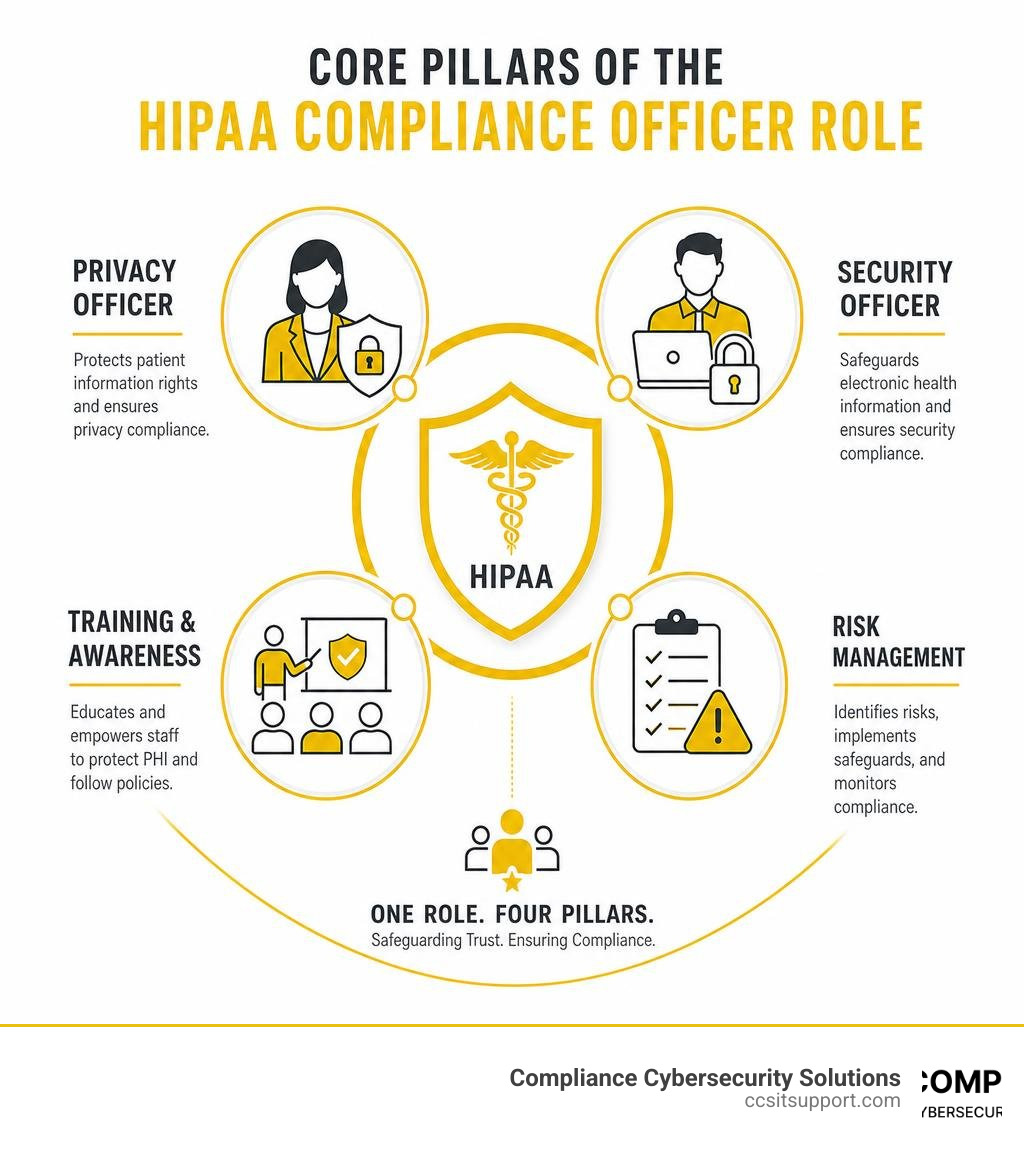
Two key roles: Privacy Officer (protects patient information rights) and Security Officer (protects electronic health data)
Legal basis: Required under 45 CFR § 164.530 and 45 CFR § 164.308(a)(2)
Healthcare organizations are under more pressure than ever. HIPAA violations have resulted in over $100 million in fines in recent years. Around 70% of healthcare organizations have experienced a data breach — with the average breach costing $7.13 million. And complaints filed with the HHS Office for Civil Rights have jumped more than 50% in just five years.
Yet many organizations still treat the compliance officer role as an afterthought — assigning it to an IT staffer or leaving it undefined entirely.
That's a costly mistake.
This guide breaks down exactly what a HIPAA compliance officer does, what qualifications they need, how to structure the role, and what happens when organizations get it wrong.
I'm Michael Gaigelas II, and through my work at Compliance Cybersecurity Solutions guiding organizations through HIPAA, CMMC 2.0, and ISO 27001 compliance frameworks, I've seen how a well-defined hipaa compliance officer role can be the difference between a clean audit and a six-figure penalty. Let's walk through everything you need to know to get this right.
The Legal Mandate: Why You Need a HIPAA Compliance Officer

Let’s start with the hard truth: appointing a hipaa compliance officer isn't a friendly recommendation. It is a strict federal requirement. Under the Health Insurance Portability and Accountability Act, specifically outlined in the legal requirements for designating a privacy official, covered entities and business associates must formally designate individuals to oversee their privacy and security programs.
In the fast-moving compliance landscape of June 2026, the Department of Health and Human Services (HHS) and the Office for Civil Rights (OCR) are not handed out "participation trophies" for compliance. With over 80% of healthcare organizations now maintaining a designated compliance officer, the regulatory expectation is that your program is fully functional, documented, and actively managed.
The administrative requirements under § 164.530 demand that covered entities designate a privacy official responsible for the development and implementation of the organization's policies and procedures. Furthermore, you must designate a contact person or office responsible for receiving complaints and providing information about your privacy practices. If your organization handles Protected Health Information (PHI) or Electronic Protected Health Information (ePHI), you fall under this mandate. This includes:
Covered Entities: Healthcare providers (doctors, dentists, hospitals), health plans (insurance companies), and healthcare clearinghouses.
Business Associates: Third-party vendors, IT providers, billing companies, and cloud hosts that access, transmit, or store PHI.
Without a dedicated leader at the helm, your organization is essentially sailing into a storm of audits, complaints, and cyber threats without a captain.
Privacy Officer vs. Security Officer Responsibilities
While many people use the term "hipaa compliance officer" as a catch-all, HIPAA actually splits administrative oversight into two distinct, specialized roles: the Privacy Officer and the Security Officer.
The HIPAA Privacy Officer is the guardian of patient rights and the "analog" flow of information. They focus on the HIPAA Privacy Rule, which covers PHI in any format—whether spoken, written on paper, or transmitted digitally. Their responsibilities include:
Developing and maintaining privacy policies and procedures.
Managing the Notice of Privacy Practices (NPP).
Handling patient requests to access, amend, or restrict their medical records.
Investigating privacy complaints and potential internal breaches.
Managing Business Associate Agreements (BAAs).
The HIPAA Security Officer, on the other hand, is the technical guardian. They focus strictly on the HIPAA Security Rule, which governs ePHI (electronic Protected Health Information). Their domain is digital, focusing on the administrative, physical, and technical safeguards needed to protect electronic records from hackers, malware, and unauthorized access. To understand how these rules are implemented technically, you can read more about HIPAA compliance IT security.
While the Privacy Officer ensures that staff members don't gossip about patients in the hallway, the Security Officer ensures that a hacker in Eastern Europe can’t breach your local server. Both roles are critical, and they must work in lockstep to keep your organization safe.
Structuring the Role in Small Practices vs. Large Health Systems
How you structure these compliance roles depends entirely on the size, complexity, and risk profile of your organization.
In a small medical practice—such as a local family clinic in Fort Lauderdale—it rarely makes financial or operational sense to hire two full-time executives for these roles. HIPAA understands this scalability. In smaller environments, the roles are almost always combined. Typically, the Practice Manager is designated as both the Privacy and Security Officer. They handle day-to-day operations while wearing the compliance hat, often relying on outsourced partners to handle complex technical assessments. For these smaller practices, leveraging professional HIPAA consulting services can help bridge the gap between daily clinical duties and complex federal requirements.
In contrast, large health systems require a massive, highly structured compliance hierarchy. They will have a dedicated Chief Compliance Officer, a separate Privacy Officer, a separate Security Officer (often working closely with the CISO), and an entire team of compliance coordinators, auditors, and legal experts.
No matter the size of your organization, the reporting lines must be clear. The compliance officer must have a direct line of communication to executive leadership and the board of directors. If a compliance officer discovers a systemic issue but has to jump through five layers of middle management to report it, the compliance program is broken. Accountability and delegation must be formally documented, and designations must be kept on file for at least six years.
Core Operational Duties of HIPAA Compliance Leaders

Now that we understand the legal structure, let’s look at what a compliance officer actually does on a Tuesday morning. The role is highly operational, requiring a mix of policy writing, technical oversight, employee training, and crisis management.
To give you a clear picture of how these duties split across the privacy and security domains, here is a breakdown of their standard operational tasks:
HIPAA Privacy Officer Tasks HIPAA Security Officer Tasks Draft and update Privacy Policies and NPPs Conduct annual Security Risk Analyses (SRA) Facilitate privacy training for new hires and staff Implement technical safeguards (encryption, firewalls) Manage patient access requests and medical releases Oversee physical security of servers and workstations Investigate physical and verbal privacy complaints Monitor network logs for unauthorized access attempts Draft, negotiate, and track BAAs with vendors Design and test Disaster Recovery/Contingency plans Coordinate breach notification letters to patients Implement multi-factor authentication and access controls
Managing Risk Assessments and Policy Development
You cannot protect what you do not measure. That’s why the cornerstone of any defensive HIPAA compliance program is the Security Risk Analysis (SRA). The Security Officer is responsible for conducting this analysis regularly (typically annually, or whenever major technology changes occur) to identify vulnerabilities in how ePHI is stored, handled, and transmitted.
But a risk assessment is only as good as the remediation plan that follows it. Once vulnerabilities are identified, the compliance officer must work to update internal policies and implement controls. This includes:
Vulnerability Assessments: Scanning networks and applications to find weak points.
Policy Updates: Reviewing and updating written policies to reflect current operational realities (such as hybrid work and remote access policies).
Documentation: Keeping a paper trail of every risk identified and the steps taken to mitigate it.
If the OCR ever knocks on your door, the very first thing they will ask to see is your historical risk assessments and your documented policies. If you don't have them, you are looking at automatic willful neglect penalties. For comprehensive support in passing these audits, organizations often utilize specialized HIPAA compliance audit services to ensure no stone is left unturned.
Breach Response and Business Associate Agreements
When a breach occurs, the clock starts ticking immediately. The compliance officer must lead the incident response team, investigate the scope of the exposure, and coordinate notifications. Under the HIPAA Breach Notification Rule, affected individuals and the HHS must be notified within 60 days of discovering a breach affecting 500 or more individuals. (And as we will discuss shortly, state laws often demand much faster action).
Equally important is the management of Business Associate Agreements (BAAs). A whopping 53% of healthcare breaches originate from internal errors or third-party vendors. If you share PHI with an IT provider, a billing company, or a cloud vendor without a signed BAA, you are in direct violation of HIPAA.
The compliance officer must ensure that:
Every single vendor handling PHI has a valid, signed BAA on file.
Vendors are vetted for their own cybersecurity postures.
A robust healthcare cybersecurity policy is in place to govern how third parties access your internal systems.
Qualifications, Training, and Career Pathways
What does it take to become a hipaa compliance officer? Interestingly, the federal government does not mandate specific degrees or state licenses to hold this title. However, because the role requires a deep understanding of both healthcare law and modern cybersecurity, the market expects a highly specialized set of credentials.
Educational Pathways to Become a HIPAA Compliance Officer
While there is no single "correct" path, most successful compliance officers come from one of three backgrounds:
Healthcare Administration / Health Information Management (HIM): Professionals who understand clinical workflows, Electronic Health Records (EHR) systems, and hospital operations.
Legal and Regulatory Studies: Individuals with a Juris Doctor (JD) or a Master of Legal Studies (MLS) who specialize in healthcare compliance and regulatory affairs.
Information Technology and Cybersecurity: Tech-minded professionals who transition into compliance to bridge the gap between system administration and federal law.
If you are looking to enter this field, starting with a bachelor's degree in legal studies, finance, healthcare administration, or IT is standard. From there, pursuing a master's degree or specialized graduate certification can significantly accelerate your career. For a deeper dive into the academic and professional options available, you can read this guide on how to become a HIPAA compliance officer.
Recommended Certifications and Continuing Education
Because technology and regulations evolve rapidly, professional certifications are highly valued by healthcare employers. Some of the most respected credentials in the industry include:
CHPSE (Certified HIPAA Privacy Security Expert): A comprehensive certification covering both the Privacy and Security rules in-depth.
CHPE (Certified HIPAA Privacy Expert) / CHSE (Certified HIPAA Security Expert): Specialized tracks for those focusing strictly on one side of the compliance coin.
CISA (Certified Information Systems Auditor): An excellent credential for Security Officers focusing on technical audits and IT controls.
CHPC (Certified in Healthcare Privacy Compliance): Offered by the Compliance Certification Board (CCB), this is a gold standard for healthcare compliance professionals.
Consider the career of industry pioneers like Dr. Leon Goldman, who transitioned from a successful career as a general surgeon to building a comprehensive compliance and privacy program from the ground up at a major Harvard-affiliated medical center. Dr. Goldman eventually earned his CIPP/US certification and became a national voice on patient confidentiality, proving that clinical experience combined with formal privacy education creates incredibly effective compliance leaders.
To maintain these certifications, officers must earn Continuing Education Units (CEUs) annually. This ongoing training ensures they stay up-to-date with emerging cyber threats, regulatory shifts, and OCR enforcement trends.
Navigating Multi-State Regulations and Compliance Challenges
If you only operate a single clinic in Fort Lauderdale, Florida, your regulatory landscape is relatively straightforward. But what happens when your healthcare organization expands, serves patients across state lines, or operates as a multi-state health system?
This is where compliance transitions from a science to an art.
State Privacy Laws vs. HIPAA Preemption
A common misconception is that HIPAA is the final, absolute word on healthcare privacy in the United States. In reality, HIPAA operates on the principle of federal preemption with a twist.
Under HIPAA, federal rules preempt state laws unless the state law is more stringent than the federal standard. If a state law provides greater privacy protections to patients, or grants them more rights over their data, the state law takes precedence.
For example, while HIPAA’s federal Breach Notification Rule gives organizations up to 60 days to report a data breach, the Florida Information Protection Act (FIPA) is much stricter. FIPA requires commercial and healthcare entities in Florida to notify affected individuals and the Florida Department of Legal Affairs within 30 days of discovering a breach. If you wait 45 days, you might be compliant under federal HIPAA rules, but you are in violation of Florida law and could face heavy state-level penalties.
For multi-state organizations, the compliance officer must possess a thorough, working knowledge of every state's specific privacy, security, and breach notification laws where they operate, ensuring their policies always default to the most stringent standard.
The Consequences of a HIPAA Compliance Officer Failing in Their Duties
When a compliance officer fails to execute their duties—whether due to lack of resources, administrative neglect, or systemic organizational pushback—the consequences can be catastrophic.
According to the duties and consequences of compliance failure detailed by the HIPAA Journal, failures often result in:
Severe Financial Penalties: The OCR can levy multi-million dollar fines for "willful neglect" when an organization fails to conduct risk assessments or train its staff.
Corrective Action Plans (CAPs): Organizations caught in violation are often placed under federal monitoring for years, requiring exhaustive reporting and massive operational overhead.
Reputational Ruin: A public breach notification can destroy patient trust overnight. If patients don't believe their secrets are safe with you, they will find another provider.
Personal and Corporate Liability: While senior management is ultimately responsible for compliance, a complete failure of the compliance officer to warn leadership of known vulnerabilities can lead to immediate termination and professional blacklisting.
Frequently Asked Questions about HIPAA Compliance
Can a legal team assume the responsibilities of a HIPAA Compliance Officer?
Yes, an internal legal team or external general counsel can manage the legal aspects of compliance. However, HIPAA requires that a specific, named individual be formally designated as the Privacy Officer and Security Officer. You cannot simply point to a "team" for accountability; there must be a single point of contact responsible for the program's oversight.
Does a covered entity need a compliance officer for each state or subsidiary?
No. A covered entity operating across multiple states or managing several subsidiaries can centralize its compliance program under a single, corporate hipaa compliance officer. However, that centralized officer must ensure that local site coordinators are appointed, and that policies are tailored to meet the specific state-level laws of each operating location.
Can the HIPAA Compliance Officer role be outsourced?
Absolutely. Especially for small-to-midsize practices, hiring a full-time, experienced compliance officer can be cost-prohibitive. Many organizations successfully outsource this role to a virtual Compliance Officer or leverage professional HIPAA security consulting partners. This gives you access to executive-level compliance expertise and technical security teams at a fraction of the cost of an in-house hire.
Conclusion
In the modern healthcare landscape, a hipaa compliance officer is no longer just a regulatory box to be checked. They are a vital strategic partner, safeguarding your patients' trust, defending your digital perimeter, and protecting your bottom line from devastating fines and data breaches.
Whether you are a small clinical practice in Fort Lauderdale or a growing multi-state healthcare provider, keeping patient secrets safe requires a proactive, structured approach to privacy and security.
At CCS Compliance & Cybersecurity Solutions, we specialize in helping healthcare organizations align their IT infrastructure with HIPAA requirements. Based in Fort Lauderdale, Florida, we provide comprehensive compliance cybersecurity services, layered security, threat detection, and virtual compliance officer support to take the headache out of regulatory adherence.
Don't wait for an OCR audit or a ransomware attack to find out if your compliance program is working. Get started with CCS compliance services today, and let us help you build a secure, compliant future.