

How to Ace Your HIPAA Compliance Audit Without Breaking a Sweat
Understanding the Landscape of HIPAA Compliance Audit Services
Navigating healthcare regulations can feel like wandering through a maze designed by lawyers who had too much coffee. At its core, however, hipaa compliance audit services are designed to ensure that Protected Health Information (PHI) remains private, secure, and available when needed.
A professional audit evaluates your organization against three primary pillars of the Health Insurance Portability and Accountability Act:
The Privacy Rule: This governs how PHI can be used and disclosed. It gives patients rights over their health information, including the right to examine and obtain a copy of their health records. You can dive deeper into the specifics of The Privacy Rule to see how it affects your daily operations.
The Security Rule: This is the technical backbone. It sets national standards for protecting electronic PHI (ePHI) that is created, received, used, or maintained by a covered entity. It requires appropriate administrative, physical, and technical safeguards. More details are available via The Security Rule official documentation.
The Breach Notification Rule: This requires covered entities to notify affected individuals, the HHS Secretary, and, in some cases, the media following a breach of unsecured PHI.
Who Needs HIPAA Compliance Audit Services?
If you think HIPAA only applies to doctors and hospitals, think again. The ecosystem of healthcare data is massive. Generally, two groups must seek out hipaa compliance audit services:
Covered Entities: This includes health plans (insurance companies, HMOs), healthcare clearinghouses (entities that process nonstandard health information into standard data), and healthcare providers (doctors, clinics, pharmacies) who conduct business electronically.
Business Associates: These are the "behind-the-scenes" players. If you are an IT vendor, a billing firm, a cloud storage provider, or even a legal firm that handles PHI on behalf of a covered entity, you are legally required to comply with HIPAA.
Whether you are a small clinic in Fort Lauderdale or a multi-state SaaS provider, the rules apply. You can explore our compliance services to see how we help both groups stay on the right side of the law.
The Strategic Value of Third-Party Assessments
Why hire someone to tell you what you’re doing wrong? Because "self-policing" is notoriously difficult. Third-party hipaa compliance audit services provide an objective, expert lens.
Risk Mitigation: We find the "open windows" in your digital house before a hacker does.
Stakeholder Trust: Patients and partners want to know their data is safe. A professional attestation report proves you take security seriously.
Data Integrity: Audits ensure that your data isn't just private, but accurate and accessible.
Professional Attestation: Having an independent firm validate your controls provides a "defensible position" if the federal government ever comes knocking.
The 2024-2025 OCR Audit Initiative and Regulatory Updates
The federal government hasn't been sitting idle. The Office for Civil Rights (OCR) has officially reignited its audit engine. After a period of relative dormancy, the 2024-2025 audit initiative is specifically targeting 50 covered entities and business associates.

This isn't a random "check-the-box" exercise. The current focus is heavily weighted toward the Security Rule provisions most relevant to the biggest threats facing healthcare today: hacking and ransomware attacks. The HITECH Act mandates these periodic reviews to ensure the industry is keeping pace with modern threats.
2025 HIPAA Penalty Adjustments
If you think the cost of an audit is high, wait until you see the cost of a fine. In January 2025, the HHS adjusted civil monetary penalties for inflation. Ignoring HIPAA is becoming exponentially more expensive.
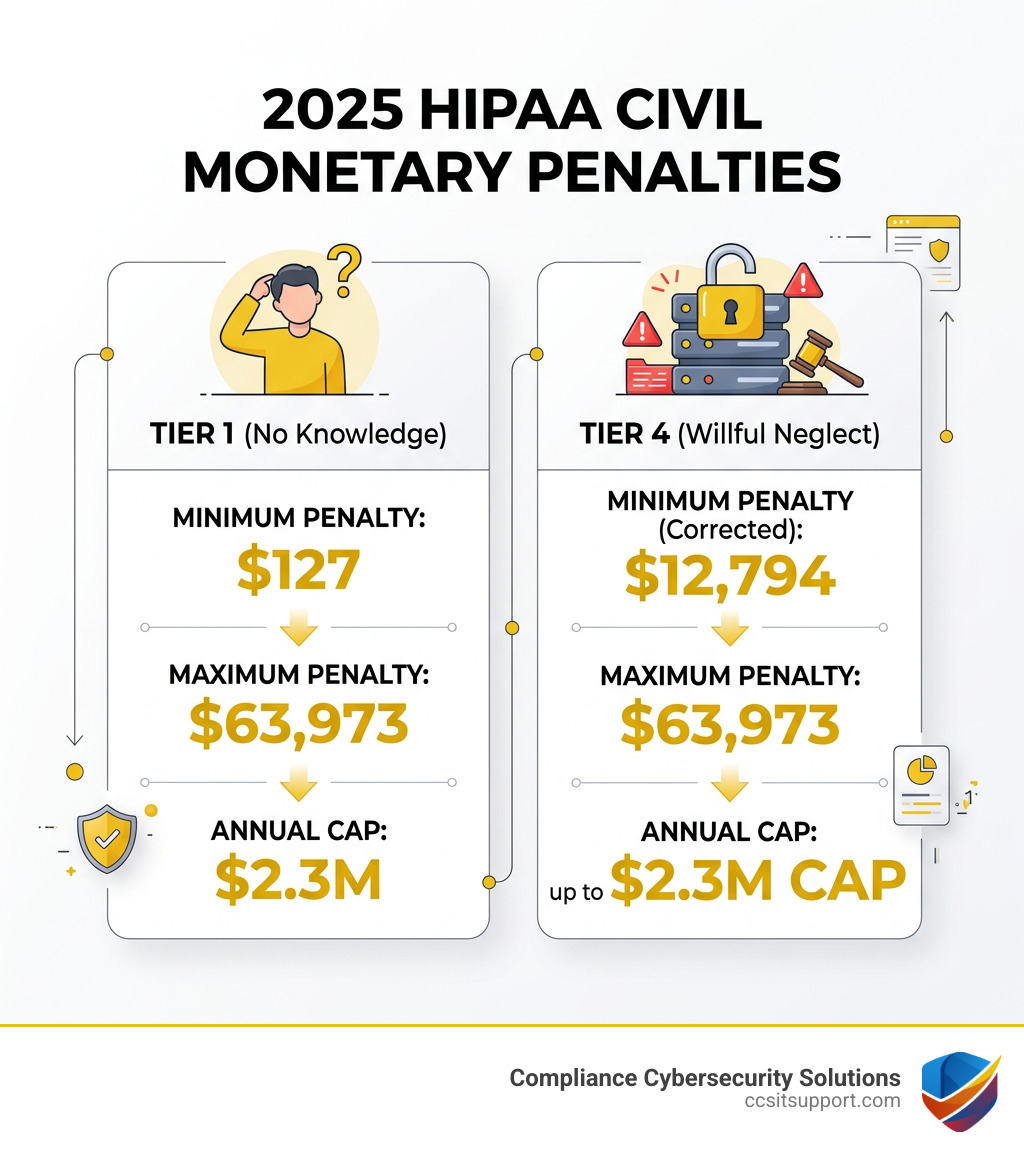
Violation Category Minimum Penalty (2025) Maximum Penalty (2025) Annual Cap Tier 1: No Knowledge $127 $63,973 $2,300,000 Tier 2: Reasonable Cause $1,280 $63,973 $2,300,000 Tier 3: Willful Neglect (Corrected) $12,794 $63,973 $2,300,000 Tier 4: Willful Neglect (Uncorrected) $63,973 $2,300,000 $2,300,000
Note: These figures represent the inflation-adjusted caps per violation category per year.
Focus on the Security Rule
The OCR’s current audit protocol is laser-focused on how you handle "ePHI" in the wild. Specifically, auditors are looking for:
Access Management: Who has the keys to the kingdom? Are you using Multi-Factor Authentication (MFA)?
Encryption: Is data encrypted both while it sits on your servers (at rest) and while it travels across the internet (in transit)?
Asset Inventory: You can't protect what you don't know you have. Do you have a list of every laptop, server, and smartphone that touches PHI?
The Security Rule is no longer a suggestion; it is the frontline of patient safety.
Key Components of a Professional HIPAA Compliance Audit Service
When we perform hipaa compliance audit services, we don't just hand you a checklist and wish you luck. A professional audit is a deep dive into the DNA of your organization’s IT and administrative processes.
Technical Validation and Cloud Integration
For many modern healthcare companies, the "office" is the cloud. If you are using AWS, Azure, or Google Cloud, your audit must reflect that. We leverage advanced tools to automate the "boring" parts of compliance.
For example, using AWS Config and Security Hub, we can monitor your environment in real-time. Research shows that healthcare startups can reduce manual evidence collection by up to 70% through this type of automation. We also look at:
CloudTrail: To see exactly who accessed what and when.
Encryption at Rest: Ensuring that even if a physical drive were stolen from a data center, the data would be unreadable.
Log Retention: HIPAA requires keeping certain logs for six years. We help you manage this cost-effectively—for instance, by migrating logs to Amazon S3, which can cut storage costs by over 45%.
Learn more about how we integrate these tools into our compliance framework.
Framework Alignment: HITRUST, SOC 2, and NIST
HIPAA doesn't exist in a vacuum. Often, our clients need to comply with multiple standards. A high-quality audit service will "map" these controls so you don't have to do the work twice.
NIST 800-66: This is the "gold standard" for implementing the HIPAA Security Rule. It provides a structured way to manage risk.
AT-C Section 315: This is a specific AICPA standard used by CPAs to provide a formal "opinion" on your HIPAA compliance. You can read the AT-C Section 315 guidelines to understand how these formal reports are structured.
HITRUST: Think of this as "HIPAA on steroids." It’s a more rigorous certification that many large health systems now require from their vendors.
How to Prepare: A Step-by-Step Roadmap to Audit Readiness
Preparing for an audit shouldn't feel like cramming for a final exam. If you are organized, it’s just another day at the office.
Conducting a Comprehensive Risk Analysis
This is the single most important step. In fact, "failure to perform an enterprise-wide risk analysis" is the #1 reason the OCR issues fines.
Vulnerability Scanning: We run tools to find "holes" in your software.
ePHI Flow Mapping: We trace exactly where patient data goes, from the moment a patient checks in until the bill is paid.
Threat Modeling: We ask, "What’s the worst that could happen?" (Ransomware, insider threats, lost laptops) and build defenses against those specific scenarios.
Remediation Roadmap: We give you a prioritized list of what to fix first.
Essential Documentation for HIPAA Compliance Audit Services
If it isn't documented, it didn't happen. That is the auditor's motto. You will need:
Privacy Policies: How do you handle patient requests for records?
Business Associate Agreements (BAAs): Do you have a signed contract with every vendor that touches your data?
Access Logs: Can you prove who looked at a specific patient record last Tuesday?
Training Certificates: Can you prove every employee has completed HIPAA training in the last year?
Leveraging AI and Automation for Modern Audits
The days of auditors carrying around massive three-ring binders are over. Modern hipaa compliance audit services use AI to make the process faster, cheaper, and more accurate.
Reducing Manual Burden with AI-Driven Tools
By using AI-driven platforms, we can cut audit time and costs by 40% to 60%. Instead of an auditor manually checking 100 different settings, an AI agent can scan your entire network in minutes.
Evidence Automation: The system automatically "grabs" screenshots and logs to prove you are compliant.
Real-time Alerts: If a security setting is changed (e.g., a database is accidentally made "public"), the system alerts us immediately.
Log Retention: AI helps categorize and store logs so you meet the six-year mandate without spending a fortune on storage.
The Future of Continuous Compliance
Compliance shouldn't be a "once a year" event. It should be "continuous." With ongoing monitoring, you are always "audit-ready." This scalable approach means that as your company grows from 10 employees to 1,000, your security grows with you. Our compliance services are built on this philosophy of "always-on" protection.
Frequently Asked Questions about HIPAA Compliance Audit Services
How often should my organization conduct a HIPAA audit?
While HIPAA doesn't strictly say "you must audit every 12 months," the industry standard is an annual assessment. However, you should also trigger an audit if:
You implement a new Electronic Medical Record (EMR) system.
You move to a new office or data center.
You experience a security incident or "near miss."
There are significant changes to federal regulations.
What are the most common findings in an OCR audit?
Based on the 2016-2017 OCR audit results (which reviewed 166 covered entities), the most common "fails" were:
Inadequate Risk Analysis: Not looking at all the ways data could be leaked.
Missing BAAs: Forgetting to get a signed agreement from a small sub-vendor.
Access Control Gaps: Employees having access to data they didn't need for their jobs.
Lack of Training: Employees not knowing how to spot a phishing email.
What is the typical timeline and cost for a professional audit?
A full initial audit typically takes 2 to 4 months. This includes the gap analysis, the time you need to fix any issues we find, and the final validation.
Pricing models vary based on the size of your organization and the complexity of your IT environment. However, when you consider that a single "willful neglect" violation can start at over $63,000, the ROI of professional hipaa compliance audit services is clear. It is much cheaper to prevent a fire than to rebuild the house after one.
Conclusion
At Compliance Cybersecurity Solutions (CCS), we believe that HIPAA compliance shouldn't be a burden—it should be a strategic advantage. By securing your data, you aren't just avoiding fines; you are building a foundation of trust with your patients and partners.
Based in Florida, we specialize in helping healthcare providers and business associates navigate the complexities of the 2025 regulatory landscape. Whether you are preparing for an OCR audit or just want to ensure your data is locked down tight, we are here to help.
Don't wait for a breach to find out where your weaknesses are. Be proactive. Be secure. Get started with our compliance experts today.