

Finding the Most Secure HIPAA Hosting Services for Healthcare
Why Choosing the Right HIPAA Hosting Services Can Make or Break Your Compliance
HIPAA hosting services are specialized hosting environments built to protect electronic Protected Health Information (ePHI) — and choosing the wrong one can expose your organization to millions in fines, lawsuits, and reputational damage.
Here's a quick summary of what to look for:
Must-Have Feature Why It Matters Signed Business Associate Agreement (BAA) Legally required before any PHI touches the provider's infrastructure AES-256 encryption at rest + TLS in transit Protects data from interception and unauthorized access Audit logging (6-7 year retention) Required for HIPAA Security Rule compliance and breach investigations Role-based access controls (RBAC) + MFA Limits who can access sensitive patient data SOC 2 Type II / HITRUST / ISO 27001 certification Third-party proof the provider's security controls actually work 24/7 monitoring and incident response Detects and contains breaches before they escalate Documented disaster recovery plan Ensures continuity of care and data availability
The stakes are real. The average healthcare data breach now costs $10.93 million — the highest of any industry. In 2023 alone, 725 breaches exposed over 133 million patient records. And HIPAA penalties can reach $50,000 per violation, up to $1.5 million annually per violation category.
Standard hosting providers like GoDaddy, Bluehost, Wix, or Squarespace are not HIPAA compliant and will not sign a BAA — making them a liability for any healthcare organization handling patient data.
I'm Michael Gaigelas II, founder of Compliance Cybersecurity Solutions, where I specialize in guiding healthcare organizations through selecting and implementing the right HIPAA hosting services as part of a broader compliance and cybersecurity strategy. With hands-on experience in HIPAA, CMMC 2.0, SOC 2, and ISO 27001 frameworks, I've helped organizations cut compliance costs while eliminating the security gaps that lead to costly breaches and audit failures.
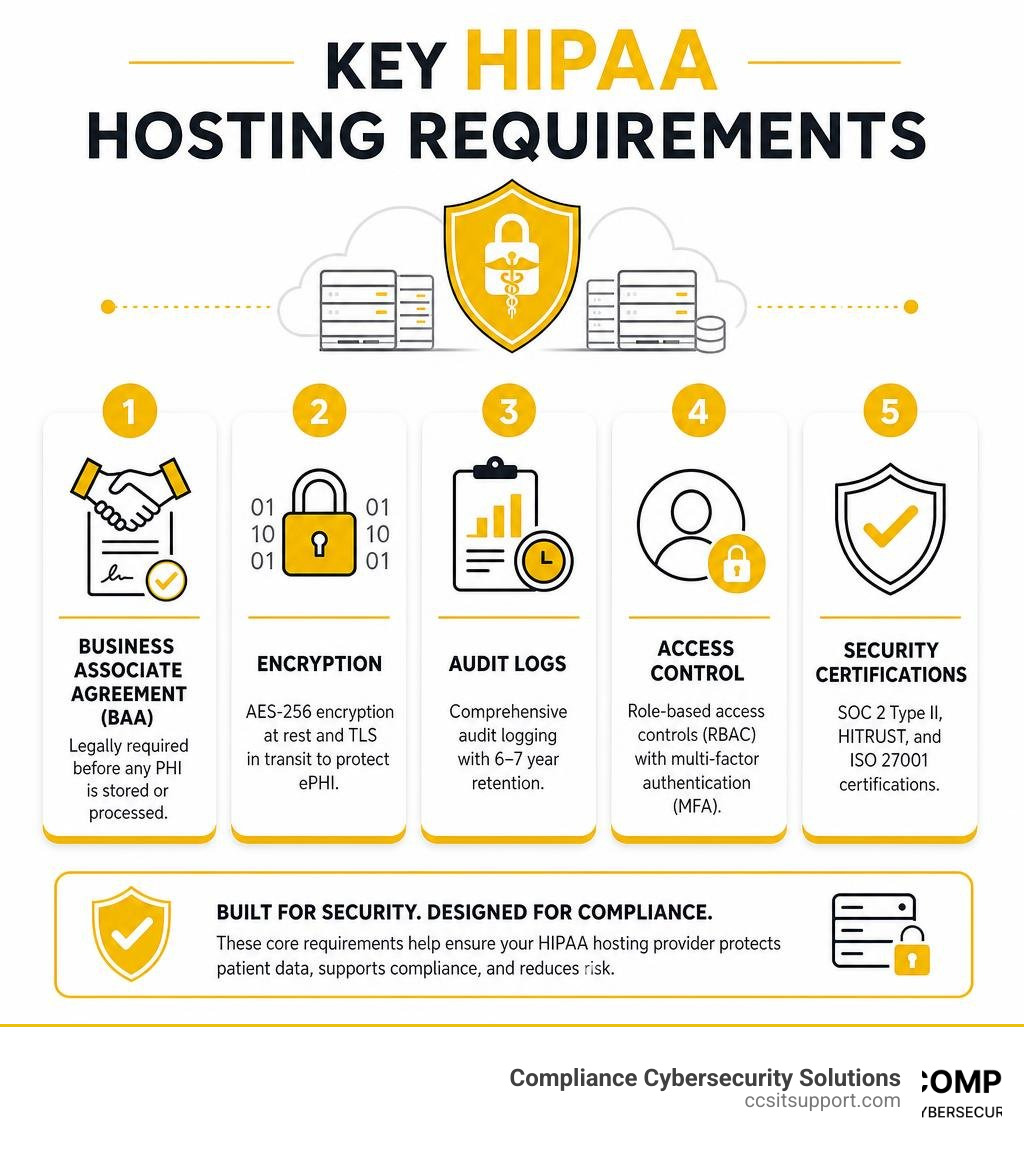
Technical and Physical Safeguards of HIPAA Hosting Services
When evaluating hipaa hosting services, we must look beyond the marketing promises and inspect the actual technical and physical safeguards implemented at the server and data center levels. The HIPAA Security Rule is highly specific about how electronic protected health information (ePHI) must be secured.

Technical Safeguards: Protecting Data in Flight and at Rest
First and foremost, any compliant hosting infrastructure must employ military-grade encryption. For data at rest, this means using AES-256 encryption. Every database, backup drive, and storage volume containing patient data must be encrypted so that even if physical drives are stolen, the data remains unreadable.
For data in transit, standard SSL is no longer enough. Modern secure hosting environments must enforce Transport Layer Security (TLS) 1.3 (or at minimum TLS 1.2) to protect data traveling between patient portals, mobile health apps, and the hosting servers. Managing these configurations is a core element of HIPAA Compliance IT Security.
Beyond encryption, technical safeguards must include:
Web Application Firewalls (WAF): To block SQL injections, cross-site scripting (XSS), and other common web application exploits.
Intrusion Detection and Prevention Systems (IDS/IPS): To monitor network traffic for malicious activity and automatically block threats in real time.
Strict Access Control: Enforcing Multi-Factor Authentication (MFA) and IP whitelisting for all administrative access.
To dive deeper into securing cloud-native environments, you can read our comprehensive guide on HIPAA Cloud Security.
Physical Safeguards: Protecting the Hardware
A hosting provider can have the most secure software in the world, but if someone can walk into the server room and pull out a hard drive, your compliance program is non-existent. True HIPAA-compliant data centers must implement stringent physical safeguards, including:
Biometric Access Controls: Fingerprint or retinal scanners to restrict server room access to authorized personnel only.
24/7/365 Video Surveillance: Continuous monitoring of all entry and exit points, server cages, and facility perimeters.
Environmental Controls: Redundant power supplies, fire suppression systems, and climate control to prevent hardware failure and data loss.
For organizations operating in Florida, local support can assist in aligning these infrastructure requirements with regional operations, ensuring state and federal compliance boundaries are fully covered.
Administrative Safeguards and the Business Associate Agreement (BAA)
Even the most secure technical setup is legally useless under HIPAA without a signed Business Associate Agreement (BAA). Under federal law, a hosting provider is considered a "Business Associate" if they store, transmit, or process ePHI on behalf of a "Covered Entity" (such as a doctor's office, hospital, or digital health platform).
A BAA is a legally binding contract that establishes a chain of trust. It contractually clarifies how HIPAA obligations are shared between your organization and the hosting provider. When reviewing a provider's BAA, we always advise our clients to look closely at the following terms:
Breach Notification Timelines: The HIPAA Breach Notification Rule allows up to 60 days to report a breach, but a reliable hosting provider should notify you within 24 to 72 hours of detecting a security incident.
Liability Limitations: Many standard cloud providers limit their liability to the amount you paid them over the last 12 months. Ensure the liability caps are reasonable given the potential cost of a healthcare data breach.
Scope of Services: The BAA must explicitly cover the specific hosting services, databases, and backup systems you plan to use.
Navigating these legal and administrative hurdles is complex. If you need help drafting, reviewing, or negotiating these agreements, our team at Compliance Cybersecurity Solutions offers specialized HIPAA Consulting Services to protect your practice from administrative liabilities.
Certifications and Audits to Look For
Because HIPAA does not offer an "official" government certification for hosting providers, organizations must rely on recognized third-party audits and security frameworks to verify compliance. When selecting a provider for hipaa hosting services, look for the following credentials:
SOC 2 Type II: This audit evaluates a provider’s security, availability, processing integrity, confidentiality, and privacy controls over a period of time (usually 6 to 12 months). A "Type II" report is far more valuable than a "Type I" because it proves the controls are consistently operational, not just designed well on paper.
HITRUST CSF Certified: The Health Information Trust Alliance Common Security Framework (HITRUST CSF) is the gold standard for healthcare security. It harmonizes requirements from HIPAA, NIST, ISO, and COBIT into a single, rigorous certification. A HITRUST-certified hosting provider offers the highest level of compliance assurance.
ISO/IEC 27001: An international standard that specifies the requirements for establishing, implementing, maintaining, and continually improving an information security management system (ISMS).
To ensure your hosting environment and broader IT infrastructure are completely prepared for regulatory scrutiny, consider utilizing professional HIPAA Compliance Audit Services to identify and remediate gaps before federal auditors or insurance underwriters raise questions.
Comparing Hosting Models for Healthcare Applications
Healthcare applications vary wildly in complexity, traffic, and resource requirements. Consequently, hipaa hosting services are delivered across several different infrastructure models.
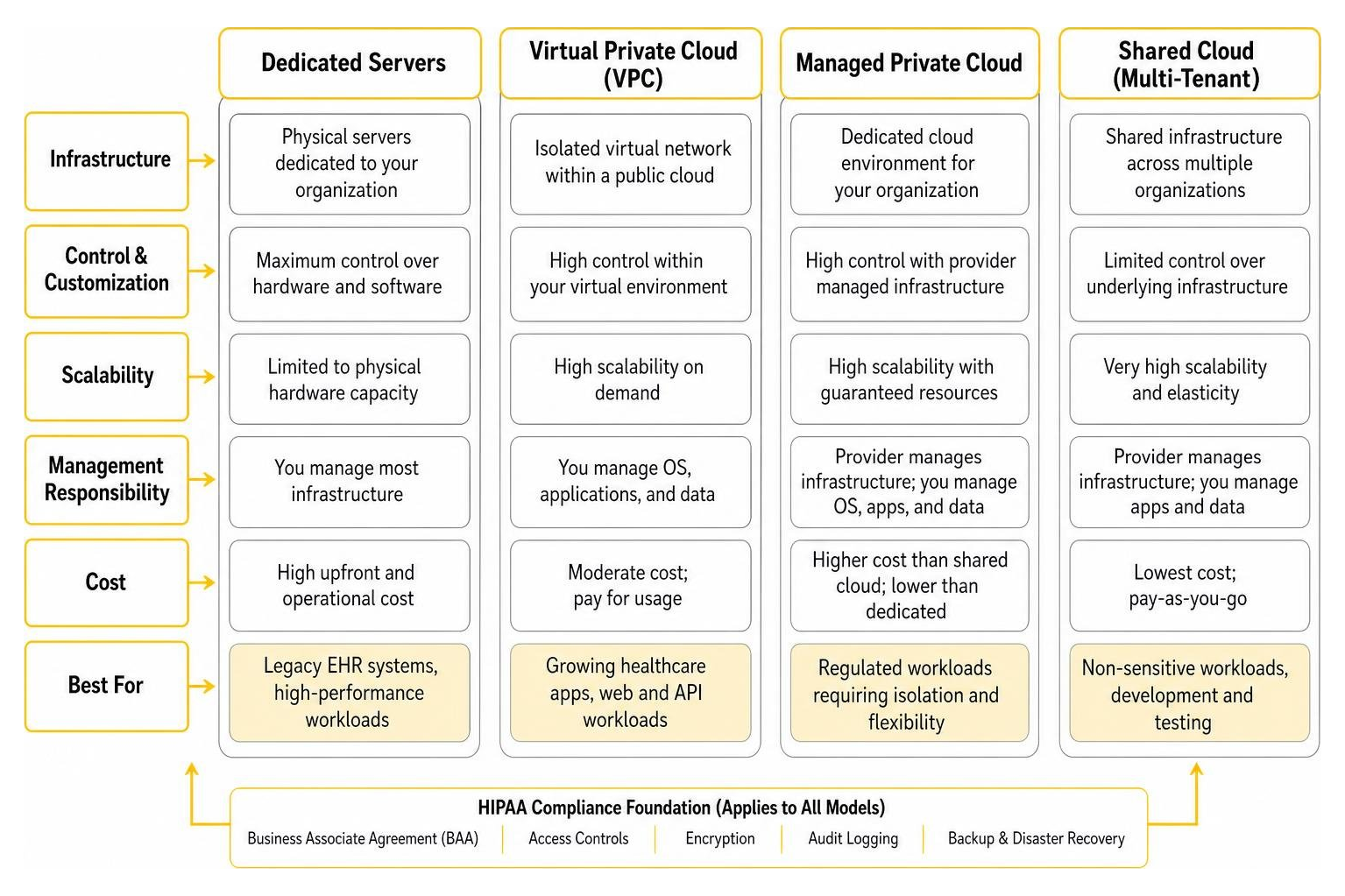
Understanding the trade-offs between control, cost, and management overhead is crucial when designing your deployment strategy.
Hosting Model Pros Cons Best For Dedicated Servers Complete hardware isolation, maximum performance control, highly secure. High cost, limited scalability, hardware maintenance overhead. Legacy EHR databases, high-throughput enterprise systems. Virtual Private Servers (VPS) Cost-effective, dedicated virtual resources, isolated environment. Shared physical hardware, limited scaling compared to public cloud. Small medical practices, medical marketing websites, simple patient portals. Public Cloud (AWS, Azure, GCP) Infinite scalability, massive global footprint, pay-as-you-go pricing. Complex configuration, high risk of misconfiguration, variable costs. High-growth digital health apps, telemedicine platforms, AI workloads. Managed PaaS (Platform-as-a-Service) Turnkey compliance, rapid deployment, zero server management. Vendor lock-in, higher base pricing, limited architectural flexibility. Fast-moving startup DevOps teams, custom healthcare APIs.
Public Cloud vs. Specialty HIPAA Hosts
A common dilemma for healthcare developers is choosing between major public clouds (like AWS, Microsoft Azure, and Google Cloud) and specialty, healthcare-focused hosts (such as Atlantic.Net, Liquid Web, or HIPAA Vault).
Major public clouds offer "HIPAA-eligible" services, but they operate on a strict Shared Responsibility Model. They will sign a BAA covering the physical infrastructure and hypervisor, but they leave the configuration of encryption, firewalls, and access controls entirely up to you.
On the other hand, specialty hosts often provide pre-configured, fully managed HIPAA environments out of the box. For instance, platforms like HIPAA Cloud Hosting | HIPAA Compliant Hosting and specialized managed environments such as HIPAA Web Hosting | Fully Managed HIPAA-Compliant Hosting or developer-centric options from Affordable HIPAA-Compliant Cloud Hosting & Storage arrive pre-hardened. They manage the operating system patching, firewalls, backups, and audit logs, which drastically reduces your internal DevOps burden.
Additionally, working with specialized providers can help you navigate geographic considerations, helping keep data close to home while adhering to state-specific regulations.
How to Choose the Right HIPAA Hosting Services for Your Practice
To choose the right hosting model and provider, we recommend analyzing your business through three lenses:
In-House Technical Expertise: Do you have dedicated DevOps engineers who understand cloud security, network segmentation, and identity management? If not, a fully managed specialty host or PaaS is almost always the safer, more compliant choice.
Scalability Needs: If your application experiences massive, unpredictable spikes in traffic (such as a rapidly growing telehealth platform), the auto-scaling capabilities of AWS or Azure are unmatched.
Total Cost of Ownership (TCO): Unmanaged public cloud services look cheap on paper, but when you factor in the cost of hiring specialized security engineers to maintain compliance, managed hosting often proves more cost-effective.
No matter which hosting model you choose, it must integrate seamlessly with your broader network architecture. Implementing robust Healthcare Network Security Solutions ensures that data moving between your on-premise clinic devices and your secure cloud host remains fully protected.
The Shared Responsibility Model and Ongoing Compliance
One of the most dangerous mistakes healthcare organizations make is assuming that because their hosting provider signed a BAA and is "HIPAA compliant," their entire application is automatically compliant.
This is simply not how compliance works. HIPAA compliance is always a shared responsibility.

The hosting provider is responsible for securing the physical data center, the virtualization layer, and potentially the operating system (if you choose a managed service).
However, you remain responsible for:
Application Security: Ensuring your code is free of vulnerabilities (like SQL injection or authentication bypasses).
User Access Management: Implementing strong password policies, enforcing multi-factor authentication (MFA), and immediately de-provisioning accounts when employees leave.
Data Classification: Ensuring that PHI is only stored in designated, encrypted database volumes and not leaked into unencrypted application logs.
Administrative Policies: Establishing employee training, incident response plans, and disaster recovery workflows.
To keep your team aligned with these ongoing requirements, we recommend reviewing our checklist on HIPAA Cybersecurity Best Practices and establishing a clear organizational Healthcare Cybersecurity HIPAA policy.
Verifying and Auditing Your HIPAA Hosting Services
Compliance is not a "set-it-and-forget-it" task. To maintain an audit-ready posture, you must continuously verify that your hosting provider—and your own configurations—remain secure.
We recommend implementing a continuous verification program that includes:
Automated Vulnerability Scanning: Weekly scans of your application and server infrastructure to identify out-of-date software, open ports, and misconfigurations.
Regular Penetration Testing: Annual, independent "ethical hacking" assessments to actively attempt to breach your hosting environment, revealing hidden security gaps.
Immutable Audit Log Reviews: Ensuring that all access logs are stored in a tamper-proof, write-once-read-many (WORM) storage system and retained for at least six years as required by HIPAA.
To systematically manage these assessments, we suggest integrating your hosting audits into a formal Network Security Audit Program to ensure no technical safeguards degrade over time.
Frequently Asked Questions About Secure Hosting
What is the difference between standard hosting and HIPAA-compliant hosting?
Standard hosting (like a basic shared hosting plan) lacks the isolation, advanced encryption, and auditing capabilities required to protect sensitive health data. Furthermore, standard hosting providers will not sign a Business Associate Agreement (BAA). HIPAA-compliant hosting provides dedicated or logically isolated environments, enforces AES-256 and TLS 1.3 encryption, maintains detailed access logs for up to 7 years, and includes a signed BAA. To learn more about securing your local workstations and connecting them to compliant hosts, read our guide on HIPAA Compliant Computer Security.
How much does HIPAA-compliant hosting typically cost?
While standard web hosting can cost as little as $10 to $20 per month, HIPAA-compliant hosting typically starts around $150 to $300 per month for basic, managed VPS configurations, and can easily scale to $1,000+ per month for dedicated servers, multi-region cloud environments, or highly managed PaaS solutions. The increased cost reflects the specialized security infrastructure, 24/7 monitoring, compliance documentation, and the legal liability assumed by the provider under the BAA.
Does a signed BAA guarantee complete HIPAA compliance?
No. A signed BAA only guarantees that the hosting provider agrees to protect the data at the infrastructure layer according to HIPAA standards. It does not protect you if your application code is insecure, if your staff shares passwords, or if you fail to appoint a designated HIPAA Compliance Officer to oversee your organization's administrative policies.
Conclusion
Finding the most secure hipaa hosting services is a critical milestone for any healthcare provider, digital health startup, or medical software developer. However, hosting is only one piece of the compliance puzzle. True security requires aligning your cloud infrastructure, local network, administrative policies, and employee habits into a single, cohesive defense system.
At Compliance Cybersecurity Solutions, based in Fort Lauderdale, Florida, we help healthcare organizations navigate this complexity. We align your IT systems with HIPAA, SOC 2, and other strict regulatory frameworks through custom-tailored security policies, multi-layered defense solutions, and 24/7 threat detection.
Let us handle the technical burden of compliance so you can focus on what matters most: delivering exceptional patient care. To get started, explore our Compliance and Cybersecurity Solutions and schedule a consultation with our team today.