

How to Run a Network Security Audit Program That Actually Works
Why Every Regulated Organization Needs a Network Security Audit Program
A network security audit program is a structured, repeatable process for evaluating your organization's IT infrastructure, policies, and controls to find vulnerabilities, fix gaps, and stay compliant with regulations like HIPAA, CMMC, and PCI DSS.
Here's what a solid program covers at a glance:
Component What It Does Scope Definition Identifies which systems, data, and networks are being audited Asset Inventory Catalogs all hardware, software, and endpoints Risk Assessment Finds and ranks threats by potential impact Vulnerability Scanning Detects known weaknesses across the network Penetration Testing Simulates real attacks to test your defenses Compliance Review Checks alignment with HIPAA, PCI DSS, NIST, etc. Remediation Tracking Ensures identified issues are actually fixed
The numbers make the stakes clear. Businesses face over 1,636 cyberattacks every single week. The average data breach now costs $4.88 million — an all-time high as of 2024. And in that same year, roughly 52,000 new security vulnerabilities were disclosed globally, up from 29,000 just a year before.
For organizations in healthcare, defense, or finance, those aren't abstract statistics. They're existential risks. A single undetected misconfiguration or weak password can expose patient records, classified contracts, or payment data — triggering regulatory penalties on top of breach costs.
That's exactly why a well-designed network security audit program isn't optional for regulated industries. It's the foundation of everything else.
I'm Michael Gaigelas II, and I've spent my career helping organizations in highly regulated industries build and execute network security audit programs that meet CMMC 2.0, ISO 27001, SOC 2, HIPAA, and FTC compliance requirements — without unnecessary costs or delays. In the guide below, I'll walk you through exactly how to build and run one that actually protects your organization.
The Core Components of a Network Security Audit Program
When we talk about a network security audit program, we aren't just talking about a one-time "check-the-box" activity. We are talking about a comprehensive strategy designed to identify vulnerabilities, validate security controls, and verify that your organization is meeting its legal and ethical obligations.

Audit Objectives
The first step in any successful program is knowing what you want to achieve. Are you trying to find technical holes? Are you preparing for a Compliance audit like HIPAA or CMMC? Or are you testing how well your team responds to a simulated breach? Setting specific, measurable objectives ensures that your resources are spent where they matter most.
Risk Assessment
Not all vulnerabilities are created equal. A risk assessment analyzes potential threats—such as malware, phishing, or even insider risks—and calculates the impact they would have on your business. This allows us to prioritize remediation. If a server holds public marketing materials, it’s a lower priority than the database holding your customers' encrypted social security numbers.
Asset Inventory
You cannot protect what you do not know exists. A robust asset inventory is the "source of truth" for your audit. This includes:
Hardware: Servers, workstations, mobile devices, and IoT sensors.
Software: Operating systems, applications, and third-party plugins.
Cloud Resources: Instances in AWS, Azure, or Google Cloud.
Network Devices: Firewalls, switches, and routers.
In Florida, educational institutions like the College of Central Florida offer Network Security Certificates that emphasize the importance of these foundational elements. Knowing your network map is the prerequisite for securing it.
Regulatory Alignment
For our clients in South Florida and beyond, staying aligned with frameworks like NIST or ISO 27001 is critical. These frameworks provide the "blueprints" for what a secure network should look like. During an audit, we compare your current state against these standards to see where the gaps lie.
Internal vs. External Auditors
Who should do the work? Internal teams have deep knowledge of the daily operations, but they might suffer from "tunnel vision." External auditors bring an unbiased, third-party perspective and often hold specialized certifications like CISSP or CISM. A healthy program often uses a mix of both: internal teams for continuous checks and external experts for deep-dive annual reviews.
Leveraging AI in Your Network Security Audit Program
The traditional "once a year" audit is becoming a relic of the past. Why? Because hackers don't wait twelve months to find a hole in your fence. This is where Artificial Intelligence (AI) is changing the game.
According to research published in the International Journal of Research Publication and Reviews (2025), AI-enhanced cybersecurity methods show higher performance metrics than traditional approaches. Specifically, AI can improve threat detection speeds from weeks or months down to mere minutes or hours. Accuracy also jumps from a standard 70-80% to an impressive 90-95%.
AI helps your network security audit program by:
Pattern Recognition: Identifying "strange" behavior that a human might miss, such as a user logging in from two different countries at the same time.
Predictive Analytics: Forecasting which systems are most likely to be targeted based on global threat trends.
Automation: Handling the repetitive tasks of scanning thousands of endpoints, freeing up your IT team to focus on complex problem-solving.
Natural Language Processing (NLP): AI can actually "read" your written security policies and compare them against your actual technical configurations to find discrepancies instantly.
Best Practices for Your Network Security Audit Program
To make your program truly effective, you need to look beyond the software and hardware.
Stakeholder Involvement: Security isn't just an "IT thing." It involves leadership, legal, and HR. When the C-suite understands the risks, budget for remediation becomes much easier to secure.
Continuous Monitoring: Instead of a "snapshot" audit, move toward continuous monitoring. Tools like SIEM (Security Information and Event Management) and EDR (Endpoint Detection and Response) provide real-time visibility into your Cybersecurity posture.
Incident Response Planning: An audit will inevitably find things that could go wrong. You need a plan for when they do. This includes identifying stakeholders, testing communication channels, and running "tabletop exercises" to practice your response.
Employee Training: The most expensive firewall in the world can't stop an employee from clicking a bad link. Regular training is essential. Programs like the UWF Florida Cybersecurity Training Program are great resources for building a more "cyber-aware" workforce.
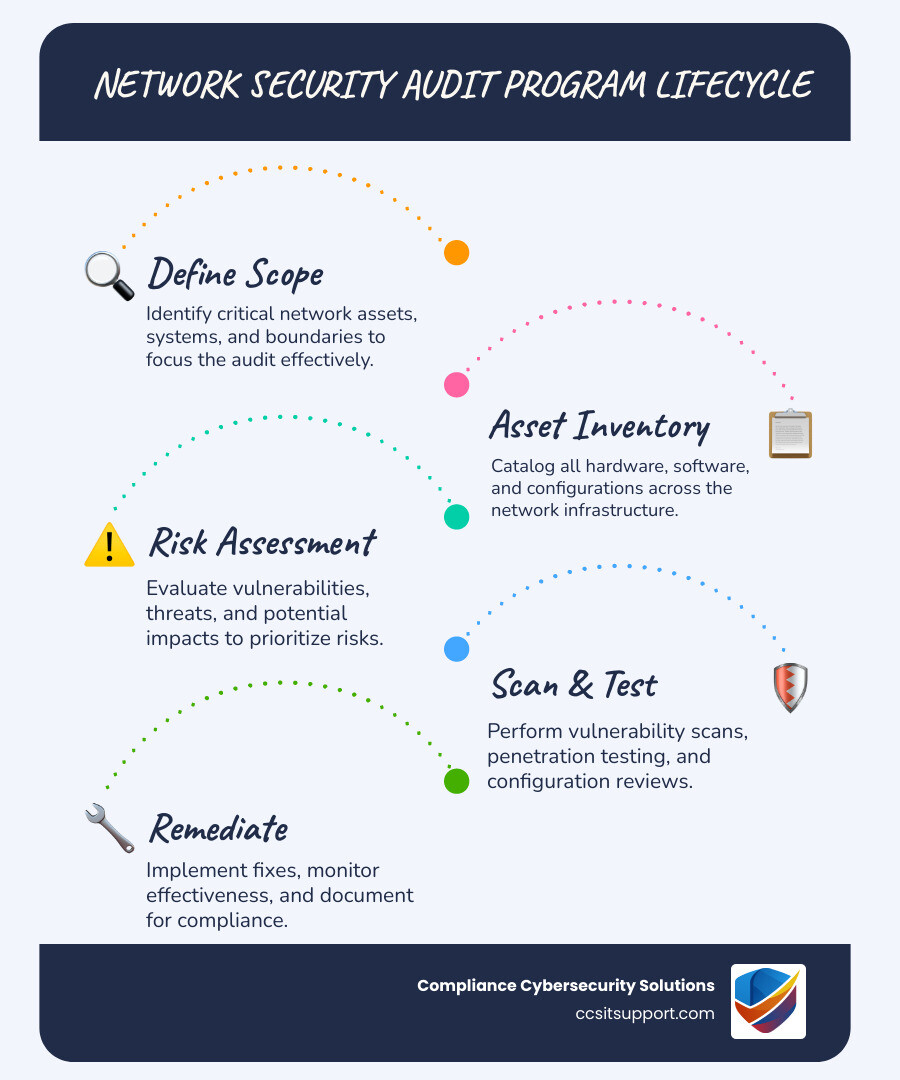
A 5-Step Framework for Executing the Audit
If you’re feeling overwhelmed by the technical jargon, don't worry. We like to break the execution of a network security audit program into five manageable steps.
1. Scope Definition
We start by drawing a circle around what we are auditing. Does this include remote workers? Does it include your cloud-based CRM? By aligning the scope with your budget and specific industry regulations (like HIPAA for healthcare), we ensure the audit is both thorough and cost-effective.
2. Documentation Gathering
We "collect the evidence." This involves gathering network diagrams, lists of all security software, hardware inventories, and previous audit reports. The NIST Program Review for Information Security Assistance provides excellent guidelines on what kind of evidence agencies and organizations should maintain to prove their security maturity.
3. Policy Review
We read your "rulebook." We look at your password policies, your remote access rules, and your data handling procedures. Are they up to date? Do they reflect the current threat landscape? If your policy says "passwords must be 8 characters" but modern tools can crack those in seconds, it’s time for an update.
4. Vulnerability Scanning & Penetration Testing
This is the "active" phase.
Vulnerability Scanning: We use automated tools to find known bugs and unpatched software.
Penetration Testing: We put on our "white hat" and try to break in. This mimics a real-world attack in four stages: reconnaissance, scanning, exploitation, and post-exploitation. It’s the ultimate "stress test" for your network.
5. Remediation Tracking
The audit isn't over when the report is finished. The most important part is the "fix-it" list. We prioritize findings based on risk and track the progress of patches, configuration changes, and policy updates until the network is truly secure.
Technical Controls and Compliance Standards
At the heart of your network security audit program are the technical controls that actually stop the bad guys.
Feature Periodic Auditing Continuous Auditing Frequency Annual or Quarterly Real-time / 24/7 Visibility Snapshot in time Constant stream of data Response Reactive (finds old issues) Proactive (finds new issues) Accuracy High (human-led) Very High (AI-enhanced)
Key Controls to Review:
Firewall Configuration: We look for "permissive" rules that allow too much traffic or "stale" rules left over from old employees or projects.
Role-Based Access Control (RBAC): Does the intern have access to the payroll server? If so, we have a problem. Users should only have the minimum access necessary to do their jobs.
Multi-Factor Authentication (MFA): This is no longer optional. We verify that MFA is enforced for all remote access and privileged accounts.
Encryption: We check that data is encrypted both "at rest" (on the hard drive) and "in transit" (moving across the internet) using modern standards like TLS 1.3.
Whether you are dealing with GDPR, HIPAA, PCI DSS, or NIST frameworks, these technical controls are the common denominator. You can find more detailed Resources on these specific standards on our site.
Overcoming Common Audit Challenges
Running a network security audit program isn't always smooth sailing. Organizations often run into hurdles that can stall progress.
Asset Visibility and Shadow IT
"Shadow IT" refers to apps or hardware employees use without telling the IT department (think of a manager using a personal Dropbox account to store sensitive files). These create blind spots. A thorough audit must use discovery tools to find these hidden assets.
Legacy Systems
Old hardware or software that can no longer be patched is a major risk. We often find these in manufacturing or healthcare settings (OT - Operational Technology). The challenge is securing these systems without breaking the critical processes they support. Sometimes the answer is "network segmentation"—putting the old machine in a digital "bubble" where it can't talk to the rest of the network.
IT-OT Convergence
In Florida’s industrial sectors, the line between IT (computers) and OT (machinery) is blurring. Auditing a network that controls a power grid or a water treatment plant requires a specialized touch. We recommend building strong relationships between these two departments—sometimes a simple "pizza party" to get the teams talking can do wonders for security!
Resource Allocation
Audits take time and money. Smaller organizations often struggle to find the "manpower" to conduct deep-dive reviews. This is why many choose to pursue a Network Security Certificate for their staff or partner with external experts to handle the heavy lifting.
Frequently Asked Questions about Network Security Audits
Who should conduct a network security audit?
It depends on your goals. Internal teams are great for monthly "health checks." However, for compliance-heavy industries, we strongly recommend external auditors. They provide an objective view and carry certifications like CISSP (Certified Information Systems Security Professional) or CISM (Certified Information Security Manager), which are often required for official compliance filings.
How often should an organization perform an audit?
While many regulations mandate an annual audit, the modern threat landscape suggests a "continuous" approach is better. At a minimum, you should perform a full audit once a year or whenever you make a major change to your network (like moving to the cloud or opening a new office).
What are the most common vulnerabilities found during audits?
We see the same "usual suspects" time and again:
Misconfigured Firewalls: Rules that are too broad or "any-to-any" connections.
Weak Passwords: Using "Password123" or failing to change default manufacturer passwords on new devices.
Unpatched Software: Running old versions of Windows or third-party apps with known vulnerabilities.
Inadequate Encryption: Sending sensitive data over the internet in plain text.
Social Engineering: Employees who aren't trained to spot phishing attempts.
Conclusion
A network security audit program is not a "one and done" project; it is a commitment to continuous improvement. By systematically identifying risks, leveraging modern tools like AI, and following a structured framework, you can turn your network from a liability into a fortress.
At Compliance Cybersecurity Solutions, we specialize in helping organizations in Florida and beyond navigate the complexities of IT security and regulatory compliance. Whether you need help setting up your first audit or want a third-party team to stress-test your existing defenses, we are here to help.
If you're ready to move from "hoping you're secure" to "knowing you're secure," visit our Support Center or Secure your network today. Let's build a program that actually works for you.