

How to Secure Your Defense Contracts with Fort Lauderdale CMMC Services
Why Fort Lauderdale CMMC Services Are Now Critical for DoD Contractors
Fort Lauderdale CMMC services are the fastest path to achieving and maintaining the Cybersecurity Maturity Model Certification (CMMC) required to win or keep Department of Defense (DoD) contracts in 2026.
Here is what you need to know right away:
What CMMC is: A mandatory DoD cybersecurity framework that protects Federal Contract Information (FCI) and Controlled Unclassified Information (CUI)
Who needs it: Any business — prime contractor or subcontractor — that handles FCI or CUI on DoD contracts
Three certification levels: Level 1 (Foundational), Level 2 (Advanced), Level 3 (Expert)
The stakes: Non-compliance means losing eligibility to bid on DoD contracts entirely
The scale: CMMC is projected to impact approximately 450,000 organizations globally
The financial driver: The DoD was losing an estimated $600 billion annually from data exfiltration and R&D theft before CMMC was implemented
South Florida has a thriving defense supply chain — from aerospace manufacturers in Pembroke Pines to maritime defense contractors at Port Everglades. For businesses in this ecosystem, CMMC compliance is no longer a future concern. The CMMC final rule took effect on December 16, 2024, and the clock is running.
The challenge most defense contractors face is real: compliance is complex, the penalties for failure are severe, and the technical requirements are demanding. CMMC Level 2 alone requires implementing all 110 security controls from NIST SP 800-171. Getting this wrong — even after months of preparation — can mean a failed audit and lost contracts.
I'm Michael Gaigelas II, founder of Compliance Cybersecurity Solutions, with deep expertise guiding defense contractors through CMMC 2.0 compliance, gap assessments, and remediation across South Florida. I built this guide specifically to help Fort Lauderdale businesses navigate Fort Lauderdale CMMC services with clarity and confidence, so you spend less time guessing and more time winning contracts.
Understanding CMMC 2.0 and Its Impact on South Florida Contractors
The Cybersecurity Maturity Model Certification (CMMC) 2.0 framework represents a major shift in how the Department of Defense enforces cybersecurity standards. Previously, contractors could self-attest to their compliance with little oversight, which unfortunately allowed critical gaps to remain unaddressed. Today, the DoD relies on CMMC as an active verification mechanism managed in coordination with the CyberAB (the official CMMC Accreditation Body). For official program information, contractors can also review the DoD's Cybersecurity Maturity Model Certification overview.
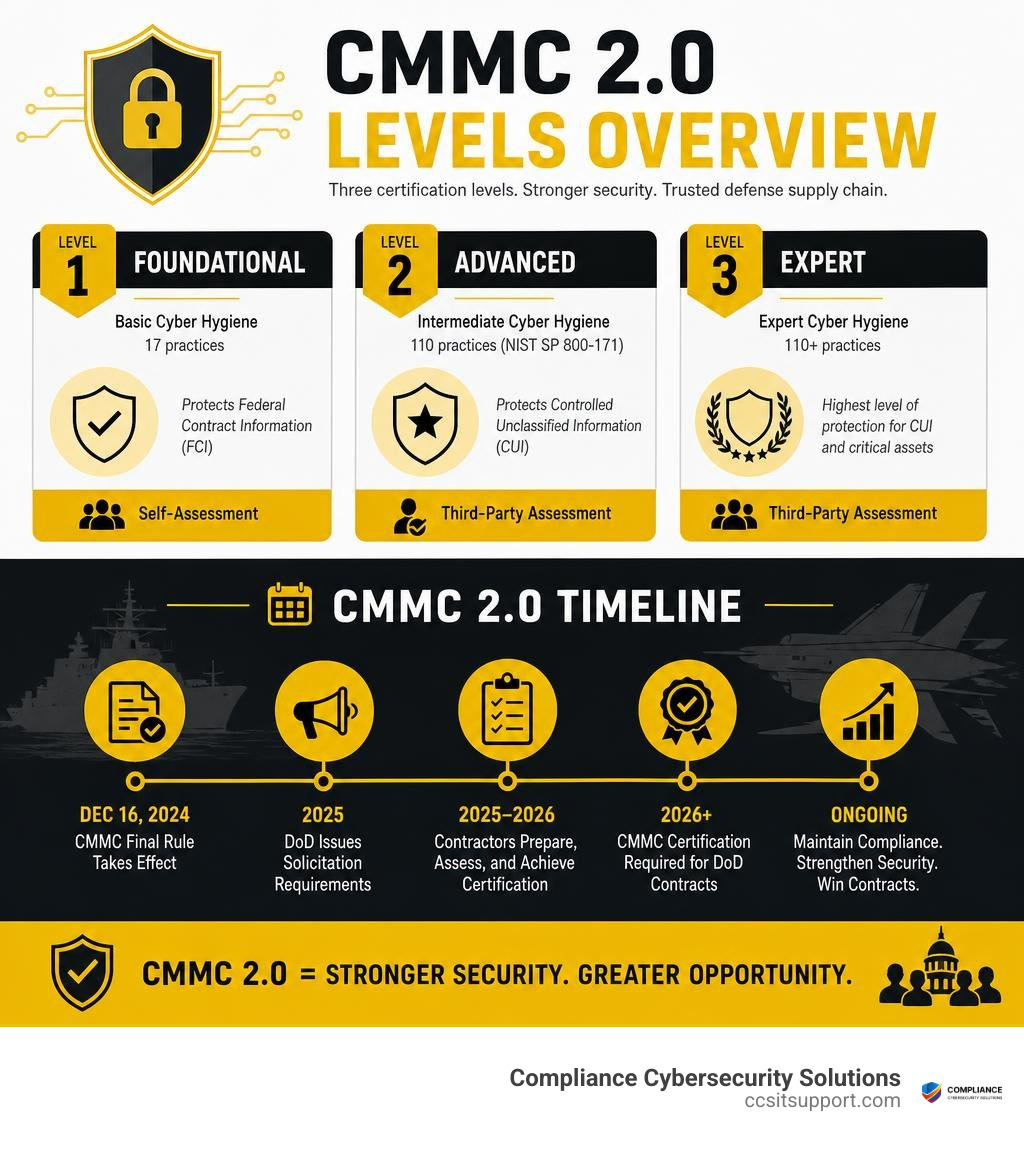
Under CMMC 2.0, the framework is streamlined into three distinct levels designed to protect different tiers of sensitive military data:
CMMC 2.0 Level Focus Security Requirements Assessment Method Level 1 (Foundational) Federal Contract Information (FCI) 17 basic controls (NIST SP 800-171) Annual self-assessment & affirmation Level 2 (Advanced) Controlled Unclassified Information (CUI) 110 controls (NIST SP 800-171) Triennial C3PAO audit (for most) or self-assessment Level 3 (Expert) Controlled Unclassified Information (CUI) 110+ controls (NIST SP 800-171 & 172) Triennial government-led assessment
The implementation of CMMC 2.0 is tied directly to contract awards. When a DoD request for proposal (RFP) contains the DFARS 252.204-7021 clause, you must hold the specified certification level at the time of award. The CMMC Final Rule established the official timelines, making it impossible to "fumble your way" through an audit last-minute.
Furthermore, contractors must submit their self-assessment scores and annual affirmation statements directly into the Supplier Performance Risk System (SPRS). Failing to report accurate scores or falsely claiming compliance exposes your company to extreme legal risks under the False Claims Act, which federal prosecutors actively use to penalize dishonest contractors.
Determining Which Level of Fort Lauderdale CMMC Services Your Business Needs
To choose the right Fort Lauderdale CMMC services for your business, you must first identify the type of data you handle:
Federal Contract Information (FCI): This is non-public information provided by or generated for the government under a contract to develop or deliver a product or service. If your systems only touch FCI, you need Level 1 (Foundational) compliance.
Controlled Unclassified Information (CUI): This is sensitive information that requires safeguarding or dissemination controls consistent with laws, regulations, and government-wide policies (e.g., blueprints, military schematics, or proprietary aerospace research). If you store, transmit, or process CUI, you must achieve Level 2 (Advanced) compliance.
High-Value Assets (Level 3): This level is reserved for major defense programs targeted by advanced persistent threats (APTs) and requires compliance with NIST SP 800-172.
If you are unsure where your data falls, our local team can help you map your data flow and pinpoint exactly where CUI resides in your network.
The Core Requirements: NIST SP 800-171 and the 110 Security Controls
For the vast majority of defense subcontractors in Fort Lauderdale, CMMC Level 2 is the target. This level is completely aligned with the NIST SP 800-171 standard, which outlines 110 security controls across 14 distinct families. These families cover everything from physical security to incident response and access control.
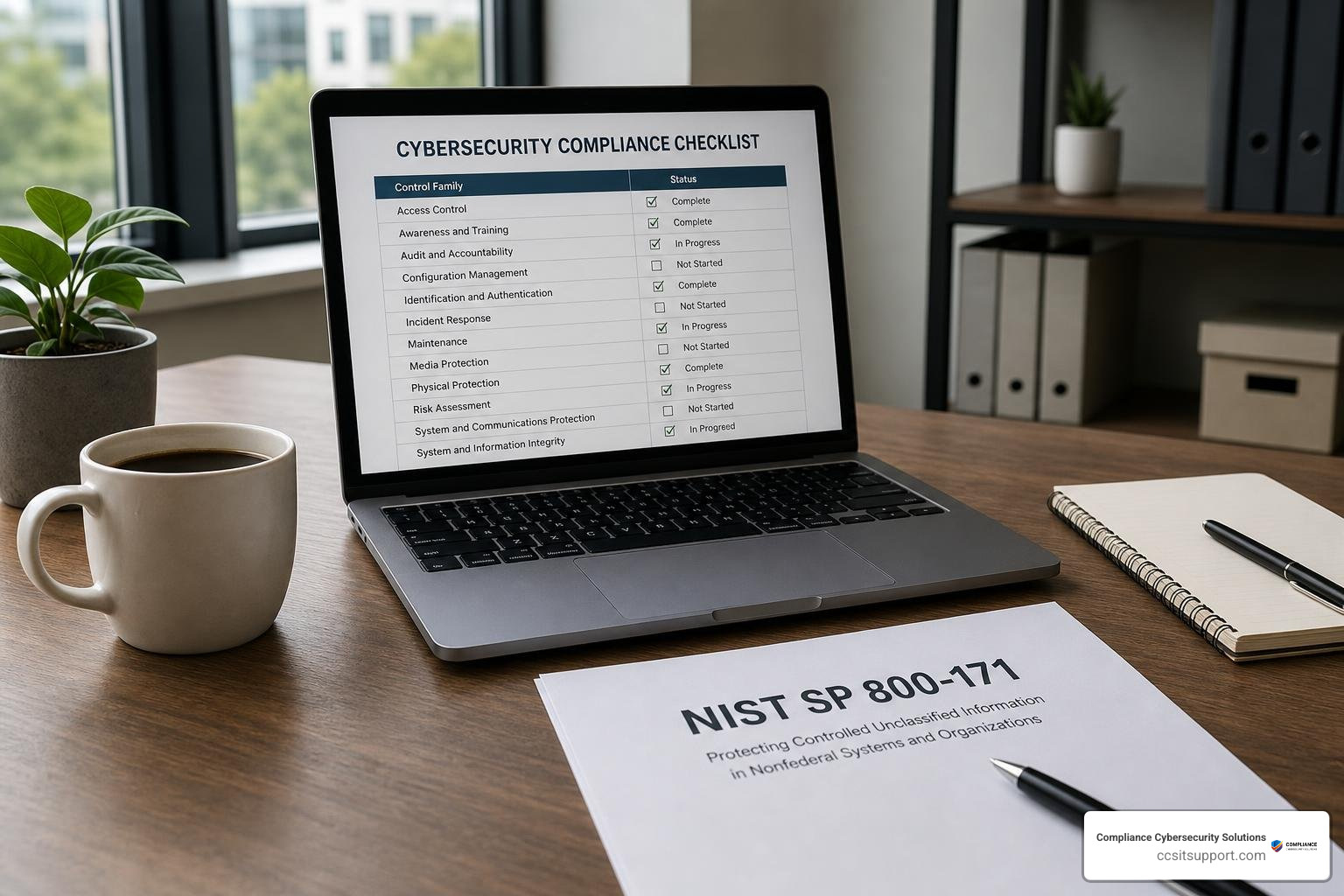
Achieving compliance is not just about installing software; it is about documenting how your business operates. The two most critical documents you will need to produce are:
System Security Plan (SSP): This document serves as the foundation of your compliance. It details the boundaries of your in-scope environment, identifies all hardware and software handling CUI, and explains exactly how each of the 110 NIST SP 800-171 controls is implemented.
Plan of Action & Milestones (POA&M): If you fall short on certain controls during preparation, you must document these deficiencies in a POA&M, detailing how and when you will remediate them. Under CMMC 2.0, only certain non-critical controls can be on a POA&M at the time of assessment, and they must be resolved within 180 days.
To ensure your documentation is audit-ready, you can leverage our structured IT Compliance Consulting services. We also recommend undergoing a comprehensive Network Security Audit Program to verify that your technical controls match what is written in your SSP.
Aligning Your Infrastructure with Fort Lauderdale CMMC Services
To meet the strict standards of NIST SP 800-171, your local IT infrastructure must be hardened. Some of the most common technical requirements include:
Access Control: Restricting system access to authorized users and processes.
Multi-Factor Authentication (MFA): Enforcing MFA for both local and network access to systems containing CUI.
Incident Response: Establishing active monitoring and reporting mechanisms to flag anomalies.
We help contractors deploy Multi-Layered Security Solutions that satisfy these requirements without disrupting daily operations. Additionally, we assist in drafting customized policies based on a Sample Cyber Security Policy to ensure your employees understand their security responsibilities.
Step-by-Step Process to Achieve and Maintain CMMC Certification
Achieving CMMC certification is a journey that requires careful planning, remediation, and verification. We break down this process into a clear, manageable roadmap:
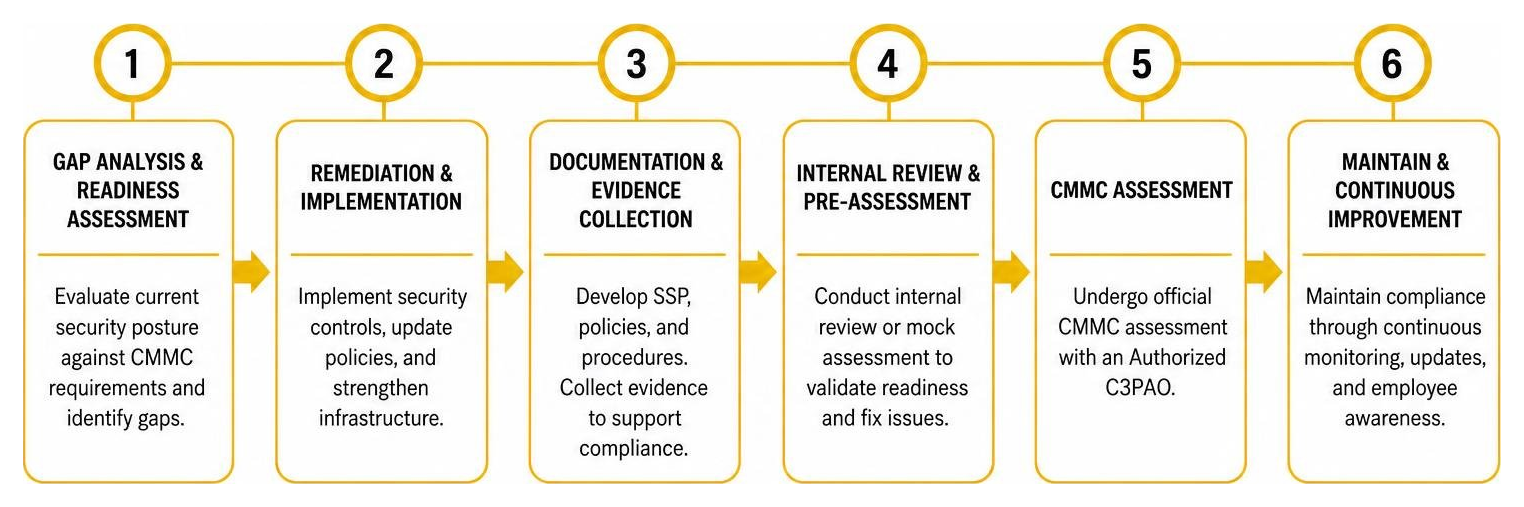
Step 1: Gap Analysis & Readiness Assessment
Before making any major changes, you must establish a baseline. A gap analysis identifies where your current security posture falls short of the target CMMC level. We evaluate your network, physical security, and corporate policies to build a comprehensive gap report.
To kickstart this phase, local businesses can utilize our structured CMMC Readiness Assessment Florida program to map out a clear remediation path.
Step 2: Technical and Policy Remediation
Once the gaps are identified, the work of fixing them begins. This is where we implement necessary hardware and software upgrades, configure secure cloud environments (such as Microsoft GCC High), and draft operational policies.
Step 3: Mock Audits & Pre-Assessment
Before inviting an external auditor, we conduct a mock audit. This simulates the actual assessment process, ensuring your team can answer auditor questions and produce the necessary "artifacts" (evidence of compliance like log files and configuration screenshots).
Step 4: C3PAO Third-Party Assessment
For Level 2 contracts requiring third-party verification, you will hire an authorized Certified Third-Party Assessment Organization (C3PAO). They will audit your environment, review your SSP, and verify that all 110 controls are fully operational.
Step 5: SPRS Affirmation
After a successful audit, your certification results are uploaded to the SPRS database. An executive from your company must then submit an annual affirmation statement confirming that compliance is being actively maintained.
Ongoing Maintenance and Threat Detection Post-Certification
CMMC is not a "one-and-done" certification. Your CMMC certification is valid for three years, but you must submit annual affirmation statements in SPRS, and your business is subject to continuous monitoring.
To maintain compliance, you must have active threat detection systems in place. Our Managed Threat Detection Service provides 24/7/365 monitoring to catch and isolate security anomalies before they result in a data breach. Furthermore, having robust Threat Detection and Incident Response Services for Businesses guarantees that if an incident does occur, it is contained and documented according to strict federal reporting guidelines.
Why Local Expertise Matters for Fort Lauderdale CMMC Services
When it comes to federal compliance, working with a remote, "one-size-fits-all" IT firm can lead to critical misunderstandings. Fort Lauderdale has a unique defense ecosystem with distinct operational challenges.

Whether you are a maritime defense contractor operating near Port Everglades or an aerospace supplier in Pembroke Pines, having local compliance experts on the ground is invaluable. We understand the local business landscape and can provide on-site technical support to secure your physical facilities—such as verifying access control systems, locking down server rooms, and training local staff.
Partnering with us ensures you get dedicated, hands-on Small Business Cyber Security Consulting tailored directly to Broward County's defense supply chain. We help you navigate the complexities of these audits and ensure your systems are fully prepared.
The Risks of a DIY Approach to CMMC Compliance
Some business owners attempt to handle CMMC compliance in-house to save money. However, this DIY approach carries massive financial and operational risks:
Failing the Audit: If a C3PAO auditor finds even a single critical control missing or poorly documented, you will fail the audit. This can delay your certification, causing you to lose out on active contract bids.
Wasted Budget: The total cost of CMMC is divided into preparation, remediation, and the actual audit. If you buy the wrong security tools during remediation because you misunderstood the requirements, you will have to pay to replace them later.
Legal Consequences: Falsely self-attesting to compliance in SPRS without proper verification can trigger False Claims Act investigations, leading to devastating federal fines.
By leveraging expert Finance IT Compliance Consulting, you can accurately budget for CMMC and ensure your compliance investments are targeted, efficient, and audit-proof.
Frequently Asked Questions About CMMC Compliance
What are the consequences of failing to achieve CMMC compliance?
If your business fails to achieve the required CMMC level, you will be disqualified from bidding on or participating in any DoD contracts that feature the DFARS 252.204-7021 clause. This applies to both prime contractors and subcontractors. Additionally, misrepresenting your compliance status on SPRS can lead to severe fines and exclusion from federal contracting under the False Claims Act.
How long does it take to prepare for a CMMC Level 2 audit?
For most small to mid-sized contractors, the preparation process takes between 6 to 12 months. This timeline depends heavily on your starting cybersecurity maturity, the complexity of your network, and how quickly you can implement technical controls and document your System Security Plan (SSP).
Can the same firm consult on readiness and perform the final certification audit?
No. Under strict CMMC independence requirements, a single organization cannot provide both readiness consulting/remediation services and perform your official C3PAO certification assessment. This clear separation of duties prevents conflicts of interest. You should work with a trusted local consultant like us to prepare, and then hire an independent C3PAO to conduct the final audit.
Conclusion
Securing your defense contracts in 2026 requires a proactive approach to cybersecurity. With the CMMC framework fully active, Fort Lauderdale defense contractors cannot afford to wait.
At Compliance Cybersecurity Solutions (CCS), we are committed to helping South Florida businesses navigate the complexities of CMMC compliance. We align your IT infrastructure with NIST SP 800-171, build your SSP, train your staff, and prepare your business to pass your audit on the very first try.
Don't risk losing your valuable DoD contracts to a failed compliance check. Get Started with CCS Cybersecurity Solutions today, and let us help you secure your business and your future federal revenue.