
Why a Managed Threat Detection Service is Your Best Defense
The Cyber Threat Landscape Is Outpacing Traditional Defenses
A managed threat detection service is one of the most effective ways organizations in healthcare, defense, and finance can outsource their security monitoring and response — without sacrificing control or visibility.
Here's what it gives you at a glance:
24/7 monitoring — threats are tracked around the clock, every day of the year
Expert human analysis — real analysts investigate alerts, not just automated rules
Active threat response — threats are contained, not just reported
Proactive threat hunting — experts search for hidden threats before damage occurs
Compliance support — helps meet HIPAA, CMMC, and other regulatory requirements
No new hires needed — you get a full security team without the recruiting headache
Today's cyberattacks are faster, smarter, and harder to spot than ever before. Ransomware, disguised phishing, and multi-surface intrusions can move from initial access to full breach in under 60 minutes. Meanwhile, most organizations in regulated industries are stretched thin — short on security staff, overwhelmed by alerts, and under pressure to pass audits.
Traditional monitoring tools and basic managed services weren't built for this environment. They alert you after something goes wrong. That's too late.
A managed threat detection service flips the script — hunting threats before they escalate, containing them fast, and keeping your security posture audit-ready.
I'm Michael Gaigelas II, founder of Compliance Cybersecurity Solutions, where I've helped healthcare, defense, and finance organizations implement managed threat detection service strategies that align with CMMC 2.0, HIPAA, and SOC 2 requirements — while cutting unnecessary security overhead. In the sections ahead, I'll walk you through everything you need to know to make the right decision for your organization.
Understanding the Managed Threat Detection Service
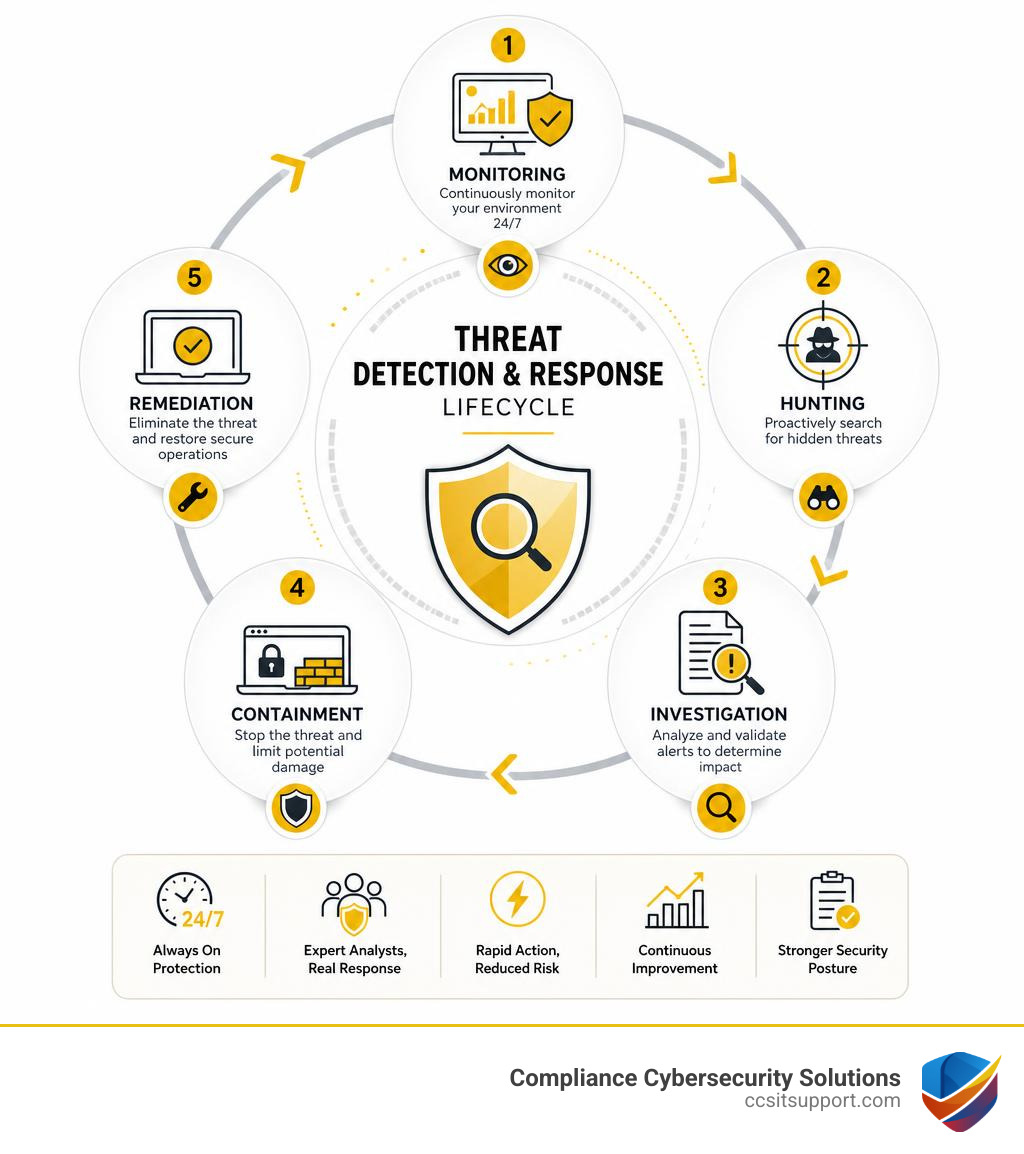
At its core, a managed threat detection service (MTDS) is a comprehensive, outsourced cybersecurity solution that combines advanced security technologies with human expertise. Instead of relying solely on software that flashes red when something goes wrong, an MTDS puts a dedicated team of security analysts in your corner. This team continuously monitors your IT environment, hunts for anomalies, and takes rapid action to neutralize threats before they can disrupt your operations.
In modern cybersecurity, relying on automated alerts is like installing a security camera but never hiring a guard to watch the feed. The camera might record the break-in, but it won’t stop the intruder from walking out with your data. An MTDS acts as both the high-tech camera and the elite security guard, providing active protection around the clock.
By implementing Threat Detection and Incident Response Services for Businesses, organizations can shift from a reactive "break-fix" security posture to a proactive defense strategy. This approach is particularly vital for highly regulated sectors in Florida, where data breaches carry heavy financial penalties and reputational damage.
Core Components of a Managed Threat Detection Service
An effective managed threat detection service is built on four core pillars:
24/7/365 Continuous Monitoring: Cybercriminals do not work standard 9-to-5 business hours. In fact, many attacks are launched late on Friday nights or during holidays to exploit skeleton IT crews. Continuous monitoring ensures your endpoints, networks, and cloud environments are watched every second of every day.
Proactive Threat Hunting: Automated tools only look for known threats (known as "signatures"). Elite threat hunters, however, search for the subtle, quiet anomalies that indicate a sophisticated attacker is already inside your network, attempting to bypass traditional defenses.
Rapid Incident Response: When a threat is validated, the service doesn't just send you an email. The analysts take immediate, remote mitigative actions—such as isolating an infected endpoint or disabling a compromised user account—to contain the blast radius.
Comprehensive Telemetry Analysis: To get a clear picture of your security health, an MTDS ingests and analyzes vast amounts of data (telemetry) from across your entire infrastructure, including email servers, cloud applications, networks, and endpoints.
How MTDS Differs from Traditional MSSPs
Many business owners confuse Managed Security Service Providers (MSSPs) with managed threat detection services. While they sound similar, their approaches to security are fundamentally different.
Traditional MSSPs focus primarily on the operational management of security devices. They will configure your firewalls, manage your virtual private networks (VPNs), and aggregate your log data. If a security event occurs, an MSSP's standard procedure is to send an automated alert to your internal IT team. This often leads to "alert fatigue," leaving your internal staff to figure out whether the alert is a real threat or a false positive.
In contrast, a managed threat detection service focuses on active threat disruption and containment. Instead of simply forwarding alerts, an MTDS analyzes the telemetry, validates the threat, and executes remote response actions.
Our specialized CCS Cybersecurity Services are designed to bridge this gap, ensuring that you don't just receive more noise, but rather clear outcomes: verified threats neutralized and documented for compliance.
How Managed Threat Detection Works
To understand the value of an MTDS, it helps to look under the hood at how the operational workflow actually handles a potential breach.
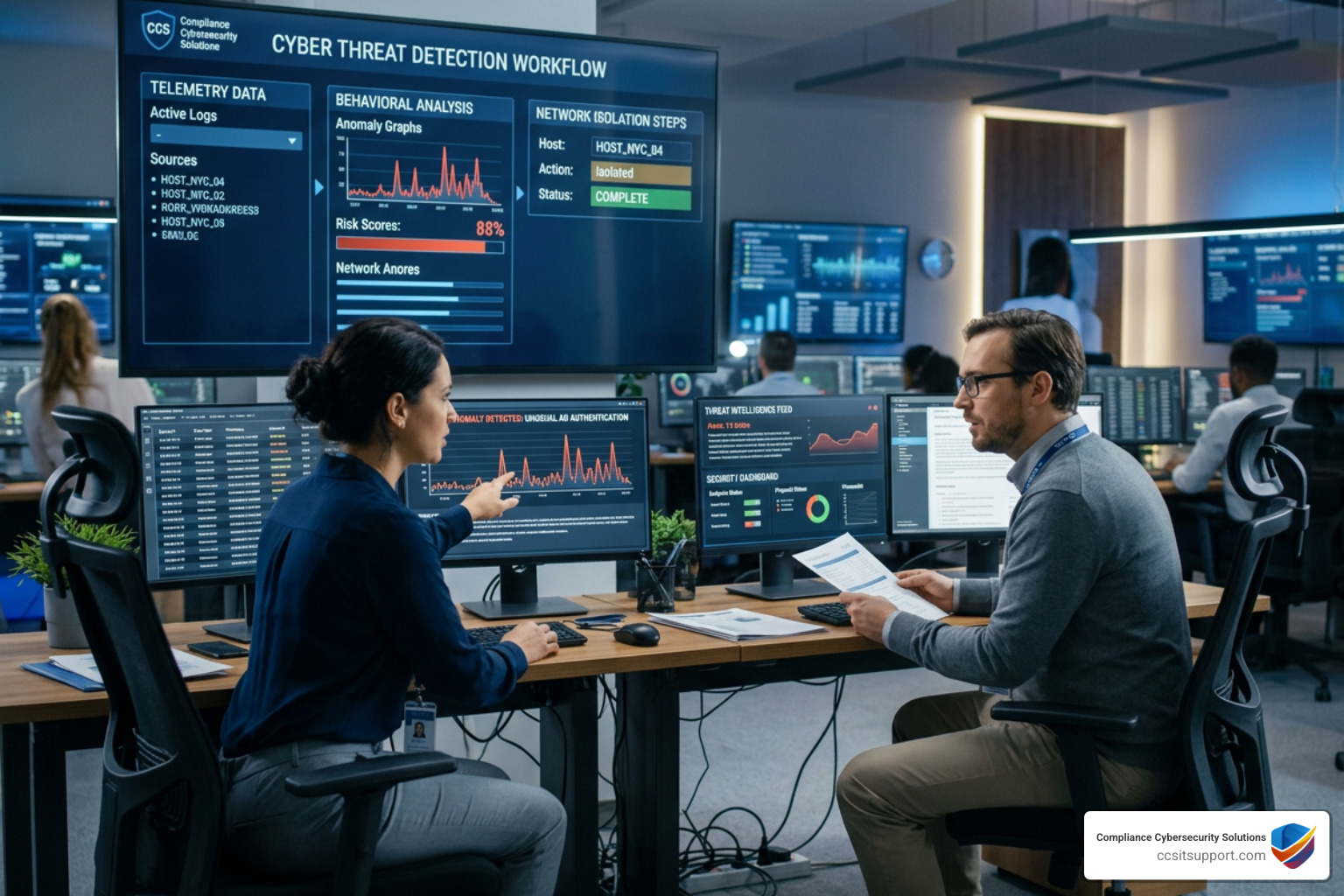
The process begins with data ingestion. Telemetry from your endpoints, cloud services, and network devices is continuously streamed to a centralized analysis platform.
Once the data is ingested, advanced analytics and machine learning algorithms filter out the normal, day-to-day background noise of your business. When an anomaly is detected—such as a user logging in from Fort Lauderdale and then, two minutes later, attempting to access database files from an IP address halfway across the world—the system flags it.
This is where human expertise takes over. A security analyst immediately investigates the flag, pulling in contextual data to determine if the activity is malicious. If a threat is confirmed, the analyst initiates active containment. By isolating the affected host from the rest of the network, the analyst stops the lateral movement of the attack.
Finally, once the immediate threat is neutralized, a thorough root cause analysis is conducted. This step ensures we understand exactly how the attacker got in, allowing us to patch the vulnerability and prevent a repeat performance.
The Role of the Security Operations Center (SOC)
The beating heart of any managed threat detection service is the Security Operations Center (SOC). A SOC is a centralized facility staffed by cybersecurity professionals who work in shifts to provide uninterrupted coverage.
Building an in-house SOC is incredibly expensive, often costing hundreds of thousands of dollars annually in software licensing, hardware, and analyst salaries. Partnering with a managed threat detection provider gives you instant access to a fully functioning, enterprise-grade SOC without the massive capital expenditure.
Our team at CCS provides these exact Cybersecurity services, acting as an extension of your business to handle the heavy lifting of triage, analysis, and escalation.
The Technology Stack and Threat Intelligence
To stay ahead of modern adversaries, a managed threat detection service utilizes a highly integrated technology stack. This stack typically includes:
Endpoint Detection and Response (EDR): Software installed on laptops, servers, and mobile devices to monitor activity at the source.
Security Information and Event Management (SIEM): A centralized platform that collects and correlates log data from across the entire IT environment.
Network Intrusion Detection System (NIDS): Tools designed to monitor network traffic for signs of unauthorized access or malicious patterns. Implementing a robust Network Intrusion Detection System ensures that even if an attacker bypasses endpoint defenses, their network footprint will be spotted.
Furthermore, this technology stack is supercharged by global threat intelligence. By integrating feeds like Google Threat Intelligence, our analysts gain real-time visibility into the latest tactics, techniques, and procedures (TTPs) used by threat actors worldwide. This intelligence allows us to update our detection rules instantly, protecting your business from zero-day exploits before they reach your network.
Comparing Managed Threat Detection to Other Security Solutions
With so many acronyms in the cybersecurity space, it’s easy to get lost. Let’s break down how a managed threat detection service compares to other common security solutions in 2026.
Feature / Capability Managed Threat Detection Service (MTDS) Managed Detection & Response (MDR) Traditional MSSP Standalone SIEM Software Primary Focus Active threat hunting, disruption, and compliance alignment Rapid endpoint/network detection and containment Firewall management, log aggregation, and alerting Centralized log storage and automated correlation Human Analysis Yes (Dedicated SOC analysts) Yes (Provider SOC) Minimal (Mostly automated alerts) No (Requires in-house team to run) Response Action Active containment and guided remediation Active containment None (Alerting only) None (Alerting only) Compliance Mapping Deep alignment (HIPAA, CMMC, SOC 2) General security alignment Basic log retention Raw log data collection Dwell Time Reduction High (Reduces dwell time to minutes) High Low Low (Without skilled internal analysts)
Managed Threat Detection Service vs. MDR, XDR, and SIEM
While Managed Detection and Response (MDR) is the broader category, a managed threat detection service is often more tailored to the specific operational and compliance needs of regulated businesses.
Extended Detection and Response (XDR) is a technology platform that unifies security data from endpoints, networks, and cloud environments into a single console. While XDR is a powerful tool, it is still just software. Without skilled human analysts to run it, an XDR platform will simply generate a prettier list of alerts that your team doesn't have time to read.
Similarly, a SIEM is excellent for storing historical log data to satisfy compliance auditors, but it lacks the active response capabilities of an MTDS. An MTDS ingests SIEM data, filters out the noise, prioritizes critical alerts, and takes action to stop the threat.
EDR, MXDR, and the Evolution of Detection
As the threat landscape has evolved, endpoint security has shifted from basic antivirus programs to Endpoint Detection and Response (EDR). EDR provides deep visibility into individual devices, but because 87% of modern intrusions span multiple attack surfaces, endpoint visibility alone is no longer enough.
This realization led to the rise of Managed Extended Detection and Response (MXDR), which expands detection across endpoints, cloud workloads, identities, and SaaS applications. For businesses with complex environments, combining these tools into Multi-Layered Security Solutions is the only way to build a resilient defense that leaves no blind spots for hackers to exploit.
Key Benefits and Business Challenges Addressed
Implementing a managed threat detection service does more than just check a security box—it solves real business challenges that keep executives awake at night.
First and foremost, it provides dramatic risk reduction. By lowering the time a hacker spends undetected in your network (known as "dwell time"), you drastically reduce the likelihood of a catastrophic ransomware attack or data exfiltration event.
Additionally, it is incredibly cost-effective. Building an equivalent 24/7 security team internally requires hiring at least five to six full-time SOC analysts to cover shifts, holidays, and sick leave. When you partner with a managed provider, you get a full team of experts for a fraction of the cost of a single full-time hire.
Overcoming the Cybersecurity Talent Shortage
The cybersecurity talent shortage is a persistent challenge. Qualified security professionals are in high demand, making them difficult to find and expensive to retain.
For small and medium-sized businesses in Florida, competing with giant tech firms for security talent is a losing battle. A managed threat detection service instantly solves this resource constraint by giving you access to our team of certified professionals at Compliance Cybersecurity Solutions. We handle the hiring, training, and 24/7 scheduling, allowing your internal IT staff to focus on strategic business goals rather than chasing security alerts.
Mitigating Alert Fatigue and Ensuring Compliance
If you ask any internal IT manager what their biggest frustration is, they will likely say "alert fatigue." Security tools are notoriously noisy, generating thousands of daily alerts that are completely harmless. Over time, analysts become desensitized to these warnings, making it easy to miss a real, critical threat buried in the noise.
An MTDS uses machine learning and expert human triage to filter out false positives, ensuring that your team only hears about threats that require actual attention.
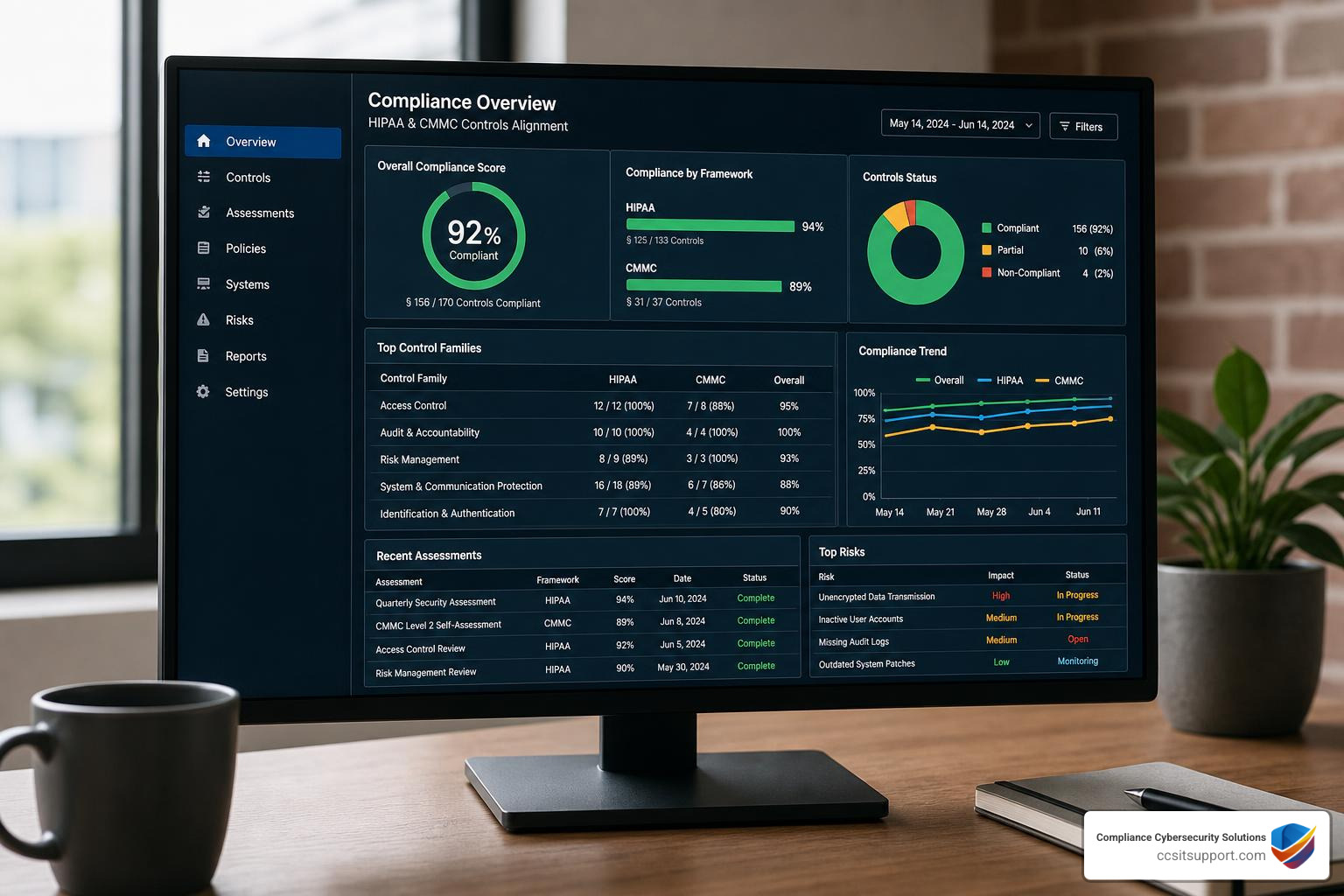
Furthermore, for businesses in healthcare, defense, and finance, compliance is not optional. Regulated frameworks like HIPAA and CMMC 2.0 require continuous monitoring and documented incident response plans. Utilizing our Small Business Cyber Security Consulting services alongside an MTDS ensures that your security operations are fully aligned with federal and state regulations, protecting you from costly audit failures.
Implementing and Measuring Your Managed Threat Detection
Transitioning to a managed threat detection service is a structured process designed to minimize disruption to your daily operations while rapidly elevating your security posture.
Step-by-Step Transition and Integration
We break down the onboarding process into four clear steps:
Gap Analysis: We review your existing security infrastructure, identifying blind spots and legacy tools that need upgrading.
Threat Modeling: We analyze your business operations to understand your most critical assets and the specific threats targeting your industry.
Data Onboarding & Integration: We connect your endpoints, cloud systems, and networks to our monitoring platform, establishing clean telemetry streams.
Joint Incident Response Planning: We establish clear communication channels and playbooks, defining exactly what actions our SOC can take automatically and when we need to loop in your internal stakeholders.
By establishing a clear roadmap for Threat Detection and Incident Response, we ensure a seamless transition that immediately hardens your defenses.
Key Metrics: MTTD, MTTR, and False Positive Rates
To measure the effectiveness of your security investment, you must track specific, outcome-driven metrics:
Mean Time to Detect (MTTD): How long does it take from the moment an attacker enters your network to the moment the threat is identified? A top-tier service should measure this in minutes, not days.
Mean Time to Respond (MTTR): Once a threat is identified, how quickly is it contained? Fast containment is the difference between a minor incident and a business-ending breach.
False Positive Rate: A lower false positive rate indicates that your security provider is successfully filtering out the noise, allowing your team to focus on legitimate threats.
Threat Coverage: This measures how well your detection rules map to established frameworks like the MITRE ATT&CK framework, ensuring you have no gaps in your defenses.
Frequently Asked Questions About Managed Threat Detection
What is the difference between managed threat detection and a SOC?
A Security Operations Center (SOC) is the actual team of people and the facility that performs security monitoring. A managed threat detection service is the complete offering delivered by that SOC. When you partner with an MTDS provider, you are essentially outsourcing your SOC functions to an external team of experts, gaining all the benefits of a dedicated security facility without the overhead costs.
How does managed threat detection integrate with in-house teams?
An MTDS is designed to augment, not replace, your internal IT team. We operate under a "co-managed" model where our SOC handles the repetitive, highly technical work of 24/7 monitoring, alert triage, and threat containment. When a critical issue arises, we provide your internal team with clear, actionable remediation steps, allowing them to act with confidence.
Why is 24/7 monitoring essential for modern businesses?
Cyberattacks are highly automated and do not stop when your office closes. If an attacker gains access to your network at midnight on a Friday, they have an entire weekend to steal data, delete backups, and deploy ransomware before your team returns on Monday. 24/7 monitoring ensures that threats are caught and neutralized within minutes, regardless of the time or day.
Conclusion
As you evaluate your security strategy for 2026, generic IT support is no longer enough to protect your business from sophisticated cyberthreats. It is clear that specialized compliance and security expertise is distinct from basic network maintenance.
While general managed service providers offer standard network support and localized IT help, a regulated business needs a partner that deeply understands compliance frameworks like HIPAA, CMMC, and SOC 2.
At Compliance Cybersecurity Solutions, based in Fort Lauderdale, Florida, we specialize in aligning your IT infrastructure with strict regulatory requirements while delivering elite, around-the-clock threat detection and active response. We protect your data, secure your reputation, and keep your business audit-ready.
Secure your business with CCS Cybersecurity Services today and let our team of experts build the proactive defense your organization deserves.