

Securing the underdog with small business cyber security consulting
Why Small Businesses Are the #1 Target for Cybercriminals (And What to Do About It)
Small business cyber security consulting helps owners in healthcare, defense, finance, and other regulated industries protect their data, meet compliance requirements, and reduce the risk of a costly breach — without needing an in-house IT team.
Here's what to know right away:
Who needs it: Any small or mid-sized business handling sensitive data, especially in regulated industries like healthcare (HIPAA), defense contracting (CMMC), or finance
What it does: A consultant assesses your vulnerabilities, builds a security roadmap, trains your staff, and helps you meet compliance standards like NIST, CMMC 2.0, or HIPAA
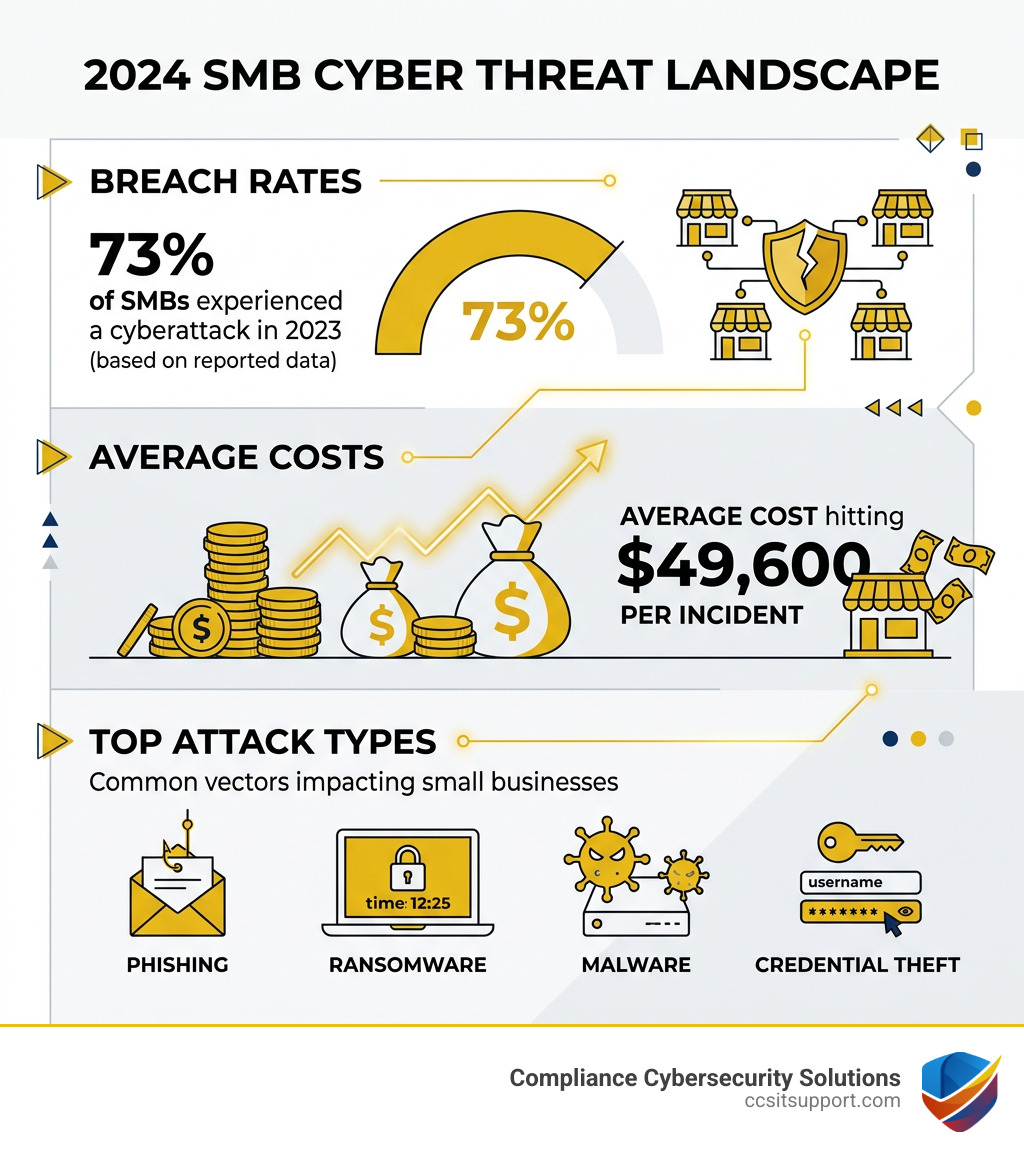
Why it matters: 73% of small and mid-sized businesses experienced a cyberattack in 2023, with the average cost hitting $49,600 per incident
Where to start: A risk assessment or security snapshot — typically a short engagement that identifies your biggest gaps first
How to choose: Look for a consultant with direct experience in your industry's compliance requirements
Small businesses are often called "soft targets." Not because they're unimportant — but because cybercriminals know they're less defended. Limited budgets, no dedicated security staff, and the mistaken belief that "we're too small to be targeted" leave real gaps. And attackers exploit those gaps every single day. In fact, a cybercrime is reported every 6 minutes in the small business space.
The good news? You don't need a Fortune 500 budget to build real protection. You just need the right guidance.
I'm Michael Gaigelas II, and over my career I've helped small businesses navigate the full landscape of small business cyber security consulting — from CMMC 2.0 and HIPAA compliance to Zero Trust implementation and incident response. In this guide, I'll walk you through exactly how to build a defensible, scalable security posture — even with limited resources.
The High Cost of Being a "Soft Target"

Many small business owners in Florida operate under a dangerous assumption: "Why would a hacker want my data when they could go after a big bank?"
The reality is that hackers are lazy. They would rather spend ten minutes breaking into a dozen small businesses with weak locks than ten months trying to crack one vault. This makes the "underdog" a primary target. According to recent data, 73% of small and mid-sized businesses experienced a data breach or cyberattack in 2023.
The financial sting is real. The average self-reported cost of cybercrime for a small business is now approximately $49,600—an 8% increase over the previous year. For a local medical clinic in Fort Lauderdale or a boutique defense contractor, that’s not just "overhead"; it’s a potential business-ending event.
Common Threats Facing SMBs
Cybercriminals don't just use one trick. They have a full toolbox:
Ransomware: 63% of small businesses face ransomware and advanced threats. These attacks often occur when you least expect them; in fact, 76% of attacks happen after hours or during the weekend when your team is home and no one is watching the shop.
Business Email Compromise (BEC): This involves hackers pretending to be a vendor or an executive to trick employees into transferring funds.
Human Error: This is the "Ouch" factor. Over 80% of data breaches are caused by human error, such as clicking a bad link or using "Password123" for every account.
Phishing: Sophisticated emails designed to steal login credentials.
Beyond the immediate financial loss, the 2023 Business Impact Report highlights the long-term reputational damage. If you lose customer data, you lose customer trust. In regulated industries, a breach can also lead to massive fines and the loss of government contracts.
Building Your Defense with Small Business Cyber Security Consulting
If you don't have a dedicated IT department, how do you even start? This is where small business cyber security consulting becomes your greatest asset. We act as your "Co-Pilot," taking the guesswork out of protection.
Step 1: The Risk Assessment
We begin by identifying your specific vulnerabilities. Every business is different. A healthcare provider in Florida has different risks than a defense manufacturer. We perform a "gap analysis" to see where your current defenses fall short of industry standards.
Step 2: Creating a Scalable Roadmap
You don't have to fix everything in one day. We help you develop a roadmap that grows with your business. We prioritize the "front door" first—securing your email, login access, and customer data—before moving to more complex layers.
Step 3: Implementing Layered Security
Effective cybersecurity isn't about one single tool; it's about layers.
Endpoint Protection: We secure every device (laptops, phones, servers) with advanced detection that stops threats at the source.
Managed Detection and Response (MDR): Since most attacks happen at night, MDR provides 24/7 expert monitoring. If something moves in the dark, our team is there to stop it in real-time.
Technical Advisory: We provide "CEO-language" reports. You shouldn't need a PhD to understand your security posture. We tell you what’s in place, why it’s there, and what the next steps are.
Essential Best Practices and Employee Training
While high-tech tools are vital, some of the strongest defenses are actually free or low-cost. We focus on "attainable security"—practical habits that make you a much harder target.
The "Big Four" Immediate Actions
Multi-Factor Authentication (MFA): This is the single most effective way to stop account takeovers. Even if a hacker gets your password, they can't get in without that second code.
Strong, Unique Passwords: Reusing passwords is like using the same key for your house, car, and office. If you lose one, you lose everything. Use a password manager to keep things secure.
Regular Backups: If ransomware hits, your backup is your "get out of jail free" card. We ensure your data is backed up offsite or in the cloud, away from your main network.
Software Updates: Those annoying "Update Available" pop-ups are often patching critical security holes. We automate this process so your systems are always shielded.
Training Your Human Firewall
Since human error is the leading cause of breaches, employee education is non-negotiable. We don't just give them a boring manual; we provide active training on:
Recognizing Phishing: How to spot a fake email before clicking.
Safe Remote Work: Securing home Wi-Fi and using VPNs.
Principle of Least Privilege: Only giving employees access to the data they absolutely need for their jobs.
By fostering a culture of "scam awareness," your team becomes an active part of your defense rather than your weakest link.
Mastering Compliance: HIPAA, CMMC, and Beyond
For many Florida businesses, cybersecurity isn't just a good idea—it's the law. If you handle patient records or work with the Department of Defense, you face strict compliance requirements.
Regulated Industry Support
Healthcare (HIPAA): We help medical practices align their IT with HIPAA standards, ensuring patient data remains private and secure.
Defense (CMMC 2.0 & NIST 800-171): If you are a contractor or supplier for the DoD, you need a System Security Plan (SSP) and a Plan of Action and Milestones (POA&M). We guide you through these complex documents to ensure you remain eligible for contracts.
Finance: We implement the layered security and threat detection required to protect sensitive financial data.
Written Information Security Policy (WISP)
A consultant helps you create a customized WISP. This isn't just a document for a shelf; it’s a living policy that outlines how your business handles data, manages access, and responds to incidents. It is often a requirement for insurance and audits.
Evaluating the ROI of Professional Security Guidance
Is small business cyber security consulting worth the investment? Let's look at the numbers.
Feature DIY / "Hope for the Best" Professional Consulting (CCS) Initial Cost $0 (until a breach) Predictable Monthly/Project Fee Breach Cost $49,600+ (Average) Significantly Reduced Risk Compliance High risk of fines/lost contracts Audit-ready & Compliant Monitoring Business hours only 24/7/365 Expert Response Focus You manage IT headaches You focus on growing your business
The Virtual CISO (vCISO) Advantage
Many small businesses can't afford a full-time Chief Information Security Officer (CISO). Through our consulting services, you get access to that high-level expertise on a fractional basis. You get the strategy and oversight of an executive without the six-figure salary.
Measuring Success
We don't just set it and forget it. We measure effectiveness through:
Regular Risk Evaluations: Seeing how your "score" improves over time.
Incident Preparedness: Running "tabletop exercises" to make sure everyone knows what to do if a threat is detected.
Business Continuity: Ensuring that even if a server fails, your business stays open.
For more resources and tools to get started, you can visit our Support Center.
Frequently Asked Questions about Cybersecurity
How much does small business cyber security consulting cost?
Pricing varies based on your needs. Some businesses prefer a one-time project fee for an initial assessment or WISP development. Others opt for a monthly retainer (often ranging from a few hundred to a few thousand dollars) that provides ongoing monitoring, support, and vCISO guidance. When you consider that a single breach costs nearly $50,000, the ROI of prevention is clear.
What are the first steps in small business cyber security consulting?
The journey always starts with an Asset Inventory and a Risk Assessment. We need to know what you have (computers, cloud accounts, data) before we can protect it. From there, we prioritize the biggest gaps and create a baseline security policy.
What should I do in the event of a cyber incident?
If you suspect a breach:
Containment: Disconnect the affected device from the internet immediately.
Communication: Notify your consultant right away.
Coordination: Do not try to "fix" it yourself, as you may accidentally delete evidence needed for insurance or legal reasons. We help you develop an Incident Response Plan in advance so that if the worst happens, you have a clear, calm path to recovery.
Conclusion
At Compliance Cybersecurity Solutions (CCS), we believe that being an "underdog" shouldn't mean being a victim. Based in Fort Lauderdale, we specialize in helping Florida small businesses navigate the complex world of IT and security.
Whether you need to align with HIPAA, prepare for CMMC audits, or simply want the peace of mind that comes with 24/7 threat detection, we are here to help. We provide the layered security and technical advisory you need to protect your livelihood.
Secure your business with expert cybersecurity consulting and turn your "soft target" into a digital fortress today.