

Surviving the CMMC Final Rule Implementation
What the CMMC Final Rule Means for Defense Contractors Right Now
The cmmc final rule is now a done deal — and if your company works with the Department of Defense, your window to prepare is closing fast.
Here's a quick snapshot of what you need to know:
Key Detail What It Means DFARS Rule Effective Date November 10, 2025 (60 days after Sept. 10, 2025 publication) Who It Affects Any DoD contractor or subcontractor handling FCI or CUI Three CMMC Levels Level 1 (15 controls), Level 2 (110 controls), Level 3 (110 + 24 controls) Phased Rollout 4 phases over 3 years (Phase 1 starts Nov. 10, 2025) Assessment Types Self-assessment, C3PAO (third-party), or DIBCAC (government-led) Conditional Status Up to 180 days to close POA&M gaps at Levels 2 and 3 COTS Exemption Pure COTS item suppliers are exempt for the first 3 years
If you're a defense contractor, this rule changes how you win contracts — not just how you run your IT.
On September 10, 2025, the DoD published its final DFARS rule embedding CMMC requirements directly into the contracting process. That means cybersecurity certification is no longer a best practice — it's a condition of contract award. Miss it, and you could lose opportunities, face False Claims Act liability, or get locked out of the Defense Industrial Base altogether.
This isn't just an IT problem. It's a business survival issue.
I'm Michael Gaigelas II, and I've spent years guiding defense contractors through complex compliance frameworks — including the evolving cmmc final rule — helping organizations achieve certification faster and at a fraction of what most expect to spend. In the sections below, I'll walk you through exactly what the rule requires and how to get your organization ready.
Understanding the CMMC Final Rule Framework
Navigating the cmmc final rule can feel like trying to read a map in a hurricane. To simplify things, we need to look at the two regulatory "engines" driving this program. First, there is the Official CMMC Program Rule (32 CFR Part 170), which sets the ground rules for the program itself. Second, there is the DFARS Clause Rule, which tells Contracting Officers how to actually put these requirements into your contracts.
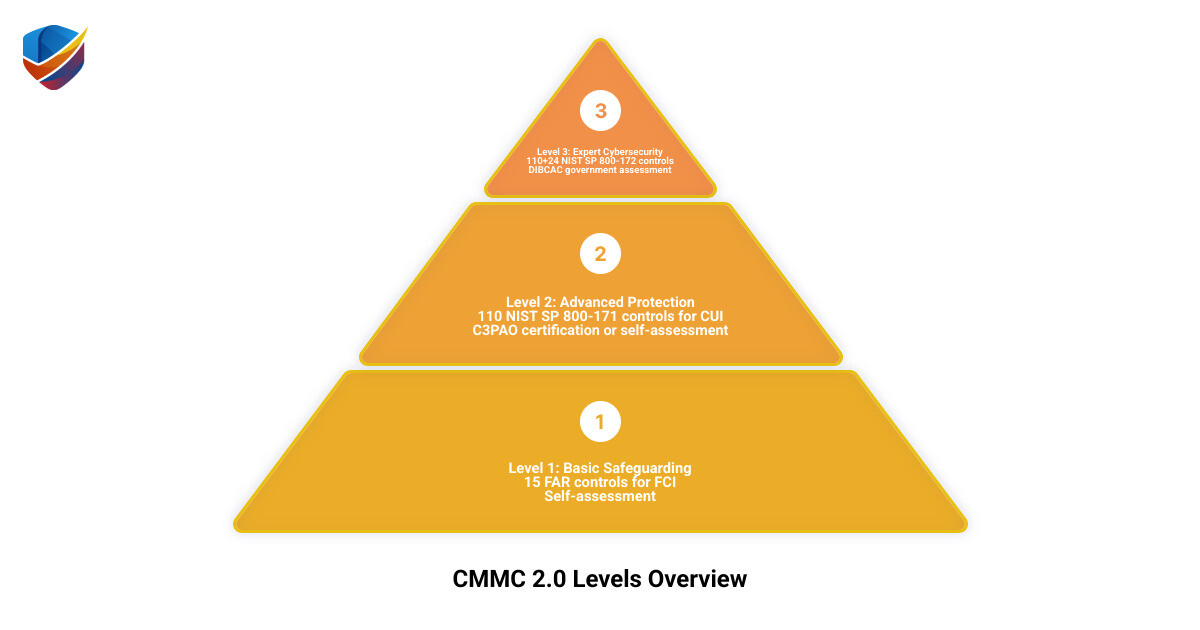
The framework is built on a tiered model. Instead of the original five levels, we now have three, which makes life a bit easier for small and medium-sized businesses in Florida and across the country. These levels are directly tied to the sensitivity of the information you handle.
CMMC Level Focus Primary Requirement Assessment Type Level 1 Basic Safeguarding 15 (or 17) FAR 52.204-21 controls Annual Self-Assessment Level 2 Protecting CUI 110 NIST SP 800-171 Rev 2 requirements Self or C3PAO (Every 3 years) Level 3 Advanced Threats Level 2 + 24 NIST SP 800-172 requirements DIBCAC-led (Every 3 years)
Key Differences: Program Rule vs. CMMC Final Rule (DFARS)
It is easy to get these two mixed up, but they serve different purposes. The Program Rule (32 CFR) is the "What." it defines the levels, the security requirements like NIST SP 800-171, and how assessments work. It became effective on December 16, 2024.
The DFARS Rule details represent the "How" and "When." This rule (Title 48) is what actually allows the DoD to put CMMC requirements into solicitations and contracts. Think of the Program Rule as the playbook and the DFARS Rule as the referee blowing the whistle to start the game.
Scoping Your Compliance: FCI vs. CUI
Before you spend a dime on new firewalls, you need to know what you are protecting. The cmmc final rule applies to nonfederal systems that process, store, or transmit Federal Contract Information (FCI) or Controlled Unclassified Information (CUI).
FCI: Information provided by or generated for the Government under a contract to develop or deliver a product or service.
CUI: Information the Government creates or possesses, or that an entity creates or possesses for or on behalf of the Government, that requires safeguarding or dissemination controls.
If you only handle Commercial Off-the-Shelf (COTS) items, you might be in luck—pure COTS providers are generally exempt. However, the definition of "specialized assets" (like IoT or test equipment) can get tricky during an assessment. We often help clients map these data flows to ensure they aren't over-scoping—or under-scoping—their environment. For more guidance, you can check out our more info about compliance services page.
Navigating the Phased CMMC Final Rule Timeline
The DoD isn't flipping a switch and demanding everyone be compliant overnight. Instead, we are looking at a four-phase rollout over three years. This gives us some breathing room, but not much.
The clock officially starts on November 10, 2025. This is when the cmmc final rule (the DFARS version) takes effect. During the first three years, the DoD has "discretionary inclusion," meaning they can choose which contracts get the CMMC language first.
Phase 1 and 2: Self-Assessments and C3PAOs
Phase 1 (Starts Nov 10, 2025): DoD will begin including Level 1 or Level 2 self-assessment requirements in solicitations. To be eligible for an award, you’ll need a "current" assessment in the Supplier Performance Risk System (SPRS).
Phase 2 (Starts Nov 10, 2026): This is the big one. DoD will start requiring Level 2 certification assessments performed by a CMMC Third-Party Assessment Organization (C3PAO).
If you're aiming for Level 2, you shouldn't wait until 2026. There are only so many C3PAOs, and the backlog will be massive. We recommend starting your cybersecurity resources review now to avoid the rush.
Phase 3 and 4: Full Implementation
Phase 3 (Starts Nov 10, 2027): Requirements for Level 3 certification (conducted by the Defense Industrial Base Cybersecurity Assessment Center or DIBCAC) begin appearing in high-value contracts.
Phase 4 (Starts Oct 1, 2028): Full implementation. CMMC requirements will be included in all solicitations and contracts, including options on existing contracts.
Technical Requirements and Assessment Types
The technical backbone of the cmmc final rule is NIST SP 800-171 Rev 2. For Level 2, you must meet all 110 requirements. For Level 1, you are looking at the 48 CFR 52.204-21 requirements, which cover 15 basic safeguarding controls.
One of the biggest shifts in the final rule is the requirement for annual affirmations. It’s no longer enough to get certified once every three years; a senior company official must sign off every year stating that the company is still in compliance. This keeps the pressure on to maintain "current" status.
Achieving Compliance Under the CMMC Final Rule
Assessment frequency depends on your level. Level 1 requires an annual self-assessment. Level 2 (Certification) and Level 3 require a three-year assessment cycle. However, "current" status means you haven't had any major changes to your network that would invalidate your score.
To stay on top of this, many contractors use DIBNet resources to stay informed on the latest threats and compliance tools provided by the DoD CIO.
Managing POA&Ms and Conditional Status
The DoD listened to industry feedback and included a "safety valve": Plans of Action and Milestones (POA&Ms). If you don't hit a 100% score, you can still get a conditional certification for Level 2 or 3, provided you:
Achieve at least an 80% score.
Meet all "critical" requirements (the 5-point items).
Close out the remaining gaps within 180 days.
If you don't close those gaps in six months, your status expires, and you could be in breach of contract. You can find the exact legal CMMC definitions for these terms in the federal register.
Contractual Obligations and Flowdown Requirements
The cmmc final rule introduces two heavy-hitting clauses: DFARS 252.204-7021 (the CMMC requirement itself) and DFARS 252.204-7025 (which instructs contractors on how to handle the rollout).
Compliance isn't just about your own office; it's about your entire supply chain. Prime contractors are now responsible for verifying that their subcontractors have the appropriate CMMC level before awarding a subcontract.
The Role of the CMMC Unique Identifier (UID)
How does the DoD track all this? Enter the CMMC Unique Identifier (UID). This is a 10-character alphanumeric code assigned to each assessed system. When you submit your results to SPRS, this UID is used to link your certification to specific contracts. According to SPRS submission info, this code will be vital for Contracting Officers to verify your eligibility.
Subcontractor Flowdown and Risk Management
If you share CUI with a sub, they must be at CMMC Level 2. If you only share FCI, they only need Level 1. We recommend that Florida contractors update their subcontracts now with risk-shifting provisions to ensure their vendors take these rules seriously. If a sub fails an audit, it could bring your whole project to a halt. If you're struggling with vendor management, our Support Center can help you set up a vetting process.
Step-by-Step Preparation for DoD Contractors
At CCS, we've seen that the most successful companies take a "legal-led" approach to compliance. This means conducting privileged reviews to protect your gap analysis from discovery and ensuring your System Security Plan (SSP) is a living document, not just a dusty binder on a shelf.
The risks of non-compliance are high—specifically regarding the False Claims Act. If you affirm you are compliant when you aren't, the Department of Justice can come knocking. You can learn more about our commitment to accuracy on our About Us page.
Step 1: Inventory and Scoping
You cannot protect what you don't know you have.
Data Mapping: Trace where FCI and CUI enter your building, where they are stored (servers, cloud), and who they are sent to.
Asset Categorization: Identify "Security Protection Assets" (like your firewall) and "Out-of-scope assets" (like a guest Wi-Fi) to limit the size of your audit.
Step 2: Gap Analysis and Remediation
Once you have your scope, compare it to the 110 controls of NIST 800-171.
POA&M Development: For every "No," create a plan to get to "Yes."
FedRAMP Check: if you use cloud services (like Office 365), ensure they meet the FedRAMP Moderate baseline.
Methodology: Follow the NIST 800-171 methodology to ensure your scoring is accurate and defensible.
Frequently Asked Questions about the CMMC Final Rule
When does the CMMC Final Rule take effect?
The DFARS rule takes effect on November 10, 2025. However, the Program Rule (32 CFR) is already active as of December 2024, meaning you can (and should) start seeking voluntary certifications now.
Are COTS providers exempt from CMMC?
Yes, contracts solely for the acquisition of Commercial Off-the-Shelf (COTS) items are exempt from CMMC requirements. However, if those items are modified for the DoD, or if you handle CUI related to them, the exemption may vanish.
How long does a CMMC certification last?
A CMMC certification at Level 2 or 3 lasts for three years, provided you submit your annual affirmations and don't make significant changes to your security posture. Level 1 self-assessments must be performed and submitted annually.
Conclusion
The cmmc final rule represents a massive shift in the defense landscape. It’s no longer about "checking a box"—it’s about proving your resilience against advanced persistent threats. While the phased rollout gives us some time, the complexity of NIST 800-171 means that most companies need 12 to 18 months to fully remediate their gaps.
At Compliance Cybersecurity Solutions (CCS), we specialize in helping Florida-based defense contractors navigate these waters. From initial scoping to final C3PAO prep, we ensure your IT aligns with DoD standards so you can focus on winning the next contract.
Don't wait for the November 2025 deadline to catch you off guard. Get CMMC Compliance Support today and secure your spot in the future of the Defense Industrial Base.