

Compliance Consulting That Keeps the Regulators at Bay
Why Finance IT Compliance Consulting Is a Critical Business Decision
Finance IT compliance consulting helps financial firms build, manage, and prove the security programs that regulators demand — before an audit, a breach, or an enforcement action forces the issue.
Here is what it covers at a glance:
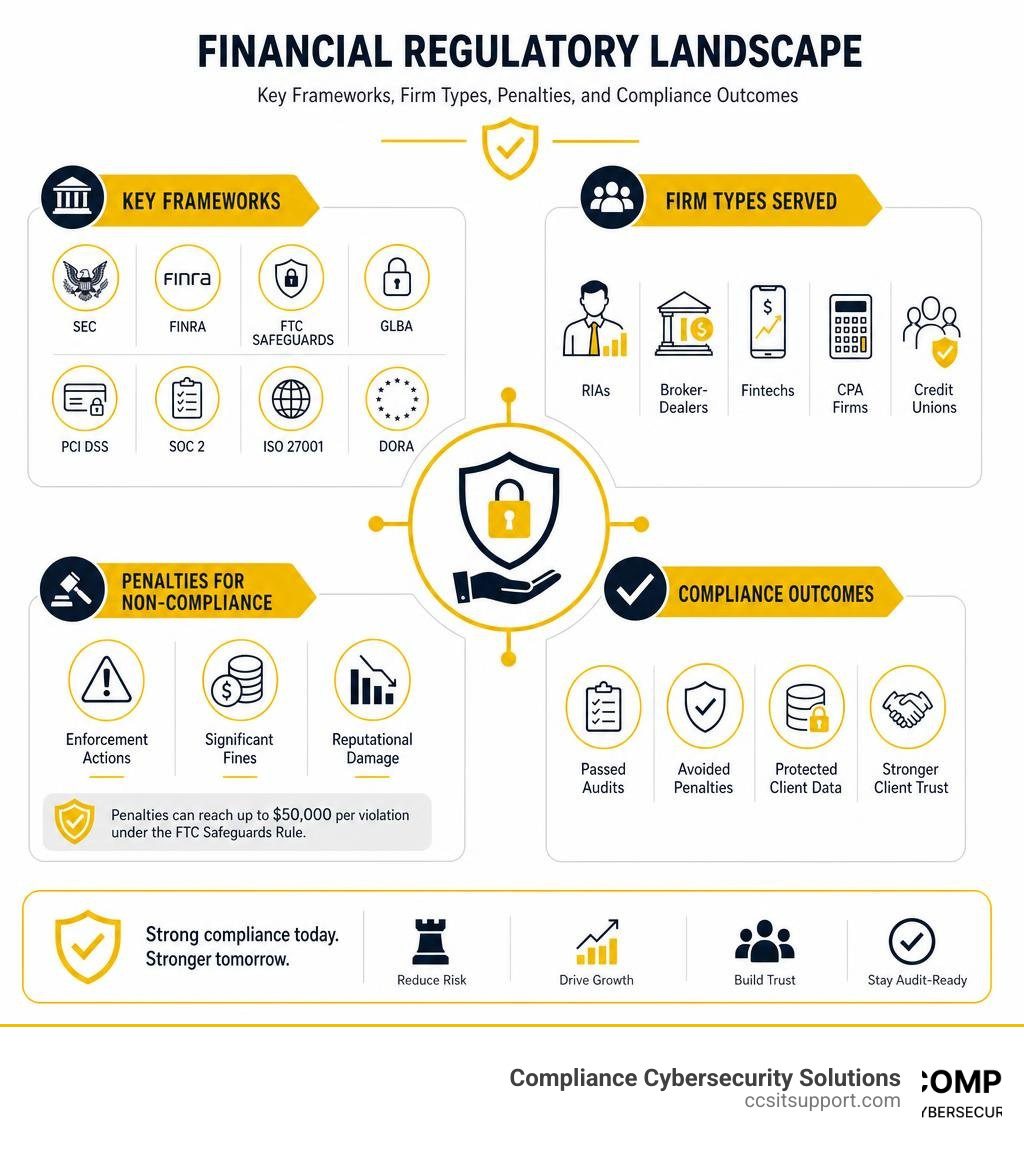
Area What It Addresses Regulatory Frameworks SEC, FINRA, FTC Safeguards, GLBA, PCI DSS, SOC 2, ISO 27001, DORA Firm Types Served RIAs, broker-dealers, fintechs, CPA firms, credit unions Core Services Gap assessments, policy drafting, vendor risk, audit readiness Key Outcomes Passed audits, avoided penalties, protected client data Who Leads It A Qualified Individual or external compliance consultant
The stakes are high. The CFPB alone filed 29 enforcement actions in 2023, resulting in $3.07 billion paid to compensate consumers. Meanwhile, cyberattacks targeting financial firms have increased by 340% in recent years. And if your firm falls short of the FTC Safeguards Rule, penalties can reach $50,000 per violation.
Most financial leaders are not short on ambition. They are short on time, resources, and a clear roadmap through a maze of overlapping regulations. That is exactly where expert guidance changes the outcome.
I'm Michael Gaigelas II, and I've spent my career helping financial firms navigate the exact compliance challenges covered in this guide — from SOC 2 and ISO 27001 readiness to FTC Safeguards and FINRA alignment — through my work at Compliance Cybersecurity Solutions. My approach to Finance IT compliance consulting is built on rapid, cost-effective implementation with no unnecessary delays or hidden costs. In the sections below, I'll walk you through every major framework, challenge, and strategy you need to protect your firm and win client trust.
The Strategic Value of Finance IT Compliance Consulting
In the fast-moving world of financial services, regulatory compliance is no longer just a checkbox for your legal team. It has evolved into a core pillar of operational resilience. When we look at the sheer volume of data financial firms handle daily, the necessity of specialized IT Compliance Consulting becomes clear.
The regulatory landscape is shifting from reactive enforcement to proactive, tech-driven oversight. Regulators are no longer just looking at your financial ledgers; they are auditing your firewalls, your data pipelines, and your employee training logs.
For modern financial services, effective risk mitigation and rigorous client data protection are the only things standing between business growth and devastating reputational damage. Consider the CFPB's enforcement track record: with billions of dollars ordered in consumer compensation, a single systemic IT failure or data handling oversight can cripple an otherwise healthy firm. Working with a dedicated consultant ensures that your IT infrastructure is built to survive this intense scrutiny.
Why Firms Partner with a Finance IT Compliance Consulting Expert
Many financial firms start out trying to manage compliance in-house, often assigning the responsibility to a busy CTO or an operations manager. However, keeping up with sophisticated cyberattacks requires deep, specialized knowledge.
When you partner with a specialized consultant, you gain access to:
Active Threat Detection: We implement continuous monitoring systems that identify anomalous behavior before data is exfiltrated.
Layered Security Architecture: We build multiple defensive rings around your sensitive data, ensuring that if one control is breached, others stand firm.
SEC & FINRA Alignment: We translate vague regulatory mandates into concrete technical settings, such as configuring compliant cloud storage and setting up immutable log archives.
Proactive Risk Management: Instead of waiting for a data breach to expose a vulnerability, we identify and patch security gaps before they can be exploited.
Key Components of a Modern Compliance Management System (CMS)
A Compliance Management System (CMS) is the operational engine that keeps your compliance program running. It is not just a binder sitting on a shelf; it is an active, integrated framework that dictates how your firm operates. To be effective, your CMS must be customized to your specific business model and regulatory profile.
At its core, a robust CMS relies on several pillars to ensure complete Compliance:
Active Corporate Governance: Clear oversight from leadership, establishing who is responsible for security decisions and defining reporting lines to the board.
Continuous Risk Assessments: Regularly analyzing your technology stack and business workflows to identify where sensitive data is created, stored, or transmitted.
Tailored Policy Drafting: Writing clear, enforceable guidelines for acceptable technology use, remote work, and data handling.
Closed-Loop Complaint Management: Tracking and analyzing customer complaints to identify potential operational gaps or compliance failures.
Ongoing Employee Training: Educating your team to recognize phishing attempts, social engineering, and safe data handling procedures.
Navigating the Complex Web of Financial Regulations
For many firms, the hardest part of compliance is simply understanding which rules apply to them. A single financial firm might fall under the jurisdiction of several federal agencies, state regulators, and international standards. Navigating these overlapping regulatory frameworks requires a clear map of how they differ and where they align.
Comparing SEC, FINRA, FTC Safeguards, and GLBA
While all of these standards aim to protect financial systems and consumer data, they approach the task from different angles.
The SEC focuses heavily on market integrity, investor protection, and corporate transparency. Key rules like Regulation S-P require firms to maintain written policies to protect customer records. Additionally, SEC Rule 17a-4 mandates that broker-dealers retain electronic records in a non-rewriteable, non-erasable format (commonly known as WORM storage).
FINRA oversees broker-dealers with a practical focus on operational continuity. Under FINRA Rule 4370, firms must maintain a detailed Business Continuity Plan (BCP) to ensure they can remain operational during a disaster or major cyber incident.
The FTC Safeguards Rule (under the Gramm-Leach-Bliley Act, or GLBA) applies to a broad range of non-banking financial institutions. It requires a highly structured information security program, including multi-factor authentication (MFA), data encryption, regular penetration testing, and the designation of a "Qualified Individual" to oversee the program.
Regulator / Framework Primary Target Key Technical Requirements Major Enforcement Risk SEC (Reg S-P, Rule 17a-4) Registered Investment Advisors, Broker-Dealers WORM storage, documented access controls, multi-factor authentication Public enforcement actions, heavy fines, loss of registration FINRA (Rule 4370) Broker-Dealers Business Continuity Plans, disaster recovery testing, incident response Operational suspension, individual executive liability FTC Safeguards (GLBA) Mortgage brokers, payday lenders, tax preparers, CPA firms Designated Qualified Individual, MFA, data encryption, 30-day breach notifications Up to $50,000 per violation, mandatory public consent decrees
Global and Technical Standards: SOC 2, ISO 27001, and DORA
If you work with institutional clients or operate internationally, regulatory compliance is only half the battle. You will also need to prove your security posture through recognized global frameworks.
SOC 2 (Type II): This is the gold standard for vendor due diligence in North America. A SOC 2 report proves to your enterprise clients that you have designed and consistently maintained strict security controls over a period of several months.
ISO 27001: An internationally recognized framework for managing information security. It focuses on establishing a continuous improvement cycle for your security posture.
DORA (Digital Operational Resilience Act): A critical European framework that impacts any global financial firm or fintech. DORA mandates strict rules for managing third-party risk, reporting major ICT incidents, and performing advanced digital resilience testing.
Implementing these frameworks requires a deep understanding of Cybersecurity best practices to ensure your controls are both auditable and effective.
Industry-Specific Compliance Challenges and Solutions
No two financial firms are identical. A small wealth management office faces entirely different operational challenges than a fast-growing fintech or a regional credit union. Your approach to compliance must be tailored to your specific business model.
To build a program that actually works, we must address the unique challenges of each sector through a tailored Managed IT for Finance strategy.
Tailored Strategies for RIAs, Broker-Dealers, and Fintechs
Registered Investment Advisors (RIAs) and broker-dealers must balance high-speed operations with strict regulatory oversight. Managing custody rules, keeping trading platforms secure, and maintaining low-latency connectivity require a specialized approach.
To build out operational compliance frameworks, firms must focus on structural program design. Additionally, keeping your underlying network infrastructure secure and aligned with regulatory expectations is critical to bridge the gap between complex network engineering and strict regulatory rules.
Addressing Risks for CPA Firms, Tax Practices, and Credit Unions
Accounting firms, tax practices, and credit unions handle some of the most sensitive personal data in existence. For these organizations, compliance is not just about SEC rules; it is about IRS guidelines and banking standards.
CPA and Tax Firms: Under IRS Publication 4557, tax professionals must implement a Written Information Security Plan (WISP). If you collect client tax documents, you are legally considered a financial institution under the FTC Safeguards Rule and must protect that data accordingly through specialized technology support.
Credit Unions: These institutions must navigate complex banking guidelines, including the SAFE Act (mortgage loan originator registration) and FACTA Red Flags Rules for identity theft prevention. Protecting member accounts requires robust Banking Data Loss Prevention strategies to stop unauthorized data transfers before they happen.
Operationalizing Compliance: Vendor Risk and AI Integration
A compliance program is only as strong as its weakest link — and frequently, that link is a third-party software vendor or service provider. Modern compliance consulting focuses heavily on automating these operational headaches so your team can focus on client service.
Streamlining Vendor Risk Management and Security Questionnaires
Every time you onboard a new software tool, you inherit that vendor's security risks. Enterprise clients will send you lengthy security questionnaires to prove you are protecting their data, and you must do the same to your own vendors.
To manage this efficiently, we recommend a structured approach:
Centralize Vendor Portals: Keep all vendor SOC 2 reports, NDAs, and security reviews in a single, easily accessible location.
Implement Risk Rating Scales: Categorize vendors based on the sensitivity of the data they access (e.g., High, Medium, Low risk).
Use Questionnaire Auto-Mapping: Leverage modern tools to automatically answer incoming security questionnaires using your existing control library, turning a three-day project into a thirty-minute task.
Automate Evidence Collection: Set up continuous integrations with your cloud systems to gather real-time proof of compliance, eliminating the stressful scramble for screenshots before an audit.
How Artificial Intelligence is Transforming Regulatory Monitoring
Artificial Intelligence is changing the compliance landscape, but it is a double-edged sword. While AI tools can dramatically speed up operations, they also introduce new risks.
Last year's financial crime reports, including Kroll's 2025 Financial Crime Report, highlighted how criminals are using AI to launch more sophisticated phishing and social engineering schemes. To combat this, compliance consultants use AI on the defensive side for:
Real-Time Regulatory Monitoring: Tracking changes across hundreds of regulatory bodies and automatically flagging updates that impact your business.
Automated Gap Assessments: Comparing your active system configurations against frameworks like NIST or SOC 2 to find security weaknesses instantly.
Smart Policy Drafting: Creating highly customized policy templates based on your unique operational workflows.
However, firms must also establish strict AI governance policies. Without proper controls, employees might accidentally paste sensitive client data or proprietary code into public AI models, creating massive data privacy violations.
Preparing for Audits and Maximizing Your Compliance ROI
No one looks forward to a regulatory examination or a third-party audit. However, with the right preparation, these events can transition from stressful disruptions to routine verifications of your day-to-day operations.
Choosing Between Software and Finance IT Compliance Consulting
Many firms wonder if they can simply buy a compliance software platform and skip the cost of a consultant. While compliance software is an excellent tool for tracking tasks and storing evidence, it cannot replace human expertise.
Software can tell you what is missing, but it cannot design a custom remediation plan, serve as your FTC-mandated Qualified Individual, or represent you during a difficult SEC examination.
The most cost-effective approach is a hybrid model. We combine the efficiency of automated compliance platforms with the strategic guidance of experienced consultants. This gives you the best of both worlds: predictable, flat-fee pricing and expert leadership when you need it most.

Turning Regulatory Alignment into a Competitive Advantage
It is easy to view compliance as a pure cost center — money spent simply to avoid getting fined. But forward-thinking firms realize that a strong security posture is a powerful sales tool.
When you can hand a prospective enterprise client a clean SOC 2 Type II report, a comprehensive WISP, and a detailed third-party risk assessment on day one, you build immediate trust. You remove friction from their procurement process, allowing you to close larger deals faster than competitors who are still struggling to answer basic security questionnaires.
Frequently Asked Questions about Financial IT Compliance
How often should financial institutions conduct BSA/AML/OFAC risk assessments?
Financial institutions must conduct BSA/AML/OFAC risk assessments every 12 to 18 months, as required by federal regulatory agencies. If your firm introduces new products, targets new customer segments, or enters new geographic markets, you should update your risk assessment immediately to reflect those operational changes.
What are the penalties for non-compliance with the FTC Safeguards Rule?
Non-compliance with the FTC Safeguards Rule can result in devastating financial and operational consequences. The FTC can levy administrative fines of up to $50,000 per violation. Beyond the direct financial penalties, non-compliant firms face mandatory, long-term consent decrees, independent audits at their own expense, and severe reputational damage that can drive away clients.
How does a firm prepare for an SEC or FINRA cybersecurity audit?
Preparation for an SEC or FINRA cybersecurity audit should be continuous, not a last-minute scramble.
Maintain Audit-Ready Evidence Packages: Ensure your system logs, access review records, and training histories are automatically archived and organized.
Review Incident Response Plans: Conduct regular tabletop exercises to ensure your team knows exactly how to contain a breach and notify regulators within mandated timelines.
Test Business Continuity Plans: Perform annual disaster recovery drills to prove you can restore operations quickly after an outage or ransomware attack.
Conclusion
Navigating the complex world of financial regulations does not have to stall your firm's growth. By building a proactive, layered security program, you protect your clients, satisfy regulators, and build a powerful competitive advantage that helps you win enterprise business.
At Compliance Cybersecurity Solutions, based in Fort Lauderdale, Florida, we specialize in aligning your IT infrastructure with complex frameworks like HIPAA, CMMC, SEC, and FINRA. We combine proactive threat detection, layered security, and customized compliance policies to keep your business secure and audit-ready.
Protect your firm with expert cybersecurity and compliance services and discover how simple, secure, and stress-free your IT compliance can be.