
What Should a Cyber Security Policy Include? (PDF Inside)
What a Sample Cyber Security Policy Should Include (Quick Answer)
A sample cyber security policy is a written document that defines how your organization protects its data, devices, and people from cyber threats. Here is what every policy should cover:
Section What It Covers Scope Who the policy applies to (employees, contractors, vendors) Confidential Data What counts as sensitive information and how to protect it Device Security Rules for company-issued and personal devices Password Management Password length, rotation, and storage requirements Email Security How to spot and report phishing and suspicious messages Data Transfer How to safely share data inside and outside the organization Incident Response Steps to take when a breach or attack occurs Disciplinary Actions Consequences for policy violations Review Schedule How often the policy is updated
The stakes are real. 60% of small and mid-sized businesses close within six months of a cyber attack. In 2023, the average data breach cost SMBs anywhere from $120,000 to $1.24 million. And cybercrime surged 600% as remote work and cloud adoption took off.
For leaders in healthcare, defense, or finance, a missing or outdated policy is not just a gap — it is a liability.
This guide walks you through exactly what a strong cyber security policy looks like, with examples, templates, and practical steps you can use right away.
I'm Michael Gaigelas II, and I've spent my career helping organizations navigate complex compliance frameworks like CMMC 2.0, ISO 27001, and HIPAA — which means I've reviewed and built more than a few versions of a sample cyber security policy for regulated industries. In the sections below, I'll break down everything you need to know so you can build or improve your own.
Why Your Business Needs a Sample Cyber Security Policy
In our experience at CCS, we’ve seen that many businesses view a sample cyber security policy as just another piece of HR paperwork. In reality, it is the operational blueprint for your company’s survival. Without a formal policy, your team is essentially "winging it" when it comes to data protection, which is a dangerous game to play in today’s threat landscape.

The vulnerability of Small and Medium-Sized Businesses (SMBs) cannot be overstated. Statistics show that 60% of SMBs go out of business within just six months of a major cyber attack. Why? Because the recovery costs—ranging from $120,000 to over $1.2 million—are often more than a growing company can bear. Since the shift to remote work and cloud adoption, cybercrime has surged by 600%, making every business a target, regardless of size.
While we often worry about external hackers, the biggest threats are frequently internal. Human error, lost devices, or a single employee clicking a malicious link can bypass the most expensive firewalls. A well-crafted Cyber Security Policy sets clear expectations, reducing the likelihood of these "insider" mistakes. If you are in a regulated industry, having these policies in place is often a legal requirement for Cybersecurity compliance.
Essential Elements of a Sample Cyber Security Policy
When you begin drafting your policy, you shouldn't start from scratch. A high-quality Cyber security policy template serves as a foundation, but it must be customized to your specific risks.
The first step is defining confidential data. You cannot protect what you haven't identified. Your policy should categorize data into tiers, such as:
Public: Information safe for anyone to see (e.g., marketing materials).
Internal: Data for employee eyes only (e.g., company memos).
Confidential/Restricted: Highly sensitive info like social security numbers, medical records, or trade secrets.
A thorough risk assessment should guide these definitions, ensuring that your most valuable assets receive the highest level of protection.
Defining Roles and Responsibilities
A policy only works if everyone knows their part. Your sample cyber security policy should explicitly outline who is responsible for what:
IT and Security Teams: Responsible for implementing technical controls, monitoring for threats, and conducting monthly security updates.
Management: Tasked with enforcing the policy, providing necessary resources, and leading by example.
Employees: Responsible for following all security protocols, attending training, and reporting suspicious activity immediately.
Third-Party Vendors: Must adhere to specific security standards defined in your contracts to ensure they don't become a weak link in your supply chain.
Key Components of a Comprehensive Cyber Security Policy Template
To build a truly robust framework, many organizations align their policies with established standards like the NIST Cybersecurity Framework (CSF) or SANS templates. These frameworks provide a structured way to address the "five functions" of security: Identify, Protect, Detect, Respond, and Recover.
Framework Best For Key Focus NIST CSF Regulated Industries Risk management and lifecycle security SANS Technical Teams Detailed, specific policy templates for IT assets ISO 27001 Global Enterprises International compliance and management systems
Whether you use a System Security Policy – Regulation and Policy Hub or a custom build, several core components are non-negotiable.
Password Management in a Sample Cyber Security Policy
Passwords are often the first line of defense—and the first point of failure. A modern sample cyber security policy must move beyond "P@ssword123." We recommend the following standards:
Length over Complexity: Encourage long "passphrases" (e.g.,
the-blue-ocean-is-deep-2024) which are easier for humans to remember but harder for machines to crack. Aim for a 12-character minimum.Multi-Factor Authentication (MFA): This is mandatory. Even if a password is stolen, MFA provides a second layer of defense.
Rotation: While traditional 30-day rotations are common, NIST now suggests changing passwords only when there is evidence of a compromise, provided MFA is in use.
Password Managers: Prohibit writing passwords on sticky notes. Instead, mandate the use of company-approved password managers to prevent credential stuffing attacks.
Email Security and Phishing Prevention
Email is the primary delivery method for malware and scams. Your policy should provide clear guidelines on how to handle communications. According to the Enterprise Cybersecurity Policy Version 1.1 from the Department of Commerce, email security is vital for mission continuity.
Employees should be trained to look for scam indicators like:
Urgent or threatening language.
Requests for sensitive info (passwords, wire transfers).
Mismatched "From" addresses or poor grammar.
Unexplained attachments or links.
If an employee spots something fishy, they should know exactly how to report it to the IT team without fear of reprimand for being "overly cautious."
Best Practices for Device Security and Remote Work
The "office" is no longer just a building in Fort Lauderdale; it's a coffee shop, a home office, or a hotel lobby. This shift has made device security more complex.
Whether an employee uses a company-issued laptop or their own phone (BYOD - Bring Your Own Device), certain rules must apply. For companies in Florida, staying in Compliance often requires strict control over how data is accessed remotely.
Key device requirements include:
Full Disk Encryption: If a laptop is stolen, encryption ensures the data remains unreadable.
Antivirus and Firewalls: These must be active and set to auto-update.
Automatic Lock: Screens should lock after a period of inactivity (usually 10 minutes or less).
Physical Security: Never leave devices in a car or unattended in public spaces.
Securing Remote Access and Third-Party Risks
Remote work requires a secure tunnel to the office network. We recommend a VPN (Virtual Private Network) with strong encryption for all remote access. In some cases, employees may even request a home network security test by your IT team to ensure their router isn't running on "admin/admin" credentials.
Furthermore, third-party risks are surging. Your policy should state that any vendor with access to your systems must undergo a security review. This "Supply Chain Risk Management" is a core part of the NIST framework and helps prevent a breach at a partner company from spilling over into your network.
Disciplinary Actions and Policy Enforcement
A policy without enforcement is just a suggestion. Your sample cyber security policy should clearly outline the consequences of non-compliance. These are typically scaled based on the severity and intent of the violation:
Verbal/Written Warnings: For minor, accidental infractions (e.g., forgetting to lock a screen once).
Suspension or Mandatory Retraining: For repeated negligence.
Termination: For intentional data theft, sharing passwords, or gross negligence that leads to a breach.
Legal Action: For criminal activities or violations of Non-Disclosure Agreements (NDAs).
How to Implement and Maintain Your Policy
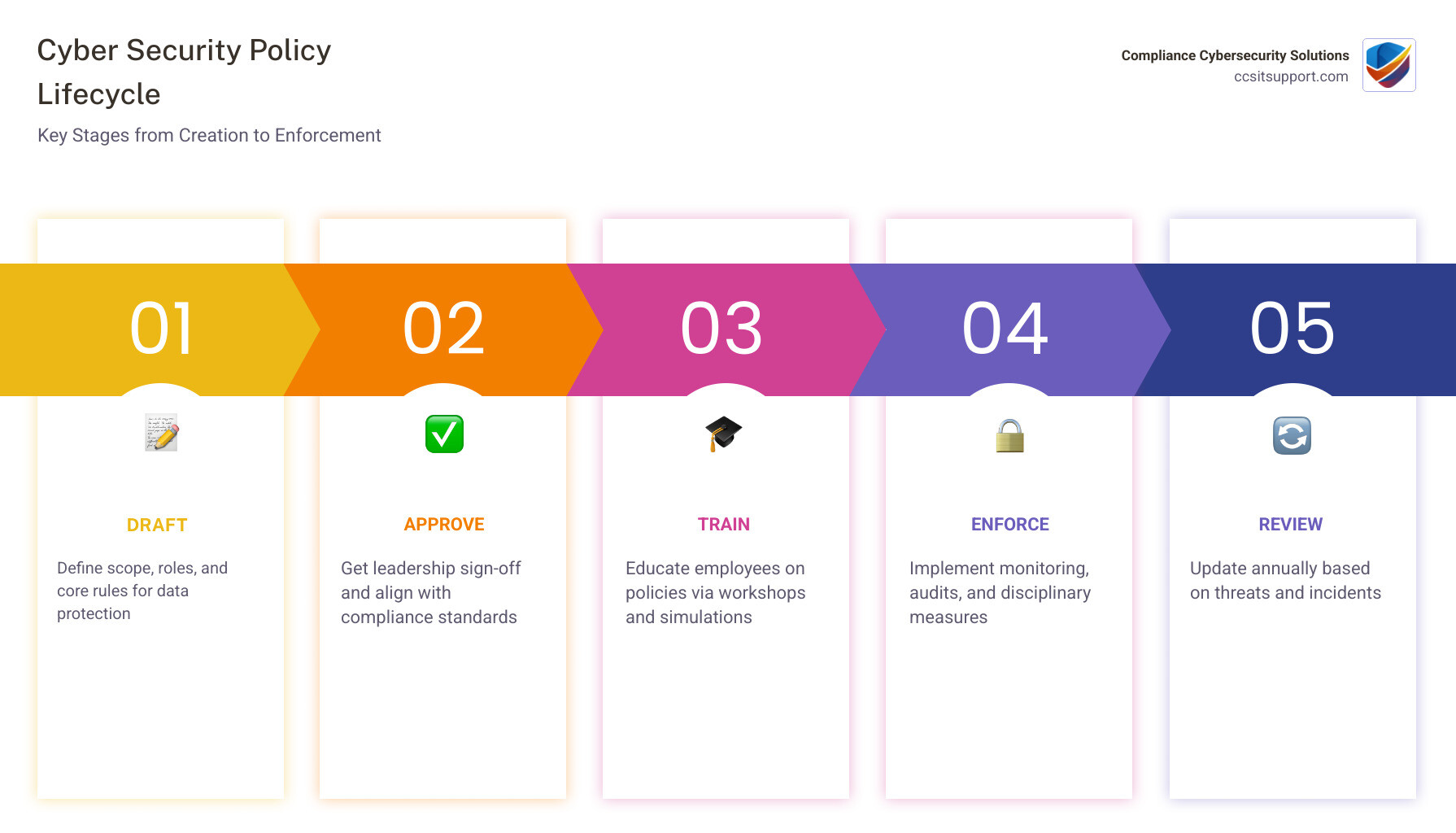
Implementing a policy is a marathon, not a sprint. It starts with a formal introduction to the staff, often requiring a signed acknowledgment form.
To keep your policy effective, follow these steps:
Annual Reviews: Cyber threats evolve daily. Your policy should be reviewed and updated at least once a year to address new risks like AI-driven phishing.
Mapping to Frameworks: Ensure your policy maps to the 49 subcategories of the NIST CSF. This makes it much easier to pass audits if you are working toward CMMC or HIPAA compliance.
Regular Training: Don't just hand out a PDF. Conduct quarterly "lunch and learn" sessions or phishing simulations.
Audit and Monitor: Use tools to ensure that encryption is active and that employees are actually using MFA.
For local government examples, you can look at the [PDF] City of Cocoa Information Technology & Cybersecurity Policies to see how public entities structure their governance.
Where to Find a Sample Cyber Security Policy and Templates
You don't have to hire a consultant to get started (though we're always here to help!). There are several high-quality, free resources available:
SANS Institute: Offers over 30 free policy templates covering everything from network access to "Acceptable Use."
MS-ISAC: Provides templates specifically mapped to NIST CSF subcategories.
Local Florida Examples: The [PDF] Information Security Policy - City of Pensacola provides a great real-world look at how Florida organizations handle information security.
Frequently Asked Questions about Sample Cyber Security Policies
Who does a cyber security policy apply to?
It applies to everyone who touches your data or systems. This includes full-time employees, part-time staff, contractors, interns, and even third-party vendors who have remote access to your network.
How often should a cyber security policy be updated?
At a minimum, you should review your policy annually. However, significant changes to your business—such as moving to a fully remote model or adopting new cloud software—should trigger an immediate review.
What is the difference between a policy and a standard?
A policy is a high-level document that outlines "what" needs to be done (e.g., "Passwords must be strong"). A standard or procedure is the "how" (e.g., "Passwords must be 12 characters, include a symbol, and be stored in Bitwarden").
Conclusion
Creating a sample cyber security policy is the first step toward building a culture of security within your organization. It protects your reputation, your financial stability, and your customers' trust. But a policy is only as good as its implementation.
At CCS Compliance & Cybersecurity Solutions, we specialize in helping businesses in Fort Lauderdale and across Florida align their IT with rigorous standards like HIPAA and CMMC. We don't just give you a template; we provide the layered security and threat detection needed to ensure that policy is actually working.
If you’re ready to move from a "sample" to a fully realized, compliant security posture, we can help. Get expert Cybersecurity support today and let's secure your business together.