

Cybersecurity Audit Services for SMBs and Enterprises
Why IT Security Audit Services Matter Before Risk Becomes a Crisis
IT security audit services give businesses an independent, structured view of whether their security controls, compliance evidence, and risk priorities are strong enough for customers, regulators, and cyber insurers.
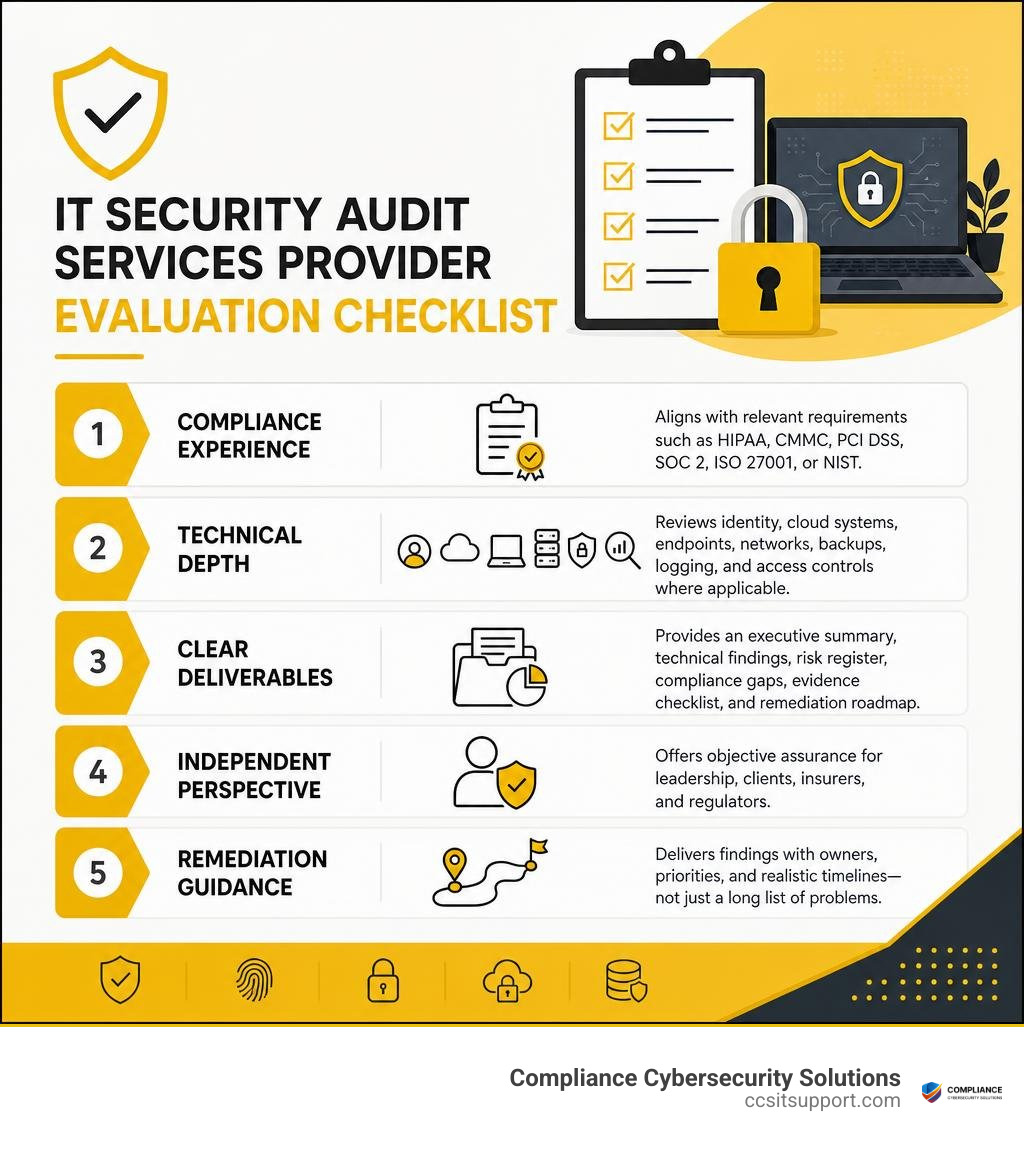
When comparing providers, look for a team that can do more than run a scan. The right provider should evaluate your technical environment and your security program, then turn findings into a clear plan your leadership and IT teams can act on.
What to evaluate Why it matters Compliance experience Your audit should align with relevant requirements, such as HIPAA, CMMC, PCI DSS, SOC 2, ISO 27001, or NIST. Technical depth Reviews should cover identity, cloud systems, endpoints, networks, backups, logging, and access controls where applicable. Clear deliverables Expect an executive summary, technical findings, risk register, compliance gaps, evidence checklist, and remediation roadmap. Independent perspective A credible audit provides objective assurance for leadership, clients, insurers, and regulators. Remediation guidance Findings need owners, priorities, and realistic timelines - not just a long list of problems.
For regulated organizations with limited internal IT resources, an audit can reveal where protected data, financial data, or defense information is exposed before an incident, failed customer review, or insurance renewal creates pressure. A meaningful security review is generally appropriate at least once per year and after major changes such as a cloud migration, acquisition, new compliance obligation, or major infrastructure change.
I am Michael Gaigelas II, and I help organizations assess gaps and build practical remediation plans through IT security audit services aligned with CMMC 2.0, ISO 27001, SOC 2, HIPAA, and broader business risk goals. The next sections explain the audit types, assurance reports, and provider capabilities that matter most when selecting an audit partner.
Fundamental Audit Types and Compliance Framework Alignment
Selecting the right evaluation path begins with understanding the distinct methodologies used to test an organization's defenses. Business leaders frequently confuse automated scans with comprehensive security evaluations. While automated tools have their place, relying on them as a substitute for a comprehensive evaluation leaves severe operational and technical blind spots.
Self-Assessments vs Vulnerability Scans vs Formal Audits
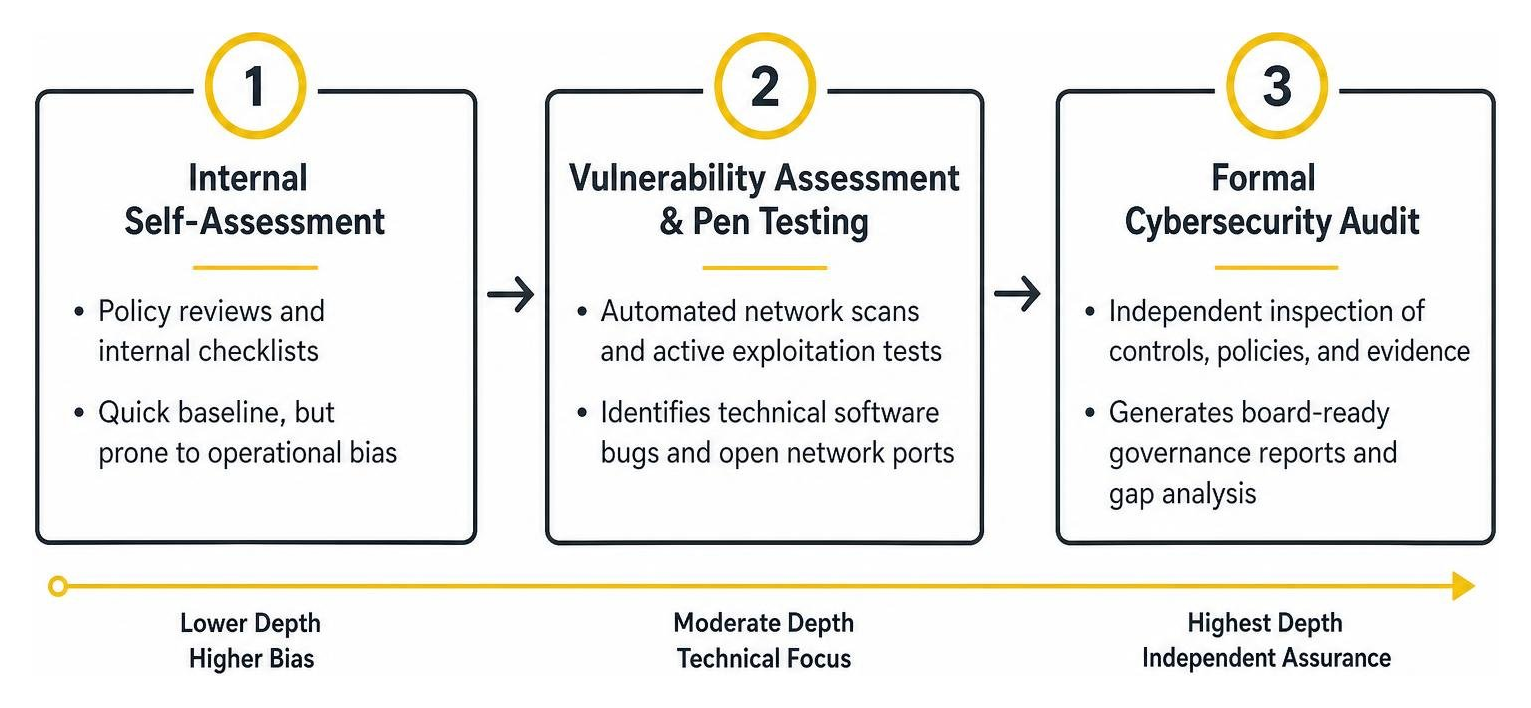
To build an effective posture, we must distinguish between internal self-assessments, technical vulnerability assessments, and independent formal audits:
Self-Assessments: Internal teams complete questionnaires or check control lists. While valuable as a low-cost starting point to establish an initial baseline, self-assessments are inherently vulnerable to internal bias, incomplete scope, and missed operational gaps.
Vulnerability Assessments: These focus purely on technical scanning and penetration testing. They identify missing software patches, open firewall ports, misconfigured cloud storage, and unencrypted channels. However, a vulnerability scan cannot evaluate whether your staff adheres to password policies, how vendor risks are managed, or whether your incident response plan actually functions.
Formal Audits: An independent, exhaustive examination of governance policies, operational routines, technical controls, and physical security measures. A formal audit tests whether security controls are designed properly (Type 1) and operating effectively over time (Type 2).
Relying solely on automated vulnerability scanning or basic self-evaluations leaves critical gaps in administrative safeguards and documentation. When regulators or enterprise clients demand proof of security, only formal audit evidence satisfies their requirements.
Evaluating Specialized IT Security Audit Services for Compliance
Regulated industries face rigid mandate structures that require specialized audit design. Our experience across multi-tenant cloud environments and hybrid enterprise networks shows that aligning your internal controls with established cybersecurity frameworks yields the highest return on compliance investments.
Different regulatory regimes require distinct focus areas during an evaluation:
Healthcare (HIPAA): Organizations handling Protected Health Information (PHI) must implement strict access controls, data encryption at rest and in transit, business associate oversight, and audited audit logs. Working with dedicated hipaa compliance audit services ensures both technical configurations and administrative procedures withstand federal regulatory scrutiny.
Financial Services & CPA Firms (IRS WISP & PCI DSS): Financial firms handling credit card processing or sensitive personal financial records must comply with PCI DSS standards and maintain a documented Written Information Security Plan (WISP) required by the IRS. Organizations utilizing finance it compliance consulting can easily bridge technical payment gateways with strict accounting compliance mandates.
Defense Industrial Base (CMMC): Government contractors working within the Department of Defense supply chain must meet Cybersecurity Maturity Model Certification (CMMC) requirements mapped directly to NIST SP 800-171. This demands verified media sanitization, strict boundary protection, system logging, and rigorous physical access oversight.
Enterprise Frameworks (NIST CSF & ISO 27001): Organizations seeking broad market credibility leverage the NIST Cybersecurity Framework or ISO/IEC 27001. These frameworks establish clear governance structures covering identify, protect, detect, respond, and recover functions.
By pairing specialized it compliance consulting with a structured cybersecurity audit program, businesses transform regulatory burdens into measurable market advantages.
Choosing the Best IT Security Audit Services
When evaluating third-party audit partners, organizations must review the independent assurance reports the auditor can produce. External stakeholders—such as prospective enterprise clients, insurance underwriters, and board directors—expect standardized reporting that accurately reflects operational reality.
Independent Assurance Frameworks Compared
Different business relationships call for specialized reporting standardizations. The table below outlines how primary assurance frameworks function across technical and operational boundaries:
Framework Target Audience Primary Focus Area Reporting Horizon Key Standard / Criteria SOC 2 Type I B2B Customers & Partners Design suitability of security controls at a single point in time Single snapshot date AICPA Trust Services Criteria SOC 2 Type II Enterprise Clients & Auditors Operational effectiveness of controls evaluated over a testing period Historical window (typically 6-12 months) AICPA Trust Services Criteria ISAE 3402 Financial Auditors & Stakeholders Internal controls relevant to user organizations' financial reporting Point-in-time or historical testing period IAASB International Standard ISAE 3000 Regulators & Enterprise Boards Non-financial operational processes, data protection, and IT operations Flexible audit parameters IAASB General Assurance Framework
Organizations seeking international alignment or broad service assurance options often look to established international standards such as IT-Audit Services for guidance on structured reporting models like SOC 2, ISAE 3402, and ISAE 3000.
Key Deliverables Provided by IT Security Audit Services
A high-value security assessment should never leave you with an indecipherable list of technical jargon. Professional it security audit services deliver an organized documentation suite structured for both executive decision-makers and hands-on technical staff:
Executive Summary: A concise overview written in clear business language that outlines top strategic risks, organizational risk scores, overall control maturity, and board-level recommendations.
Technical Findings Report: Deep-dive analysis covering missing security patches, open ports, identity permissions, cloud misconfigurations, and infrastructure vulnerabilities across all evaluated systems.
Risk Register: A structured inventory classifying every single identified gap by threat severity, business impact score, exploit likelihood, assigned risk owner, and review cadence.
Remediation Roadmap: A prioritized, step-by-step action plan dividing fixes into immediate short-term containment tasks, mid-term system reconfigurations, and long-term policy adjustments.
Compliance Gap Analysis: A side-by-side mapping comparing your current operating procedures against target controls in frameworks like HIPAA, NIST CSF, or CMMC.
Evidence Checklist: A complete catalog of verified evidence artifacts—such as configuration backups, active directory export logs, firewall policy screenshots, and user access lists—ready for external auditor presentation.
Leveraging a focused network security audit program ensures that technical deliverables bridge the gap between network infrastructure engineers and executive management.
Independent Assurance for Clients and Regulators
Independent security audits provide direct value by providing objective validation of your technical environment. When an accredited external auditor reviews your technical controls, your enterprise clients obtain verified proof that their shared data remains safe.
Independent assurance strengthens client trust by validating key operational areas:
System Processing Integrity: Verifies that automated system processing remains accurate, authorized, and free from unauthorized interference.
Third-Party Vendor Risk Oversight: Demonstrates to enterprise buyers that your supply chain risks are actively monitored and controlled.
Control Validation Under Regulatory Oversight: Delivers defensible, un-biased documentation required by regulatory inspectors during formal compliance reviews.
The 10-Step Audit Process, Cyber Insurance, and vCISO Oversight

Executing an effective audit requires a systematic approach. Rather than disrupting daily operations, a well-planned audit follows a structured, multi-phase lifecycle.
Navigating the End-to-End Audit Lifecycle
A comprehensive information security program audit progresses through ten defined milestones to maintain full transparency and thorough technical review:
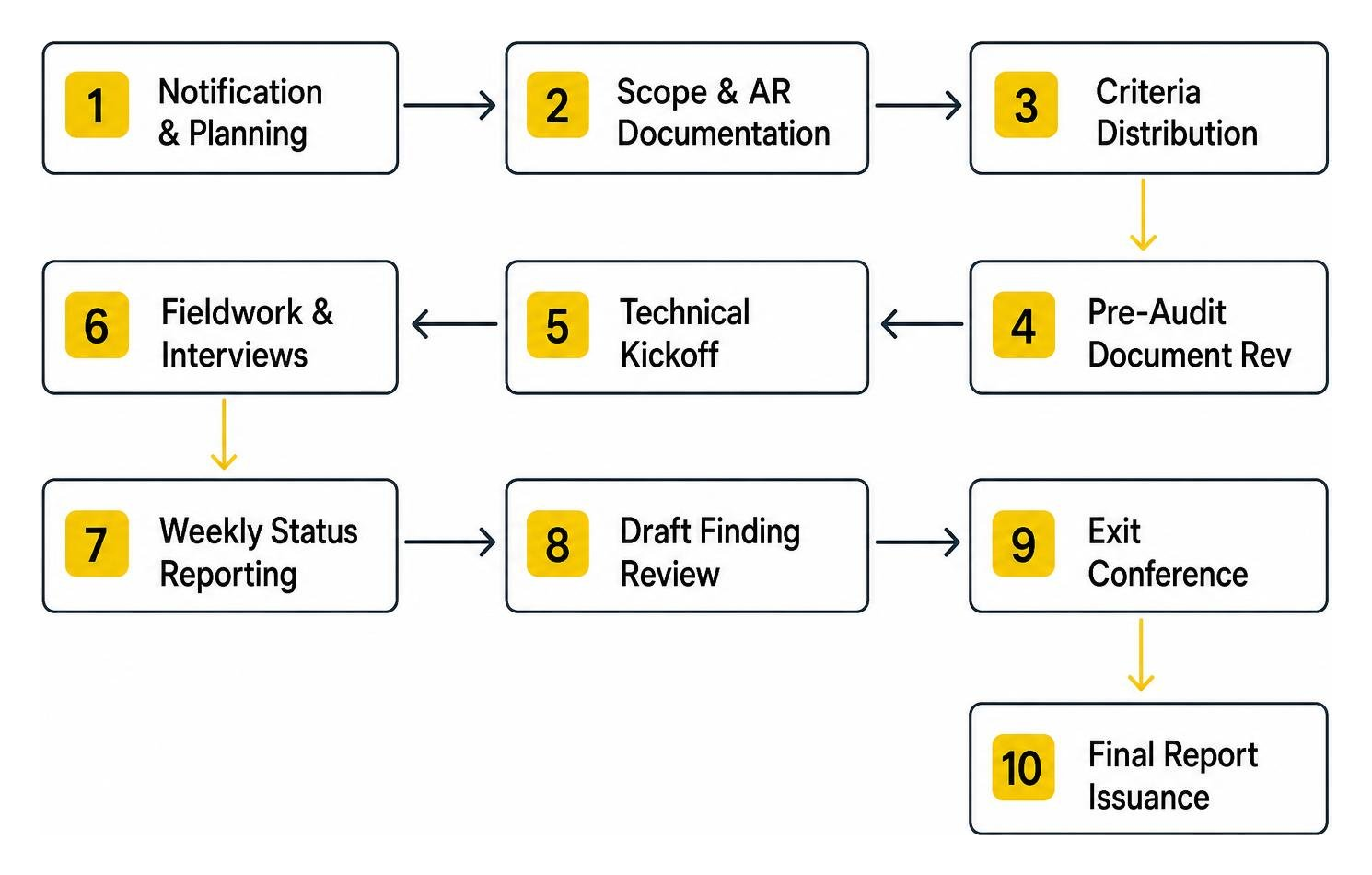
Notification & Initial Scoping: Setting project parameters, establishing boundaries, and defining operational systems under evaluation.
Articles Request (AR) Submission: Gathering administrative policies, network diagrams, and standard operating procedures prior to active testing.
Audit Criteria Distribution: Providing internal teams with complete audit control rubrics so expectations are clear from day one.
Pre-Audit Documentation Review: Off-site evaluation of written security policies, architecture blueprints, and previous assessment history.
Technical Kickoff Meeting: Aligning internal IT engineers, executive management, and audit teams on timelines, system access requirements, and operational rules of engagement.
Fieldwork & Technical Interviews: Active technical scanning, account privilege reviews, physical walk-throughs, and subject matter expert interviews.
Weekly Status Reporting: Providing leadership with ongoing updates to surface major findings early and prevent end-of-audit surprises.
Draft Report Review: Presenting initial findings to internal teams to allow clear factual verification and preliminary feedback.
Exit Conference: Formal executive meeting discussing identified risks, control deficiencies, business impacts, and suggested remediation timelines.
Final Report Issuance: Delivering polished, board-ready audit reports, risk registers, and finalized compliance evidence packages.
Achieving Cyber Insurance Readiness and Governance with a vCISO
Obtaining and renewing cyber liability insurance has evolved from completing a quick questionnaire into a rigorous underwriting process. Insurers routinely deny coverage or raise premiums significantly for businesses lacking proven essential controls.
This is where a Virtual Chief Information Security Officer (vCISO) becomes essential. A vCISO bridges executive governance with operational IT execution by translating raw audit results into prioritized action items.
Your vCISO leads the remediation effort by establishing mandatory security governance framework foundations:
Establishing clear risk ownership and actionable deadlines across technical staff.
Enforcing multi-factor authentication (MFA) across every remote access point, email mailbox, and cloud environment.
Deploying Endpoint Detection and Response (EDR) solutions across all network endpoints.
Verifying isolated, immutable backup architectures capable of surviving automated ransomware attacks.
Drafting comprehensive administrative controls, such as a formal sample cyber security policy, tailored to operational workflows.
Frequently Asked Questions About IT Security Audits
How often should a business perform a security audit?
A comprehensive security review should be conducted at least annually. Additionally, organizations should trigger targeted audits following major operational shifts, including:
Migrating core infrastructure to public or hybrid cloud environments (e.g., Microsoft 365 or Azure).
Executing corporate mergers, acquisitions, or restructuring efforts.
Introducing new regulatory compliance mandates or entering highly regulated market spaces.
Experiencing a major cybersecurity incident or significant near-miss breach event.
Preparing for annual cyber insurance policy renewals or major customer vendor security reviews.
What is the role of a vCISO in guiding audit remediation?
A Virtual CISO provides executive leadership without the high cost of a full-time executive salary. Following an audit, the vCISO analyzes complex technical findings, prioritizes remediation based on real-world business risk, creates budget allocations, writes custom security policies, and reports progress directly to executive leadership and board directors.
How do audits assist with cyber insurance requirements?
Insurance underwriters require verifiable proof that key security controls are active before approving policy applications. An independent audit validates that mandatory requirements—such as MFA, EDR, endpoint encryption, patch routines, and immutable backups—are operating effectively. Presenting an independent audit report simplifies underwriting approvals, prevents coverage denials, and helps secure favorable premium rates.
Strengthening Organizational Defense with Expert Audit Guidance
In an era of rising cyber threats and strict compliance demands, reactive security leaves your business vulnerable to unexpected downtime, regulatory penalties, and reputational loss. Partnering with experienced cybersecurity professionals allows you to identify vulnerabilities early and build an actionable, defensible security strategy.
CCS Compliance & Cybersecurity Solutions, based in Fort Lauderdale, FL, delivers complete security and compliance support designed for regulated organizations across Florida. Our experienced team blends deep compliance expertise with proactive technical safeguards—including layered security architectures, managed threat detection, identity management, and cloud controls—to protect your critical data.
Whether you are preparing for a CMMC evaluation, navigating HIPAA requirements, aiming to satisfy cyber insurance requirements, or looking to strengthen your security posture, we provide clear, executive-level guidance every step of the way. Explore our comprehensive Cybersecurity and Compliance Services today to schedule your comprehensive security review and strengthen your organizational defenses before risks turn into business disruptions.