

The Blueprint for a Modern Cybersecurity Audit Program
Why Every Regulated Organization Needs a Cybersecurity Audit Program in 2026
A cybersecurity audit program is a structured, repeatable process for evaluating whether your organization's security controls are in place, functioning, and aligned with regulatory requirements — giving leadership documented assurance that risks are being managed.
Here's what a cybersecurity audit program typically covers:
Asset and risk management — knowing what you have and what threatens it
Configuration management — ensuring systems are hardened and change-controlled
Identity and access management — limiting who can access what
Continuous monitoring and logging — maintaining real-time visibility into threats
Incident response — having a tested plan when something goes wrong
Contingency planning and recovery — restoring operations after a breach
The stakes have never been higher. According to IBM, the average data breach now costs $4.24 million. Statista reports that data breaches jumped 37 percent in a single quarter. For organizations in healthcare, finance, or defense contracting, a single audit gap can mean regulatory penalties, lost contracts, or a breach that makes headlines.
Yet most organizations still treat cybersecurity audits as a one-time checkbox rather than a living program. That's a costly mistake — and one that this guide will help you fix.
I'm Michael Gaigelas II, and I've spent my career guiding organizations through complex compliance frameworks — including CMMC 2.0, HIPAA, ISO 27001, and SOC 2 — helping them build audit-ready cybersecurity programs that reduce real risk without blowing the budget. If you're a leader in a regulated industry trying to figure out how to structure or strengthen your cybersecurity audit program, this guide was written for you.
Understanding the Cybersecurity Audit Program
To build a program that actually protects your business, we first need to define what it is. A cybersecurity audit program isn't just a single visit from an auditor; it is a formal, documented methodology designed to establish inherent risks and institute mitigating controls. Its ultimate goal is to provide "reasonable assurance" that your business objectives can be met without being derailed by a cyber catastrophe.
In the banking and healthcare sectors, these programs are vital for risk management. They ensure that the "auditable entity"—whether that's your cloud environment, your local network, or your payment processing system—is protected by controls that are both present and functioning.
Feature Point-in-Time Audit Continuous Assessment Frequency Annual or Semi-Annual Real-time / Ongoing Focus Compliance & Control Presence Effectiveness & Risk Exposure Method Manual Review & Sampling Automated Monitoring & Analytics Output Formal Report (Static) Dynamic Dashboards & Alerts
By shifting from a "once-a-year" mindset to a programmatic approach, you align your security with your cybersecurity strategy, ensuring that risk mitigation is a constant state rather than a seasonal event.
The Critical Difference: Audit vs. Assessment
We often see these terms used interchangeably, but in a professional cybersecurity audit program, they serve different masters.
Cybersecurity Audit: This is a formal, often independent validation. It’s a "snapshot" that checks for the presence of controls. Did you say you have a firewall? The auditor checks the box. It is primarily driven by compliance and provides a high-level view of whether you are following your own policies.
Cybersecurity Assessment: This is a more proactive, technical evaluation. It doesn't just ask if the firewall is there; it tests if the firewall is effective against a modern SQL injection attack. Assessments use peer benchmarking and risk exposure data to find the "why" behind vulnerabilities.
Think of an audit as a building inspector checking that you have smoke detectors. An assessment is the fire department checking to see if those detectors actually trigger the sprinklers when smoke is present.
Integrating Continuous Monitoring into your cybersecurity audit program
In 2026, a "point-in-time" audit is no longer enough to satisfy regulators or insurance carriers. The gap between audits—often called the "residual risk window"—is where attackers live. To close this window, modern programs must integrate Continuous Cybersecurity Monitoring and Ongoing Audit Programs.
This integration allows for real-time visibility. For example, CISA’s Continuous Diagnostics and Mitigation (CDM) program now supports dashboards across 23 federal civilian agencies, providing a blueprint for how private organizations can maintain persistent awareness. By leveraging standards like NIST SP 800-137A, we can develop ISCM (Information Security Continuous Monitoring) programs that evaluate the completeness of security data analysis every single day, not just once a year.
Frameworks and Regulatory Mandates for 2026
If the audit program is the house, frameworks are the architectural blueprints. In April 2026, the gold standard remains the NIST Cybersecurity Framework (CSF) 2.0. This updated version introduced the GOVERN function, which places leadership accountability at the center of all security activities.
To make your cybersecurity audit program effective, you should utilize the Cybersecurity Program Audit Guide | U.S. GAO. While originally designed for federal agencies, the GAO’s guide offers a battle-tested methodology for identifying weaknesses in any complex IT environment. This level of rigor is essential for maintaining compliance in high-stakes industries.
Industry-Specific Requirements: HIPAA, FFIEC, and FISMA
Depending on your industry, your audit program will have specific "must-haves":
Healthcare (HIPAA): Audits must map technical evaluations to NIST SP 800-66 standards, focusing heavily on the protection of Electronic Protected Health Information (ePHI).
Banking (FFIEC): The focus here is on risk management and the "inherent risk profile" of financial transactions.
Federal/Defense (FISMA & FedRAMP): If you are a cloud provider or contractor, you likely face monthly continuous monitoring deliverables, including vulnerability scans and Plans of Action and Milestones (POA&Ms).
Furthermore, the SEC now requires more transparent reporting of cyber incidents, making a documented audit trail a legal necessity for many organizations.
Leveraging NIST CSF 2.0 for Audit Scoping
One of the best ways to improve your cybersecurity audit program is through the use of NIST CSF Organizational Profiles.
Current Profile: Shows where you are today.
Target Profile: Shows where you need to be to meet regulatory or business goals.
By conducting a "Gap Analysis" between these two, you can prioritize your audit findings. NIST also provides "Informative References" and "Quick-Start Guides" that help small and medium-sized organizations implement foundational protections without needing a 50-person IT team. This is especially useful for addressing supply chain risk management, ensuring your vendors aren't the weak link in your armor.
Key Components of an Effective cybersecurity audit program
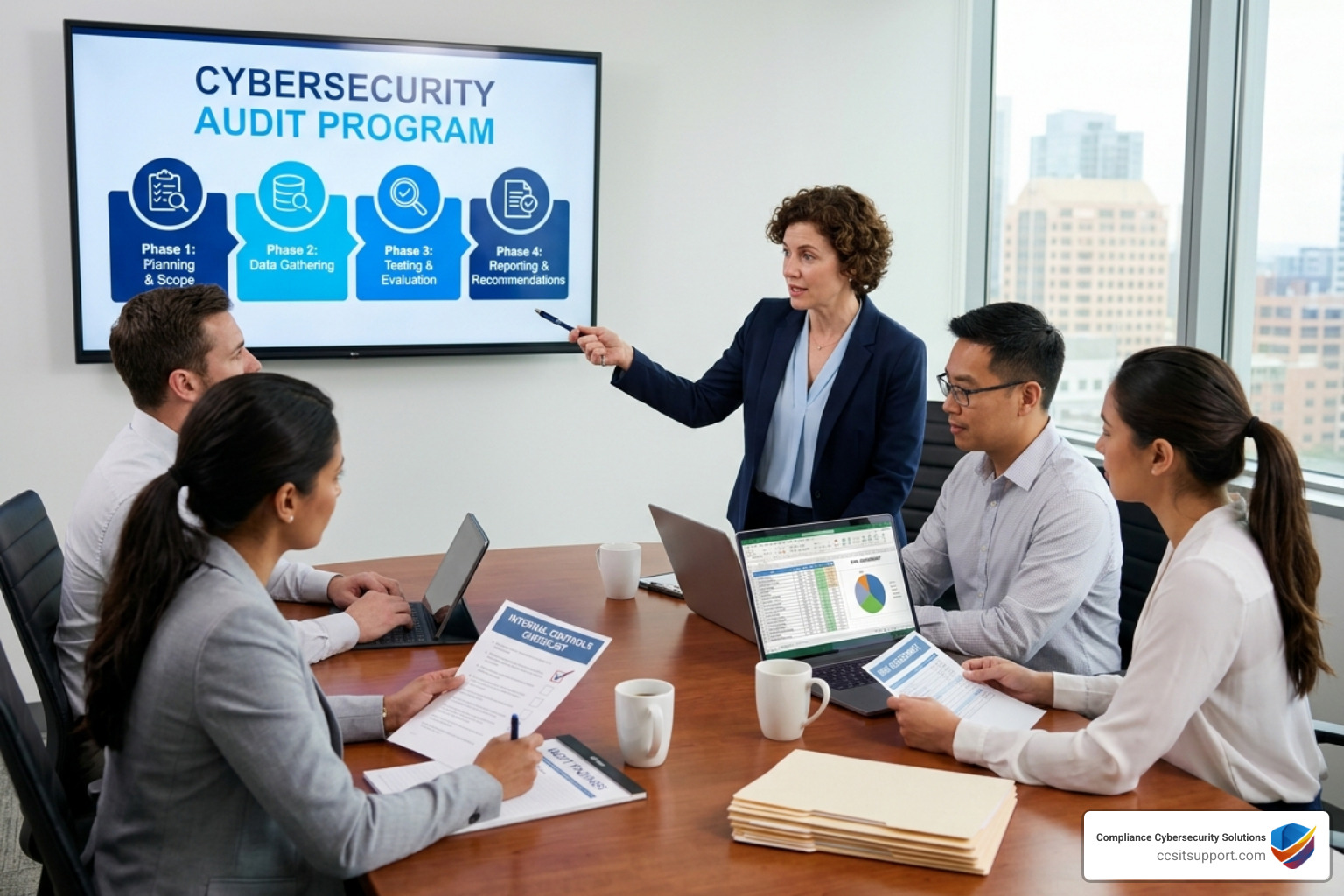
A truly effective program doesn't just look at the "big stuff." It drills down into the six primary components identified by the GAO:
Asset and Risk Management: You can’t protect what you don’t know you have. This involves a full inventory of hardware, software, and data.
Identity and Access Management (IAM): Limiting access to the "least privilege" necessary for a job.
Configuration Management: Controlling changes to system settings so security isn't accidentally turned off.
Continuous Monitoring and Logging: Maintaining a "black box" recorder of everything that happens on your network.
Incident Response: A documented plan for who does what when a breach is detected.
Contingency Planning: How you get back to work after a disaster.
Addressing Emerging Threats: AI Risks and Supply Chain Scrutiny
As we move through 2026, two new areas are dominating the cybersecurity audit program landscape: AI Risk and Supply Chain Scrutiny.
Generative AI has introduced new vulnerabilities, such as prompt injection and data leakage. Your audit program must now evaluate how your employees are using AI and whether sensitive company data is being fed into public models. Simultaneously, third-party risk management has shifted from a "check-the-box" questionnaire to requiring verified proof of security from your vendors. CISA's Cross-Sector Cybersecurity Performance Goals (CPGs) 2.0 now emphasize that internet-facing systems should have zero Known Exploited Vulnerabilities (KEVs), a standard you should hold your vendors to as well.
Technical Controls and Vulnerability Logging
On the technical side, your audit should verify the integration of a SIEM (Security Information and Event Management) system. This tool centralizes log collection and correlation, allowing you to see patterns that individual sensors might miss. For our clients in Florida, the Cybersecurity Resources - Florida Inspectors General provides excellent localized guidance on maintaining these IT security controls to protect public and private data alike.
The Audit Lifecycle: From Planning to Remediation
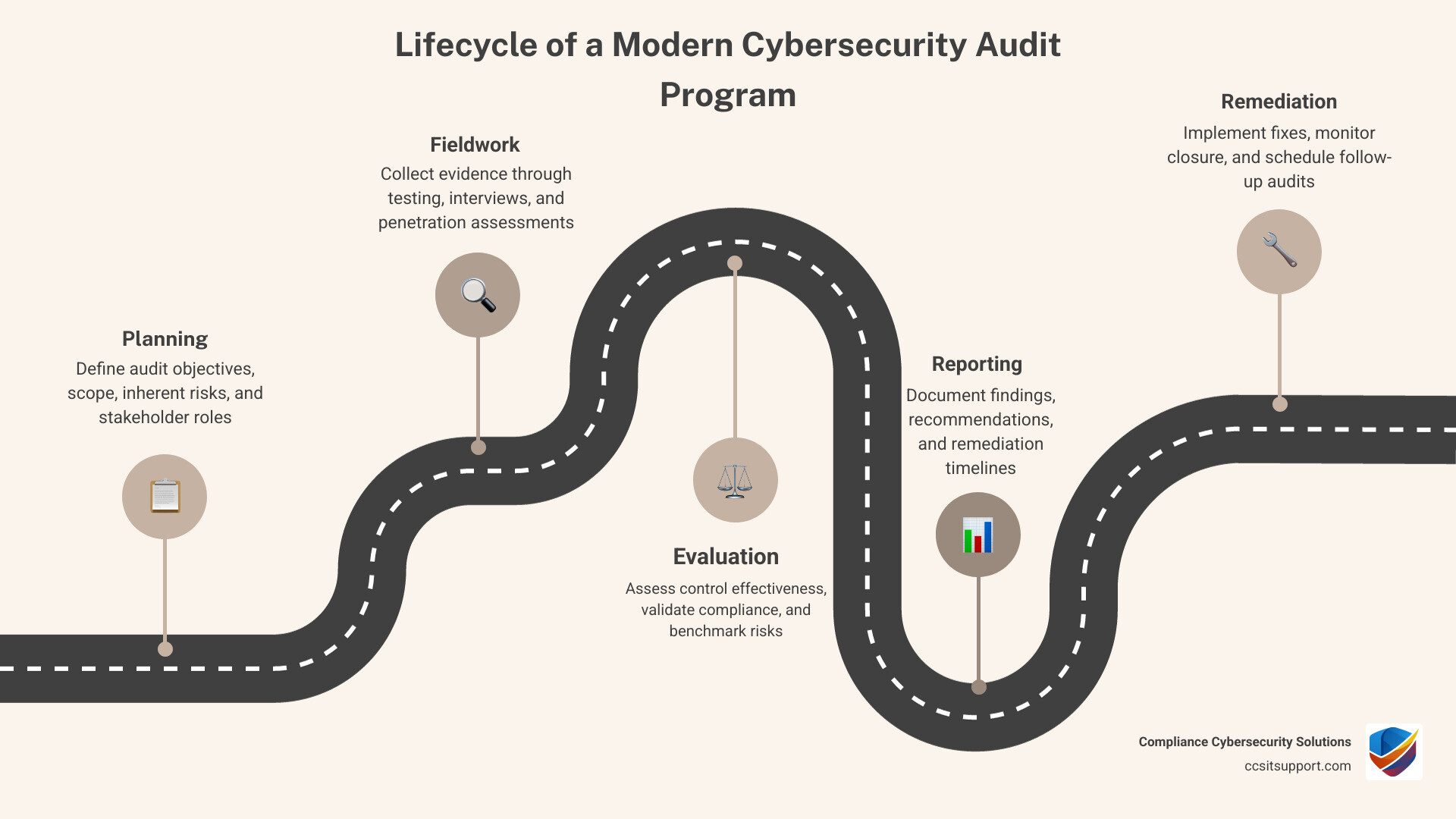
Conducting an audit is a journey, not a destination. To ensure you don't miss anything, we recommend using tools like the Cyber Security Audit Program - Canadian Centre for Cyber Security. Their "Preliminary Survey Tool" is fantastic for focusing your audit on the areas that matter most.
Planning and Conducting the Audit
The planning phase is where you define your audit objectives. Are you auditing for HIPAA compliance, or are you preparing for a CMMC assessment?
Inherent Risk Assessment: Determine the natural risk level of the entity before any controls are applied.
Fieldwork: This involves stakeholder interviews, evidence collection (screenshots, logs, policies), and often penetration testing to find real-world weaknesses.
Independent Judgment: The auditor must remain objective, providing a "reasonable assurance" that risks are effectively mitigated.
Measuring Success: Metrics for your cybersecurity audit program
How do you know if your Our Services are actually working? You need metrics.
Finding Closure Rate: How quickly are you fixing the "red flags" found in the last audit?
Mean Time to Remediate (MTTR): The average time it takes to patch a critical vulnerability.
Effectiveness Ratio: The percentage of controls that passed testing versus those that failed.
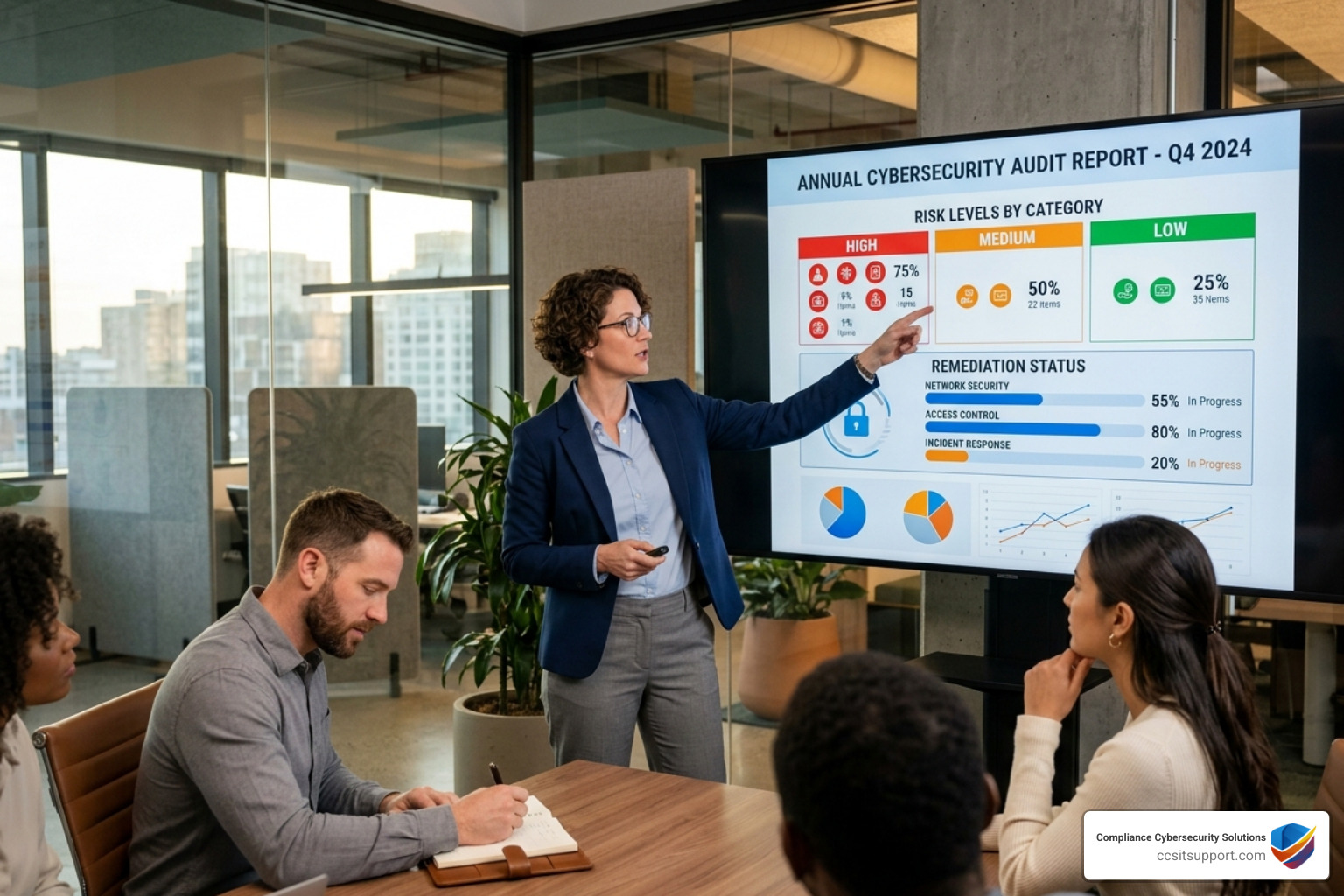
Regularly reporting these metrics to the board ensures that cybersecurity remains a funded, high-priority business function.
Professional Standards and Implementation Tools
The quality of your cybersecurity audit program is only as good as the people running it. We recommend that auditors hold recognized certifications like the CISA (Certified Information Systems Auditor), CISSP, or CEH (Certified Ethical Hacker). For internal teams looking to level up, Auditing the Cybersecurity Program Certificate - The IIA provides a specialized pathway to master these skills.
Internal vs. Third-Party Audits: Benefits and Limitations
We are often asked if an internal team can handle the audit.
Internal Audits: These are great for continuous improvement and cost-efficiency. They understand the business culture and can perform "pulse checks" frequently.
Third-Party Audits: These offer objectivity. A third party doesn't have a "boss" to please within the IT department, so they are more likely to report uncomfortable truths. For major compliance milestones (like SOC 2 or HIPAA), a third-party audit is usually a requirement for external stakeholders.
Using templates, such as the Excel-based programs from AuditNet, can help both internal and external teams stay organized and ensure no control is overlooked.
Recommended Certifications for Cybersecurity Auditors
If you are building an in-house team in the Sunshine State, resources like HOME | Cyber Florida at USF are invaluable for training. ISACA's Cybersecurity Audit Certificate is another excellent benchmark, requiring 8+ hours of specialized content and a rigorous exam to ensure the auditor understands governance, operations, and specific technology risks.
Frequently Asked Questions about Cybersecurity Audits
How often should an organization conduct a cybersecurity audit?
At a minimum, a formal audit should be conducted annually. However, for highly regulated industries like healthcare or finance, a "continuous audit" approach—where specific controls are tested quarterly—is becoming the standard to manage evolving threats.
What are the most common findings in a modern cybersecurity audit?
The "usual suspects" include unpatched software (vulnerability management), overly broad user permissions (identity management), and a lack of documented incident response testing. Interestingly, "shadow IT"—employees using unauthorized AI tools or cloud apps—is a rapidly growing finding in 2026.
Can a cybersecurity audit replace a penetration test?
No. An audit checks if the locks are on the doors and the policies are in the drawer. A penetration test is a controlled attempt to actually "break in." A modern cybersecurity audit program should include penetration testing as a technical component of the fieldwork.
Conclusion
Building a modern cybersecurity audit program is no longer a luxury—it's a fundamental requirement for business survival in 2026. By moving away from "checkbox compliance" and toward a continuous, risk-based program, you protect your reputation, your data, and your bottom line.
At CCS Compliance & Cybersecurity Solutions, we specialize in helping organizations in Fort Lauderdale and across Florida navigate these complexities. Whether you need to align with HIPAA, prepare for CMMC readiness, or simply want to ensure your IT support is actually keeping you secure, we are here to help.
Don't wait for a $4 million breach to find out your controls aren't working. Explore our Resources or Get Started with a Cybersecurity Audit today to build a blueprint for a more secure tomorrow.