

Securing the Digital Vault with Managed Services
Why Finance Cybersecurity Managed Services Are No Longer Optional
Finance cybersecurity managed services are specialized, outsourced security programs that protect financial institutions from cyber threats while keeping them compliant with regulations like NYDFS Part 500, GLBA, SEC rules, FINRA, and PCI DSS.
Here's what they typically include:
24/7 Security Operations Center (SOC) monitoring and threat detection
Managed Detection and Response (MDR)
Identity and Access Management (IAM/PAM)
Incident response planning and execution
Regulatory compliance support and audit preparation
Virtual CISO (vCISO) leadership
Cloud security and vulnerability management
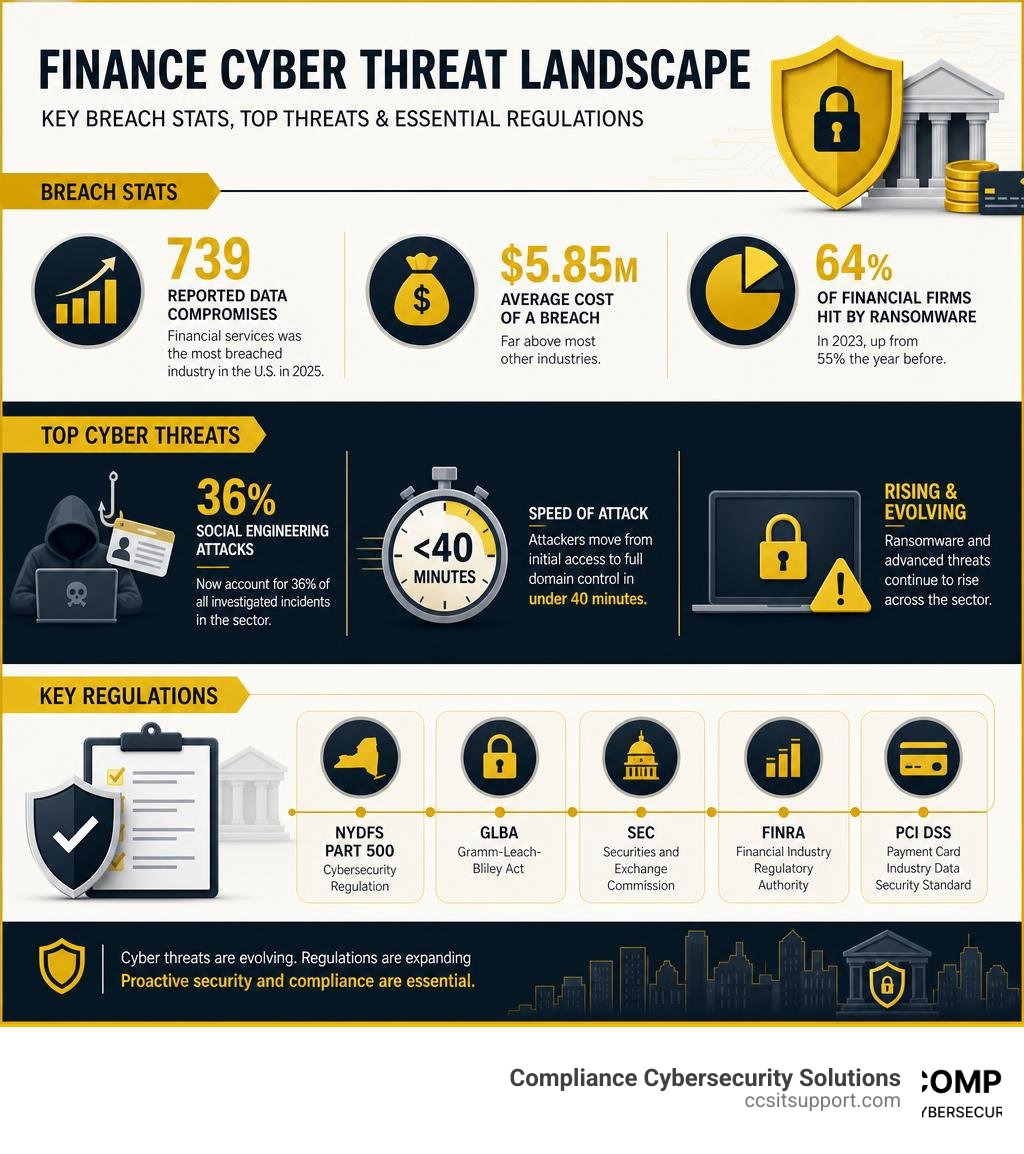
Financial services firms are under constant attack. In 2025, financial services was the most breached industry in the United States, with 739 reported data compromises. The average cost of a single breach in the sector hits $5.85 million — far above most other industries.
And it's not slowing down. Ransomware hit 64% of financial firms in 2023, up from 55% the year before. Social engineering attacks now account for 36% of all investigated incidents in the sector, with attackers moving from initial access to full domain control in under 40 minutes.
At the same time, regulators keep raising the bar. More than 30 cybersecurity regulations have been released in the U.S. alone since 2014, and the list keeps growing.
For most mid-market firms, hedge funds, RIAs, and community banks, building a full in-house security team to handle all of this is simply not realistic. A CISO in a major financial hub commands $425,000 to $575,000 per year in salary alone — before tools, staff, or infrastructure.
That's exactly where managed services come in.
I'm Michael Gaigelas II, founder of Compliance Cybersecurity Solutions, with deep experience helping financial services firms implement finance cybersecurity managed services that meet SEC, GLBA, NYDFS, and SOC 2 requirements — without the overhead of a full in-house team. In the sections ahead, I'll break down the threats you're facing, the solutions available, and how to choose the right approach for your firm.
Cyber Threats and Regulatory Compliance Challenges in Finance

To protect your digital vault, we first have to understand who is trying to break in—and how. The financial sector is a premier target for cybercriminals because, as the old saying goes, "that’s where the money is." In fact, 95% of attacks on this sector are purely financially motivated, resulting in over $12 billion in direct firm losses globally.
Today's threat actors have moved past generic, mass-phishing emails. They are deploying highly targeted, AI-enhanced social engineering campaigns—including deepfake audio and video clones—to trick employees. According to industry investigations, 36% of all cyber incidents in financial services now begin with social engineering, and more than half of those lead directly to the exposure of highly sensitive customer data.
Once inside, attackers don't waste time. Modern cybercriminal syndicates can escalate from initial entry to full domain administrator privileges in under 40 minutes. This speed makes traditional, reactive security measures obsolete.
Beyond social engineering, financial institutions face a wave of other high-priority threats:
Ransomware and Double Extortion: Attackers no longer just lock your systems; they steal your data first and threaten to leak it publicly unless a ransom is paid.
Insider Threats: Whether through malicious intent or simple human error, internal staff members remain a significant point of vulnerability.
Cloud Misconfigurations: Rapid digital transformation has led to identity gaps and exposed cloud storage, giving attackers an easy way to bypass traditional perimeter defenses.
To keep these threats at bay, we must implement rigorous data security controls. This is where Banking Data Loss Prevention becomes critical, ensuring that sensitive customer records, social security numbers, and routing details never leave your secure perimeter.
Navigating the Regulatory Minefield
While keeping hackers out is hard enough, financial firms must also satisfy an increasingly complex web of state and federal regulators. Since 2014, more than 30 major cybersecurity regulations have been enacted for financial services in the United States.
For Florida-based wealth managers, community banks, and investment firms, compliance is a multi-front battle:
GLBA Safeguards Rule: Requires a comprehensive, written information security program (WISP), continuous vulnerability monitoring, and strict oversight of third-party service providers. Under recent updates, breaches affecting 500 or more consumers must be reported to the FTC within 30 days.
SEC Regulation S-P: The SEC has significantly tightened its rules. Smaller firms under $1.5 billion in Assets Under Management (AUM) must comply with 2024 amendments by June 3, 2026. This includes a strict requirement to notify affected clients within 30 days of discovering a breach involving sensitive information.
NYDFS Part 500: Even if you are based in Florida, if you do business with New York residents, you must comply with these rules. It is widely considered the strictest state-level cybersecurity regulation in the country, requiring a named CISO, annual compliance certifications, and robust penetration testing.
FINRA and PCI DSS: Broker-dealers must secure communications capture and archiving, while any institution processing card payments must adhere to strict PCI DSS standards.
DORA (Digital Operational Resilience Act): If your Florida-based firm has European partners or clients, you must align with DORA's strict operational resilience and incident reporting timelines.
Staying compliant while managing day-to-day operations can lead to severe compliance fatigue. Partnering with experts for IT Compliance Consulting helps you build a structured framework that satisfies auditors, protects client trust, and prevents expensive fines.
Core Components of Finance Cybersecurity Managed Services
When you partner with a managed security service provider (MSSP), you aren't just buying software. You are deploying a comprehensive, multi-layered defense system designed to protect every layer of your business.
The core components of a robust financial cybersecurity program include:
24/7 Security Operations Center (SOC) & Managed Detection and Response (MDR): Continuous monitoring of your endpoints, networks, and cloud environments to spot and neutralize threats before they can spread.
Identity and Access Management (IAM) & Privileged Access Management (PAM): Enforcing the principle of least privilege. This ensures employees only access the specific data they need to do their jobs, backed by Multi-Factor Authentication (MFA) and Single Sign-On (SSO).
Security Information and Event Management (SIEM): Aggregating and analyzing log data from across your entire IT infrastructure to identify anomalies, track user behavior, and provide audit-ready compliance reporting.
Vulnerability Scanning and Management: Regularly testing your systems to find and patch security holes before attackers do.
To keep your defenses strong, you must rely on Multi-Layered Security Solutions that protect your perimeter, your endpoints, and your data. This layered approach is supported by a Managed Threat Detection Service, which uses advanced analytics to identify suspicious activity in real time.
For many mid-market financial firms, the big question is whether to build these capabilities in-house or outsource them. The table below highlights the key differences:
Capability / Resource In-House Security Team Managed Security Services (MSSP) Annual Cost Extremely High ($500k+ for staff, tools, and overhead) Predictable Monthly Fee ($8k to $25k for mid-market) Coverage Typically 8x5 (Overnight coverage requires 3x staff) Guaranteed 24/7/365 Monitoring & Response Time to Deploy 6 to 12 Months (Hiring, training, tool integration) 1 to 4 Weeks (Pre-built, integrated security stack) Compliance Expertise Dependent on individual hires' knowledge Dedicated compliance team specialized in SEC, GLBA, FINRA Scalability Slow (Requires hiring more staff as AUM grows) Instant (Can scale up endpoints and users overnight)
Implementing Threat Detection in Finance Cybersecurity Managed Services
In the financial sector, a single delayed alert can cost millions. That is why modern managed services combine advanced technology with human expertise to detect threats instantly.
We use artificial intelligence and machine learning to analyze network traffic patterns, establishing a baseline of "normal" behavior. If an account suddenly attempts to download a massive volume of client files or logs in from an unusual location, the system flags it immediately.
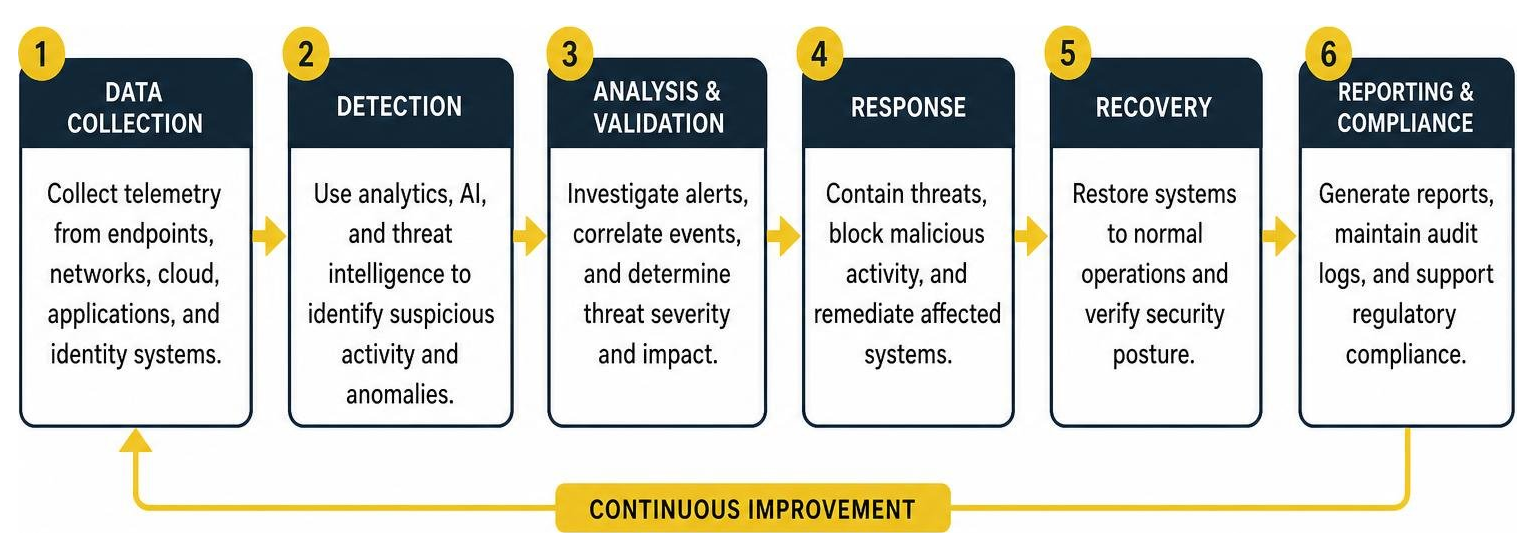
To achieve this level of visibility, we implement a dedicated Network Intrusion Detection System to monitor your incoming and outgoing traffic for known threat signatures and suspicious anomalies. To go a step further, we pair this with a Network Intrusion Prevention System that can automatically block malicious traffic, quarantine compromised devices, and stop an active attack in its tracks.
Incident Response and Governance in Finance Cybersecurity Managed Services
Even the best defenses can face a breach attempt. When an incident occurs, survival depends on having a tested, documented plan. Our managed services ensure you are never left guessing what to do next.
We help you develop a comprehensive incident response plan that outlines exact roles, communication channels, and containment procedures. For firms regulated by the SEC, we establish materiality assessment frameworks. If an incident occurs, this framework helps your executive team quickly determine if the breach is "material" and must be disclosed to the SEC within the mandatory 4-business-day window.
Furthermore, managed governance is essential for growing firms seeking institutional capital. During LP Operational Due Diligence (ODD) reviews, sophisticated investors treat cybersecurity as a primary risk. They will inspect your security policies, vendor risk management records, and incident response testing logs.
By utilizing Threat Detection and Incident Response Services for Businesses, you can confidently present auditors and investors with the exact documentation, testing logs, and executive-level reports they need to see.
Strategic Benefits of Outsourcing to an MSSP

Outsourcing your security to a specialized provider is more than just a defensive move—it is a strategic decision that supports your firm's growth.
Key benefits include:
Predictable Cost Control: Instead of facing unpredictable capital expenses for new security software and high salaries for in-house analysts, you pay a predictable monthly fee. This allows you to allocate capital directly to growing your business.
True 24/7/365 Protection: Cybercriminals do not work 9-to-5. Our managed services keep eyes on your network overnight, on weekends, and during holidays, ensuring you are protected around the clock.
Rapid Scalability: As your firm opens new offices, launches new funds, or adds endpoints, your security scales with you automatically. There is no need to pause growth while waiting to hire more IT staff.
Access to Specialized Expertise: You gain instant access to a team of credentialed security professionals, compliance experts, and certified engineers who live and breathe financial security.
To ensure your basic IT needs run as smoothly as your security, we recommend integrating your defense strategy with a Managed IT for Finance program. This combines day-to-day helpdesk support with advanced cybersecurity, keeping your team productive, your systems online, and your data completely secure.
Frequently Asked Questions about Financial Cybersecurity
What is the average cost of a financial sector data breach?
The average cost of a data breach in the financial sector is $5.85 million. This includes direct financial losses, regulatory fines, forensic investigation fees, and the cost of notifying clients. However, the largest long-term cost is often reputational damage. Financial firms run on client trust; once that trust is broken, client churn can cost far more than the immediate breach cleanup.
How do managed services support SEC and FINRA exam preparation?
We support exam preparation by acting as your technical compliance partner. We maintain the continuous documentation, audit logs, and evidence of administrative safeguards that examiners ask for. During an audit, our virtual CISO (vCISO) can work directly alongside your compliance team to answer technical questions and present evidence of your active security controls.
Can a managed service provider work alongside an in-house IT team?
Yes. This is known as a co-managed IT model. If you have an internal IT manager or a small helpdesk team, we can handle the heavy lifting of 24/7 security monitoring, compliance reporting, and threat hunting. This frees up your internal team to focus on daily user support and strategic technology projects, creating a highly efficient partnership.
Conclusion
In the financial world, trust and clean records are your most valuable assets. With cyber threats growing more sophisticated and regulatory requirements like SEC Reg S-P and GLBA imposing strict deadlines, trying to manage your security alone is a massive risk.
At Compliance Cybersecurity Solutions (CCS), based in Fort Lauderdale, Florida, we specialize in helping financial institutions align their technology with strict compliance standards. We deliver the layered security, continuous threat detection, and expert governance you need to protect your clients and survive your next audit.
Don't wait for a breach or a failed regulatory exam to take action. Contact our team today to schedule a comprehensive cybersecurity assessment and secure your digital vault.