

How Managed IT Services Keep Financial Firms Afloat
Why Financial Firms Can't Afford to Ignore Managed IT
Managed IT for finance refers to outsourcing your firm's technology management — including cybersecurity, compliance, infrastructure, and helpdesk support — to a specialized provider who handles it all for a predictable monthly fee.
Here's a quick breakdown of what it covers and why it matters:
What It Includes Why It Matters for Finance 24/7 monitoring and helpdesk Prevents costly downtime during trading hours Regulatory compliance support Keeps you aligned with FINRA, SEC, SOC 2, PCI DSS, GLBA Cybersecurity and threat detection Protects sensitive client data from breaches and fraud Cloud and infrastructure management Supports scalability and remote work securely Disaster recovery and backups Ensures business continuity when things go wrong AI-powered automation Speeds up reporting, onboarding, and fraud detection
Financial firms operate in one of the most regulated, high-stakes environments in any industry. A single hour of downtime, one failed audit, or one data breach can cost far more than an entire year of managed IT services. Yet many firms — especially mid-sized ones — are still running lean internal IT teams stretched across compliance, security, and day-to-day support all at once.
The pressure is real. Regulations keep expanding. Cyber threats keep evolving. And talented IT staff are hard to find and expensive to keep. According to KPMG, 70% of companies are already using managed services for half or more of their activities — and 81% expect to expand that further to stay competitive.
The question isn't really whether to explore managed IT outsourcing. It's how to do it right for a regulated financial environment.
I'm Michael Gaigelas II, and I've spent my career helping financial and regulated-industry firms implement managed IT for finance through compliance-first strategies — including SOC 2, ISO 27001, and CMMC 2.0 — while cutting technology costs by up to 50%. In this guide, I'll walk you through everything you need to evaluate your options clearly and confidently.
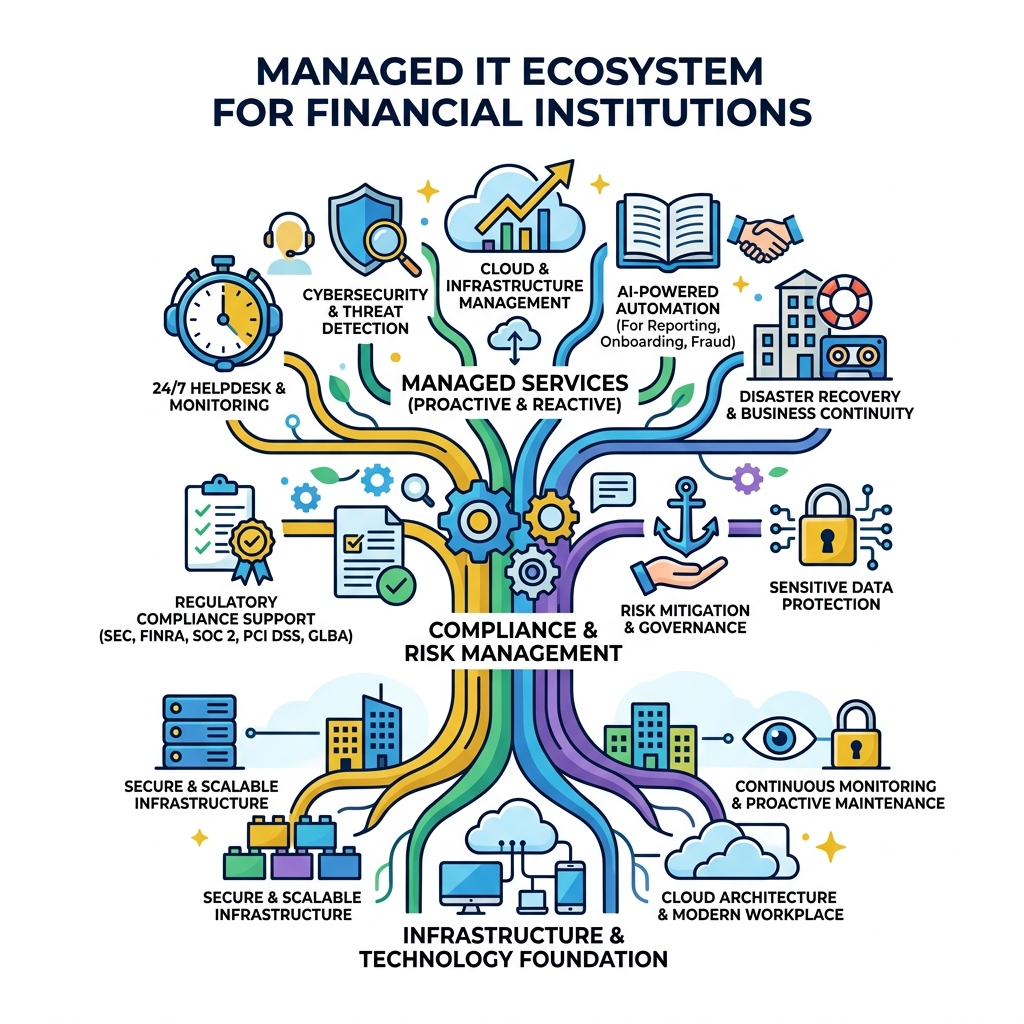
The Strategic Role of Managed IT for Finance
In the world of Florida’s financial sector, technology is no longer just a "back-office" function; it is the very engine of your business. Whether you are managing an investment fund in Fort Lauderdale or a credit union in Miami, your systems must be available 100% of the time. This is where the strategic role of Managed IT for finance becomes a game-changer.
24/7 Monitoring and Proactive Maintenance
Financial markets don't wait for your IT guy to wake up. We provide 24/7 monitoring to catch glitches before they turn into outages. This proactive approach is vital for high-stakes workflows like real-time trading and client onboarding. If a server starts to overheat or a network switch begins to lag at 3:00 AM, our team is already on it. This level of system reliability ensures that when the markets open, your team is ready to execute.
Closing the Talent Gap
Finding IT professionals who understand both advanced cybersecurity and the nuances of financial regulations is like finding a needle in a haystack. Many CFOs report spending up to 40% of their time managing HR issues related to back-office functions. By outsourcing, you gain immediate access to a full team of experts without the overhead of hiring, training, and retaining them.
Scalability for Growth
Are you planning a merger or opening a new branch? Managed IT allows you to scale your infrastructure instantly. You don't need to worry about buying new servers or hiring more helpdesk staff; your managed provider adjusts your service level to match your growth. This flexibility is why 99% of top U.S. banks use specialized financial technology solutions to maintain their competitive edge.
Navigating Complex Regulatory Compliance and Security
For financial firms, compliance isn't a "one and done" checklist—it’s a continuous state of being. Navigating the alphabet soup of FINRA, SEC, SOC 2, PCI DSS, GDPR, and GLBA can be overwhelming.

Layered Defense and Threat Detection
A basic firewall isn't enough anymore. Modern Managed IT for finance requires a "layered defense" strategy. This includes:
MDR (Managed Detection and Response): Constant hunting for threats within your network.
SIEM (Security Information and Event Management): Collecting and analyzing log data to spot patterns of a breach.
Identity Governance: Ensuring that only the right people have access to sensitive financial data.
Our compliance services focus on aligning your IT with strict standards like FFIEC and SEC requirements. We help you move beyond reactive "firefighting" to a proactive stance where your security framework actually supports your business goals.
Audit Readiness
Nothing strikes fear into a compliance officer like an unannounced audit. Managed IT providers maintain detailed documentation and audit trails year-round. When the regulators come knocking, you can produce the necessary reports with a few clicks. This significantly reduces "audit fatigue" and the risk of heavy fines. Specialized tools, such as NetSuite Purchase Management, also help by creating clear digital paper trails for every financial transaction and approval within your organization.
Enhancing Operations with AI and Cloud Infrastructure
The financial industry has historically been slow to move to the cloud due to security concerns. However, that has changed. Today, hybrid infrastructure—combining secure on-site hardware with scalable cloud power—is the gold standard for operational resilience.
Leveraging AI in Managed IT for Finance
Artificial Intelligence is no longer a futuristic concept; it is a current necessity for fraud detection and operational efficiency.
Fraud Detection: AI can monitor millions of transactions in real-time, flagging anomalies that would be impossible for a human to spot.
Automation: From order management to client reporting, AI-driven automation reduces manual errors and speeds up workflows.
Predictive Analytics: Use your data to forecast market trends and client needs more accurately.
Cloud Migration and Hybrid Managed IT for Finance
Migrating to the cloud isn't just about storage; it's about accessibility and disaster recovery. If a hurricane hits Florida, having your data in a secure, geo-redundant cloud ensures your firm stays online even if your physical office is inaccessible.
We specialize in cybersecurity for remote work, ensuring that your advisors can securely access client files from anywhere without violating privacy laws. This involves multi-cloud management and modernizing legacy systems to ensure they play nice with modern, secure web applications.
Cost-Benefit Analysis: Outsourcing vs. In-House Teams
When evaluating Managed IT for finance, the conversation eventually turns to the bottom line. Is it actually cheaper to outsource?
According to industry data from KPMG, an outcome-based managed services approach can reduce the total cost of operations by 15% to 45%.
Feature In-House IT Team Managed IT Services (CCS) Monthly Cost High (Salaries + Benefits + Taxes) Fixed, predictable monthly fee Availability Typically 9-5 (plus overtime) 24/7/365 Monitoring & Support Expertise Limited to the skills of 1-2 people Access to a full team of specialists Scalability Slow (requires new hires/hardware) Instant (software-defined scaling) Compliance Hard to maintain internally Built-in, expert-led management Strategic Focus Reactive (fixing broken things) Proactive (vCIO strategy & planning)
Predictable OpEx vs. Spiky CapEx
With an in-house model, you often face massive, unexpected capital expenditures (CapEx) when a server dies or a major software update is required. Managed IT shifts these costs to a predictable operating expense (OpEx). You pay per user or per device, making it much easier for your CFO to budget for the year.
Furthermore, a vCIO (virtual Chief Information Officer) works with you to develop a long-term technology roadmap. This ensures you aren't just spending money to keep the lights on, but investing in tools like NetSuite Item Management that actually improve your firm's efficiency and profitability.
Frequently Asked Questions about Financial IT Support
How do Managed IT services help with SEC and FINRA audits?
Managed IT providers implement automated logging and reporting tools that track every access point and data change. This creates a "single source of truth" for auditors. Instead of scrambling to find emails or manual logs, you provide clean, compliance-aligned documentation that demonstrates your adherence to SEC and FINRA standards. This level of transparency often leads to faster audits and fewer findings.
What is the typical ROI for outsourcing financial IT?
The ROI comes from three main areas:
Reduced Downtime: For a trading firm, even 10 minutes of downtime can equal thousands in lost revenue. Managed IT aims for 99.9% uptime.
Labor Savings: You avoid the costs of recruiting, training, and paying benefits for a full-time IT staff.
Faster Resolution: Specialized managed IT providers have shown they can accelerate response times for critical financial tickets by 35% to 45%.
Can Managed IT services prevent financial fraud?
While no system is 100% foolproof, Managed IT significantly lowers the risk. By using MDR (Managed Detection and Response) and SIEM (Security Information and Event Management), we monitor for suspicious behavior—like a login from an unknown country or an unusual bulk data transfer—and block it instantly. We also implement privileged access management, ensuring that employees only have access to the specific data they need to do their jobs, which prevents internal fraud.
Conclusion
In the modern financial landscape, technology is either your greatest asset or your biggest liability. Staying afloat requires more than just good financial advice; it requires a robust, secure, and compliant digital foundation.
At Compliance Cybersecurity Solutions (CCS), we don't just "fix computers." We act as your strategic partner, future-proofing your infrastructure against evolving threats and shifting regulations. From our base in Fort Lauderdale, we serve Florida firms with a "compliance-first" mindset, ensuring your IT aligns with the highest industry standards.
Don't wait for a data breach or a failed audit to realize your IT is lagging. Schedule an Appointment today to see how our Managed IT for finance solutions can protect your firm and empower your growth.