

Mastering Your Tech with IT Support Orlando Florida
Why IT Support Orlando Florida Matters for Regulated Businesses
IT support Orlando Florida helps local organizations keep systems available, protect sensitive data, support employees, and meet demanding compliance duties. For healthcare, defense, finance, and other regulated teams, the right support partner should combine fast user help, proactive monitoring, cybersecurity, backup planning, and clear guidance on frameworks such as HIPAA, CMMC 2.0, ISO 27001, and SOC 2.
What Orlando businesses need Why it matters Responsive help desk and desktop support Reduces employee downtime and disruption Secure networks, identity controls, and endpoint protection Limits ransomware, account compromise, and data loss On-site capability when needed Many Central Florida support roles and infrastructure needs remain hands-on Compliance-focused IT planning Helps prepare for audits and protect regulated information Backup and disaster recovery Keeps the business moving after outages, cyber incidents, or hardware failure
Orlando's IT market is active, with more than 2,000 technical-support openings across the metro area. The work is largely on-site, reflecting the area's healthcare facilities, defense contractors, government services, hospitality operations, and businesses that depend on physical devices and local networks.
I am Michael Gaigelas II, and I help organizations strengthen IT support Orlando Florida through practical cybersecurity, high-availability planning, and efficient compliance programs for CMMC 2.0, HIPAA, ISO 27001, and SOC 2. My focus is helping teams reduce risk, avoid costly rework, and make technology easier to manage as their needs grow.
Navigating IT Support Orlando Florida for Local Businesses
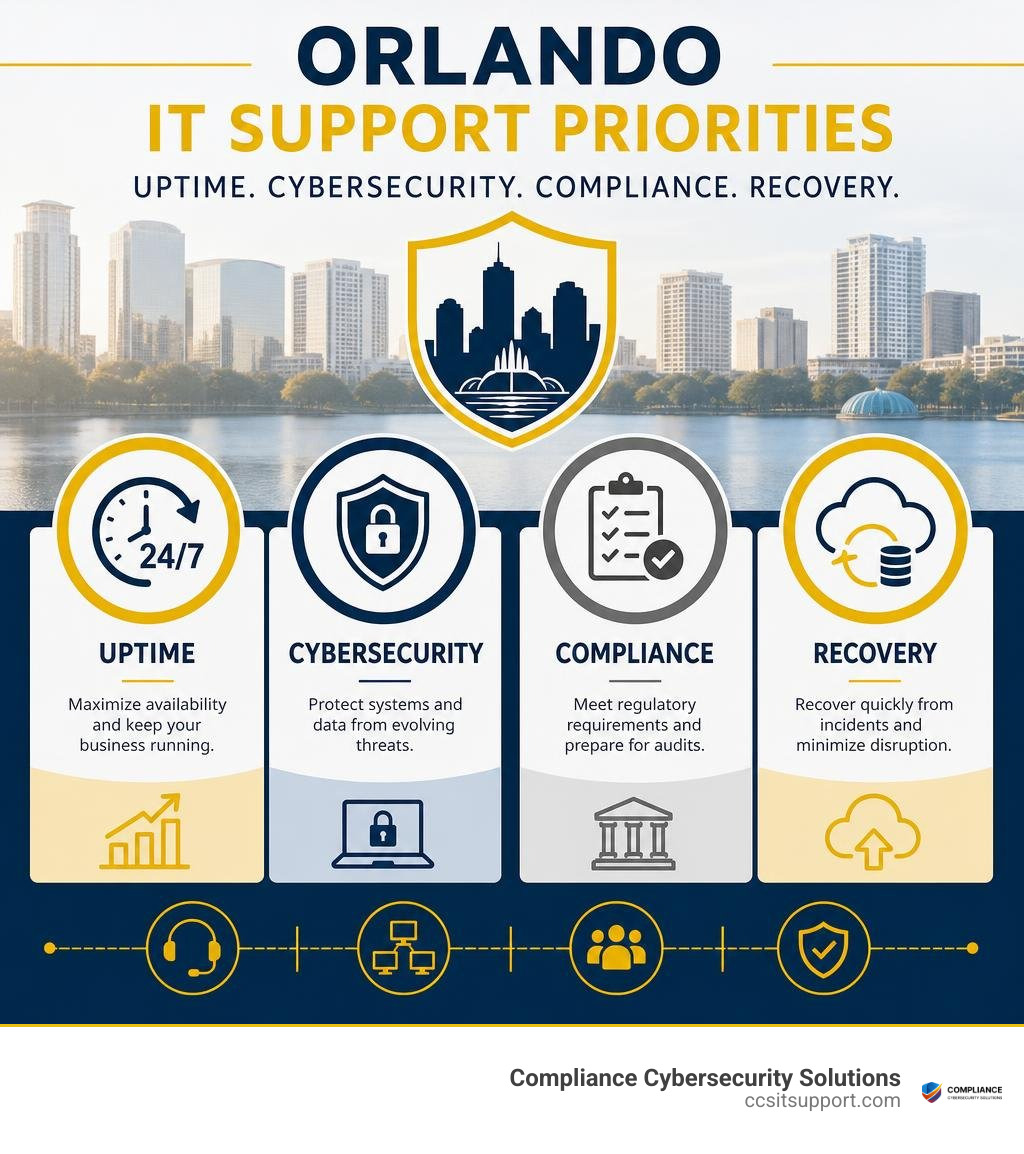
The Central Florida enterprise landscape is evolving rapidly in 2026. From expanding healthcare networks along the I-4 corridor to defense manufacturing in Research Park and growing commercial hubs in Lake Mary and Altamonte Springs, businesses require technology environments that are resilient, scalable, and secure. Navigating it support orlando florida means understanding how to balance rapid help desk response times with long-term, proactive network management.
When internal users encounter workstation freezes, server outages, or multi-location audio-visual conference glitches, immediate relief is required. However, reactive troubleshooting alone cannot protect a business from modern security risks or unplanned operational downtime. Proactive management involves continuously auditing network traffic, monitoring device connectivity, applying Group Policy Objects (GPOs), and updating patches before vulnerability exploits occur.
For many local companies, achieving this balance through in-house staffing can strain annual operating budgets. Below is a realistic financial and operational comparison:
Operational Dimension In-House IT Department Outsourced Managed IT Support Cost Structure Variable (Salaries, Benefits, Certification Training, Overtime) Predictable Monthly Fee Skill Range Limited to the knowledge of 1-3 internal employees Multidisciplinary team of engineers and security experts Response & Coverage Standard business hours; risk during vacations/illness 24/7 continuous monitoring and rapid ticketing response Compliance Readiness Requires dedicated internal compliance officers Integrated compliance alignment (HIPAA, CMMC, SOC 2) Cost Savings Potential Baseline expenditure overhead Typical 25% to 40% reduction in IT management costs
Managed Services vs In-House IT Support Orlando Florida
Building and maintaining an internal IT team equipped to stay ahead of evolving cyber threats is increasingly impractical for small to mid-sized organizations in Orlando. Non-technical business leaders often find evaluating IT candidates challenging—verifying specialized technical certifications and assessing real-world competency can easily lead to costly hiring errors.
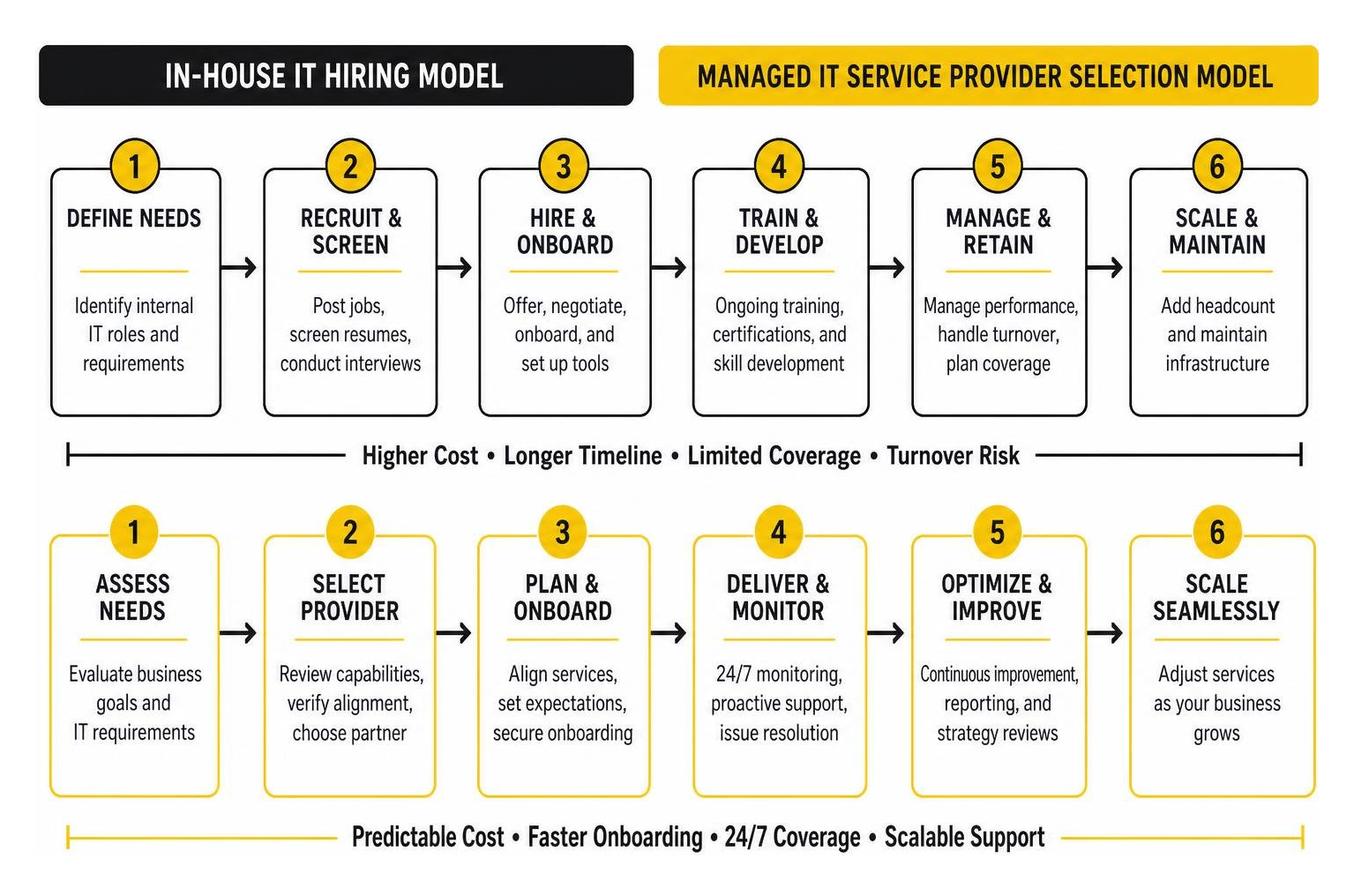
By partnering with a managed service provider (MSP), businesses gain immediate access to predictable monthly pricing and 24/7 network monitoring. Outsourcing removes knowledge gaps and eliminates the single point of failure inherent in small internal teams. Key performance metrics reflect this difference: top-tier managed service frameworks achieve high first-call resolution rates (often reaching 96%) while sustaining client retention rates above 98%. Rather than risking turnover and training lag, businesses secure immediate bench depth across server virtualization, cloud migration, and network engineering.
Industry-Specific Compliance and Cybersecurity Needs
Central Florida businesses face strict regulatory landscapes depending on their sector. Healthcare facilities handling electronic Protected Health Information (ePHI) must uphold rigorous HIPAA privacy and security controls. Meanwhile, defense subcontractors operating near defense hubs must align with federal standards, including NIST SP 800-171 and CMMC requirements.
To maintain government contracting eligibility, organizations often seek specialized guidance, such as Fort Lauderdale Cmmc Services, to structure their network segmentation and system access controls properly. Protecting regulated data requires layered threat detection:
Perimeter Defense: Managed firewalls and intrusion prevention systems.
Endpoint Security: Managed Detection and Response (MDR) software tracking suspicious behavior across workstations.
Identity & Access Management: Multi-factor authentication (MFA) combined with strict Active Directory permissions.
Data Encrypting: Full-disk encryption for laptops and secure cloud repositories.
The Job Market and Career Progression for IT Support in Central Florida
Central Florida’s technology workforce expansion has created a dynamic job market. Over 2,000 technical support positions are active across the greater region, with 1,443 located directly within Orlando proper. Additional employment nodes thrive in nearby sub-markets such as Lake Mary, Maitland, and Kissimmee.
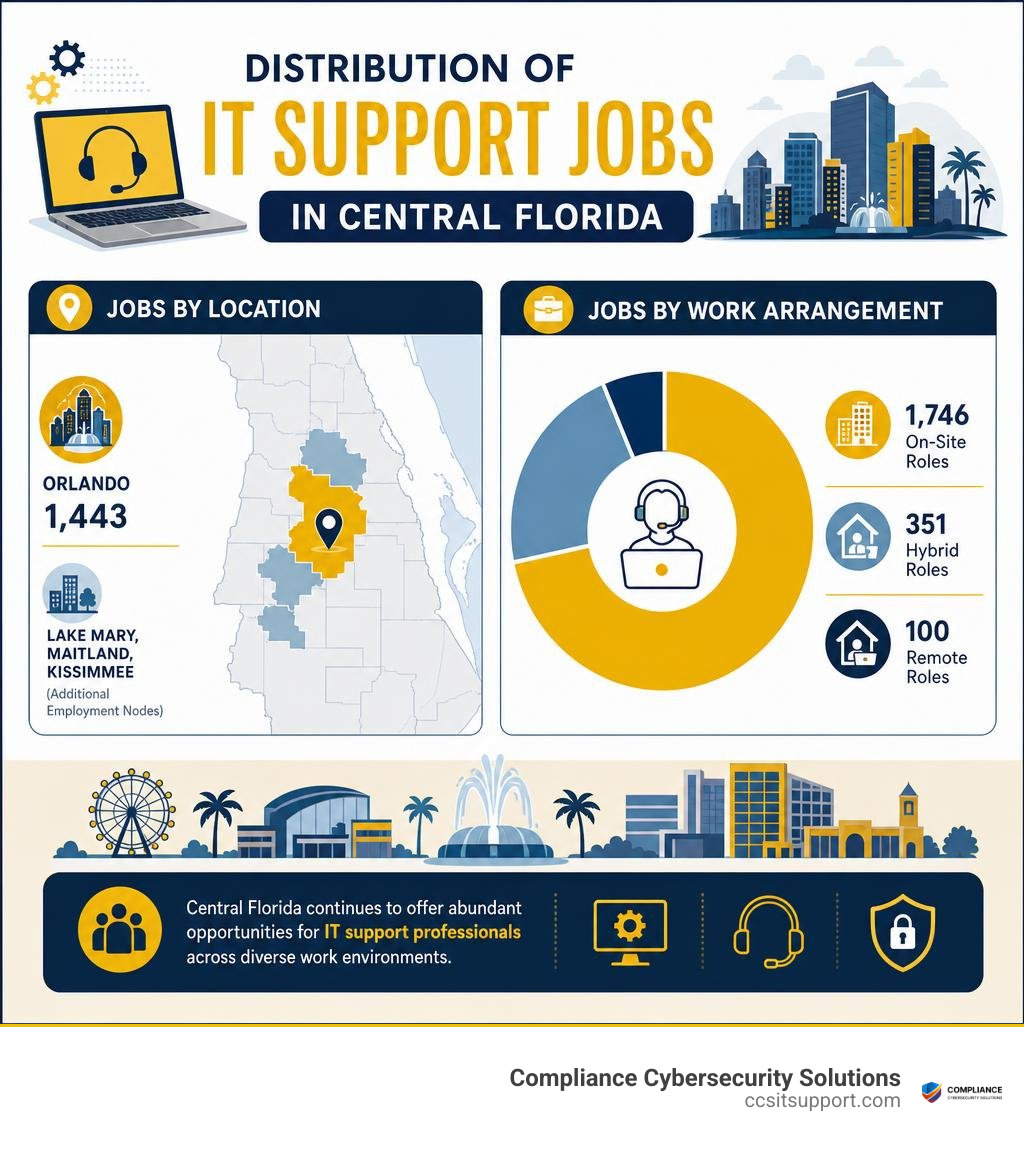
A distinct characteristic of Central Florida's IT market is its strong preference for physical, on-site personnel over fully remote configurations:
On-Site Roles: 1,746 positions
Hybrid Roles: 351 positions
Remote Roles: 100 positions
This distribution is driven by the region's industry mix. Medical facilities, defense manufacturing labs, hospitality resorts, and logistics centers rely on physical infrastructure, specialized endpoint equipment, and hands-on hardware service.
High-Demand Tiers and IT Support Orlando Florida Roles
Hiring demand spans several job tiers, offering entry points for new tech professionals as well as mid-senior leadership opportunities:
Help Desk Specialist / Tier 1 Service Desk Technician: Focusing on initial ticket triage, password resets, basic software installations, and user account creation. Entry-level positions account for 635 open listings in the area.
Desktop Support Analyst: Responsible for physical PC deployment, workstation hardware maintenance, network cabling, device compliance checks, and site walk-through audits.
IT Support Escalation Engineer / Lead IT Support Technician: Handling complex server disruptions, network routing issues, Active Directory GPO updates, and multi-location conference troubleshooting. Mid-to-senior positions comprise 1,044 listings in the regional market.
Salary benchmarks across Central Florida vary based on technical specialization and tier level:
$40,000+ per year: 267 roles
$60,000+ per year: 233 roles
$80,000+ per year: 187 roles
$100,000+ per year: 165 roles
$120,000+ per year: 126 roles
Hourly compensation for experienced roles, such as enterprise Lead IT Support Technicians, typically spans from $23.91 to $44.46 per hour, depending on specialized industry experience and clearance credentials. Job seekers looking to navigate these local pathways can explore detailed state trends through our guide on It Support Jobs In Florida.
Essential Skills and Certifications for Career Advancement
To advance from entry-level help desk roles to mid-senior technical engineering, professionals must demonstrate both technical competency and procedural discipline. Key foundational skills include:
Directory Services: Hands-on experience with Microsoft Active Directory and Group Policy Objects (GPOs) to control user access and device compliance.
Operating Systems: Mastery of Microsoft Windows Desktop and Server OS environments, macOS deployment, and server virtualization platforms.
Networking Foundations: Network troubleshooting, VLAN setup, routing, DNS/DHCP configuration, and firewall management.
Industry Certifications: CompTIA Network+, CompTIA Security+, Microsoft Certified: Enterprise Administrator, and CCNA credentials offer clear signals of technical proficiency.
Comparing Orlando’s IT Ecosystem Across Major Florida Tech Hubs
Florida features distinct technology corridors, each with unique economic engines and infrastructure demands. While Central Florida is powered by healthcare networks, defense simulation, aviation, and tourism, South Florida hubs rely heavily on international finance, trade, and enterprise legal markets.

When evaluating service models across regions, such as reviewing It Support Boca Raton, business owners see clear regional trends:
Orlando/Central Florida Corridor: High concentration of on-site service requirements driven by sprawling physical facilities (hospitals, defense sites, theme parks). High demand for CMMC defense compliance and HIPAA regulatory structures.
South Florida Corridor (Miami, Fort Lauderdale, Boca Raton): Higher density of financial services, legal firms, and international trade enterprises requiring cloud hosting, remote access resilience, and high-frequency data backup solutions.
Despite these differences, both markets require robust managed IT foundations, fast first-call resolution rates, and security architecture designed to resist sophisticated ransomware campaigns.
Overcoming Tech Infrastructure Challenges with Managed Security
Unplanned downtime disrupts operations, damages client confidence, and causes revenue loss. For businesses operating without proactive oversight, common technology challenges include aging hardware, unpatched legacy software, slow ticket resolution times, and weak security postures.
Modernizing business technology requires moving away from outdated physical server hardware toward cloud virtualization. Virtualizing servers consolidates multiple physical machines into streamlined virtual environments, cutting power costs, minimizing hardware points of failure, and making disaster recovery restoration vastly faster.

A comprehensive security strategy integrates managed security with routine infrastructure care. Organizations looking to secure their operations often turn to Fort Lauderdale Managed Security frameworks to implement continuous monitoring, threat detection, and automated backup routines.
Proper disaster recovery planning ensures that if a hardware failure, natural disruption, or cyber event occurs, data can be restored from offsite, encrypted backups quickly without halting operations.
Frequently Asked Questions about IT Support in Orlando
What is the average salary range for IT support positions in Orlando?
IT support salaries in Orlando vary widely based on tier level and specialized skills. Entry-level help desk roles generally start between $40,000 and $55,000 per year (or $20 to $26 per hour). Lead IT Support Technicians and mid-level escalation engineers earn between $23.91 and $44.46 per hour ($50,000 to $92,000 annually). Specialized systems engineers, security analysts, and IT directors frequently exceed $100,000 to $120,000+ per year.
Why do on-site IT support roles outnumber remote positions in Central Florida?
Out of over 2,000 technical support listings in Orlando, 1,746 are on-site positions, compared to only 100 remote roles. This strong on-site presence stems from the region's economic backbone: large healthcare systems, defense sub-contractors, aviation firms, and hospitality resorts. These operations rely heavily on physical network cabling, local server racks, clinical workstations, and hands-on peripheral hardware maintenance that cannot be serviced remotely.
How does outsourcing IT support reduce operational risk for SMBs?
Outsourcing eliminates the single point of failure common to small in-house teams. Instead of relying on one or two employees who may lack specialized security expertise or take sick leave, outsourcing provides access to an entire team of certified engineers for a predictable monthly fee. This model delivers 24/7 continuous threat monitoring, faster ticket resolution, and compliance alignment while typically lowering overall IT operating costs by 25% to 40%.
Conclusion
Navigating the local tech ecosystem requires a clear strategy: pairing responsive day-to-day user support with forward-looking cybersecurity, scalable cloud infrastructure, and strict regulatory alignment. Whether managing complex healthcare records, maintaining defense industry standards, or keeping a commercial business operating without disruption, proactive technology management is essential for long-term growth.
At CCS Compliance Cybersecurity Solutions, we partner with organizations across Florida to eliminate downtime, secure critical data, and ensure seamless compliance with CMMC, HIPAA, SOC 2, and ISO standards. Contact our expert team today through CCS Compliance Cybersecurity Solutions to assess your tech infrastructure and build a secure, reliable foundation for your business.